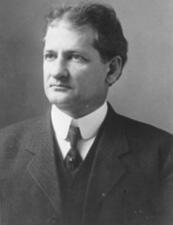
Robert Foligny Broussard (August 17, 1864 – April 12, 1918) was both a U.S. representative and a U.S. senator from Louisiana. He was born on the Mary Louise plantation near New Iberia, the seat of Iberia Parish, Louisiana, to Jean Dorville Broussard and his wife, Anastasie Elizadie Gonsoulin Broussard. Raised in a plantation environment in south Louisiana, he grew up in a region shaped by agriculture, commerce along the Gulf Coast, and the cultural influences of French-speaking Creoles and Acadians, influences that would inform his later public service and political identity.
Broussard pursued his early education in Louisiana before attending Georgetown University in Washington, D.C., from 1879 to 1882. His time in the nation’s capital exposed him to federal institutions and national politics at a relatively young age. After leaving Georgetown, he returned to Louisiana and entered public service in the federal customs system. From 1885 to 1888, he served as a night inspector of customs in New Orleans, a major port city whose trade and tariff issues were central to the regional economy. In 1888 he was appointed assistant weigher and statistician in the customs service, a position he held from 1888 to 1889, gaining experience in federal administration and commercial regulation.
Determined to enter the legal profession, Broussard enrolled at Tulane University Law School in New Orleans and graduated in 1889. He was admitted to the bar that same year and commenced the practice of law in New Iberia. His legal career quickly led to elective office: in 1892 he was elected prosecuting attorney of the Nineteenth Judicial District of Louisiana. He held that office from 1892 to 1897, prosecuting criminal cases and building a reputation as a capable attorney and public official. This combination of legal expertise and prior federal service positioned him for a broader political career at the national level.
Robert Foligny Broussard served as a Senator from Louisiana in the United States Congress from 1897 to 1919. A member of the Democratic Party, Robert Foligny Broussard contributed to the legislative process during 10 terms in office. In fact, his congressional career began in the U.S. House of Representatives. Broussard was elected as a Democrat to the Fifty-fifth and to the eight succeeding Congresses, serving from March 4, 1897, to March 4, 1915. His service in Congress occurred during a significant period in American history, spanning the era of industrial expansion, the Progressive movement, and the early years of U.S. involvement in world affairs. As a member of the House of Representatives, he participated in the democratic process and represented the interests of his Louisiana constituents, particularly in matters affecting agriculture, navigation, and the economy of the Gulf Coast.
During his tenure in the House, Broussard rose to positions of responsibility. In the Sixty-third Congress he served as chairman of the Committee on Expenditures in the Department of Justice, overseeing and reviewing the use of federal funds within that department. Among his more unusual legislative initiatives was the introduction in 1910 of H.R. 23261, popularly known as the “American Hippo Bill.” This proposal sought $250,000 in federal funding to import hippopotamuses from Africa to Louisiana’s bayous, with the dual aim of addressing a national meat shortage and combating the invasive water hyacinth that was clogging the state’s waterways. Although the measure did not become law, it illustrated Broussard’s willingness to pursue unconventional solutions to economic and environmental problems.
Broussard did not seek renomination to the House in 1914, having become a candidate for the United States Senate. He was elected to the Senate on May 21, 1912, and took his seat on March 4, 1915. As a senator from Louisiana, he served during the Sixty-fourth and Sixty-fifth Congresses, a period that included the lead-up to and early years of American participation in World War I. In the Senate he was chairman of the Committee on National Banks in both the Sixty-fourth and Sixty-fifth Congresses, a role that placed him at the center of legislative oversight of the banking system during the formative years following the creation of the Federal Reserve. As a member of the Senate, Robert Foligny Broussard participated in the democratic process and represented the interests of constituents at a time of significant national and international change.
Outside of his formal duties in Congress, Broussard was active in the social and civic life of his state. He was a member of The Boston Club of New Orleans, one of the city’s prominent social organizations, reflecting his standing in Louisiana’s political and professional circles. His long service in both houses of Congress made him a familiar figure in Washington and a key representative of Louisiana’s interests in federal affairs.
Broussard’s Senate career was cut short by his death in office. He died on April 12, 1918, in New Iberia, Louisiana, the community where he had begun his legal practice and to which he remained closely connected throughout his life. His death ended more than two decades of continuous service in the national legislature, from 1897 to 1918, encompassing ten consecutive terms in Congress as both representative and senator. Memorial addresses honoring Robert F. Broussard were later delivered in the House of Representatives and the Senate, and published in 1919, reflecting the esteem in which he was held by his colleagues and his significant role in Louisiana and national politics.
Congressional Record