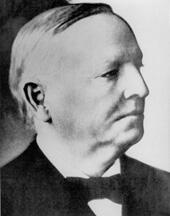
Rienzi Melville Johnston (September 9, 1849 – February 28, 1926) was an American journalist, newspaper executive, and Democratic politician who served briefly as a United States Senator from Texas in 1913. Over a long career in journalism and public life, he became one of the most influential editorial voices in Texas and a significant figure in state and national Democratic politics, later serving in the Texas Senate and as president pro tempore of that body.
Johnston was born in Sandersville, Georgia, on September 9, 1849, the son of Freeman W. Johnston and Mary J. (née Russell). Some sources give his birth year as 1850, but 1849 is generally accepted. As a boy he worked in a print shop, gaining early exposure to the newspaper trade that would shape his career. During the Civil War, at the age of twelve, he was enlisted as a drummer in the Confederate States Army and served from 1862 to 1863. After being discharged, he re-enlisted in 1864 and remained in service until the end of the war. Following the Confederate defeat, Johnston returned to civilian life and resumed work in newspapers, building on the skills he had acquired before and during the conflict.
In the early 1870s, Johnston became editor of the Savannah Morning News in Georgia, establishing his reputation as an able and forceful journalist. Seeking new opportunities, he moved west to Texas in 1878, where he took on the editorship of the Crockett Patron. After a year there, he went on to edit the Corsicana Observer and also established a paper called the Independent in Corsicana. In 1880, Johnston relocated to Austin, Texas, where he wrote for the Austin Statesman. During this period, the Houston Post enlisted him as a correspondent to cover the state capital, further broadening his influence and connections in Texas political and journalistic circles.
Johnston’s association with the Houston Post deepened in 1885 when, following a reorganization of the paper, he was chosen as editor-in-chief. He would edit the Houston Post from 1885 to 1919, becoming one of the most prominent newspaper editors in the state. Under his leadership, the Post became a leading voice in Texas and regional politics, and Johnston’s editorials were frequently quoted by newspapers across the United States. He later became president of the Houston Printing Company, the corporate entity behind the Post. His standing in the profession was further reflected in his service as the first vice president of the Associated Press for two years, a position that underscored his national stature in American journalism.
Through his newspaper influence, Johnston emerged as a leader in the Texas Democratic Party. He declined the party’s nomination for Lieutenant Governor of Texas in 1898, but remained deeply involved in partisan affairs. From 1900 to 1912, he served as a member of the Democratic National Committee, participating in the direction of the party at the national level. His prominence in Democratic politics and his close ties to Texas officeholders made him a natural choice for higher responsibilities when vacancies arose.
At the beginning of January 1913, Governor Oscar Branch Colquitt of Texas appointed Johnston to the United States Senate to fill the unexpired term of Senator Joseph Weldon Bailey, who had resigned. A member of the Democratic Party, Johnston served from January 4 to January 29, 1913, representing Texas during a significant period in American history as the nation moved into the Progressive Era. His service in Congress, though brief, placed him in the midst of the federal legislative process and allowed him to represent the interests of his constituents at the national level. His 29-day term, which ran entirely in January 1913, has been recorded as one of the shortest in Senate history; it has been described as the fifth shortest and also as the second shortest, behind John N. Heiskell’s 24-day tenure. Johnston’s appointment ended when Morris Sheppard, elected to complete the term, took office; Sheppard would later introduce the Eighteenth Amendment, establishing nationwide prohibition of alcohol. Following his single, short term in the Senate, Johnston returned to Houston and resumed his role as editor of the Houston Post.
In 1916, Johnston was elected to the Texas Senate, representing Houston, and he served from January 9, 1917, to January 12, 1920, during the 35th and 36th sessions of the legislature. In the state Senate he continued his long engagement with public affairs, this time as a lawmaker rather than as an editorial commentator. On March 27, 1918, he was elected president pro tempore of the Texas Senate, reflecting the esteem in which he was held by his colleagues. During the 36th Legislature he chaired the Towns and City Corporations Committee and served as vice chair of the Public Printing Committee, positions that gave him influence over municipal legislation and state publishing matters. In 1920 he resigned his Senate seat after being appointed by Governor William P. Hobby as chairman of the State Prison Commission, shifting his focus to the administration and oversight of the state’s penal system. In the special election that followed his resignation, Lynch Davidson—later lieutenant governor of Texas—was elected to fill Johnston’s former seat.
Johnston retired from the newspaper business in 1919, concluding more than three decades at the helm of the Houston Post. His later years were marked by continued recognition of his contributions to Texas journalism and public life. A collection of his papers, dating from 1899 to 1926, is preserved at Rice University in Houston, providing a documentary record of his editorial work and political activities. His legacy is also reflected in the naming of “Rienzi,” the Museum of Fine Arts, Houston’s house museum for European decorative arts, which bears his name through his family connection; the house once belonged to his grandson, Harris Masterson III.
In his personal life, Johnston married Mary E. Parsons in 1875, and the couple had three children. He died on February 28, 1926, and was buried in Glenwood Cemetery in Houston, Texas. Through his long career as a journalist, party leader, state legislator, and briefly as a United States Senator from Texas in 1913, Rienzi Melville Johnston left a lasting imprint on both the political and journalistic history of Texas.
Congressional Record