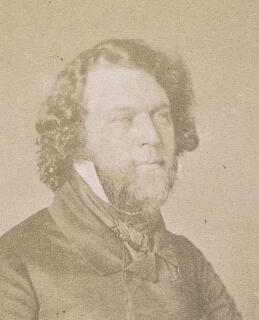
Richard Vaux (December 19, 1816 – March 22, 1895) was an American politician and lawyer who served as a Democratic member of the U.S. House of Representatives for Pennsylvania’s 3rd congressional district from 1890 to 1891. A member of the Democratic Party, he represented Pennsylvania in the United States Congress during one term in office and earlier served as mayor of Philadelphia from 1857 to 1858. His congressional service occurred during a significant period in American history, and as a member of the House of Representatives he participated in the democratic process and represented the interests of his constituents.
Vaux was born on December 19, 1816, in Philadelphia, Pennsylvania, into a prominent Quaker family. His father, Roberts Vaux, was a well-known judge and philanthropist. Raised in the Society of Friends, he was educated by private tutors and attended the Friends Select School in Philadelphia, followed by Bolmar’s French School in West Chester, Pennsylvania. He subsequently read law under the noted attorney William M. Meredith and was admitted to the bar in Philadelphia in 1837. Shortly thereafter, he traveled to London carrying government dispatches and remained there for about a year, serving as secretary of legation under Andrew Stevenson, the United States Minister to Great Britain.
Upon his return to Philadelphia in 1839, Vaux quickly entered public and civic life. That year he was nominated as a Democratic candidate for the Pennsylvania House of Representatives, though he was defeated by a Whig opponent. In 1840 he opened a private law practice in Philadelphia and became active in party affairs, serving as a delegate to the Democratic state convention. He was appointed recorder of deeds for the city, serving from 1841 to 1847, and in 1845 he published a volume titled “Recorders’ Decisions.” He also served on the Board of Comptrollers for the public schools of Philadelphia, reflecting his interest in local governance and education. In 1839 he began a long association with penal reform and administration as a member of the Board of Governors of the Eastern State Penitentiary, a position he held for more than five decades, from 1839 to 1892.
Vaux’s political ambitions extended to municipal office, and he ran repeatedly for mayor of Philadelphia as a Democrat. He was an unsuccessful candidate in the 1842 mayoral election against John Morin Scott, again in 1848 against John Swift, and in 1854 against Robert T. Conrad. Building alliances with Irish and other immigrant political leaders, he finally secured election as mayor in the 1856 Philadelphia mayoral contest and served from 1857 to 1858. His administration expanded and professionalized the city’s police force, removed the requirement that policemen be native-born citizens, introduced a police and fire telegraph system, and established standardized uniforms for officers. Despite these reforms, he was defeated for reelection in the 1858 mayoral election by Alexander Henry. Beyond City Hall, he served on the Board of City Trusts from 1859 to 1866 and was its president from 1863 to 1865, overseeing important municipal and charitable trusts, including those related to Girard College.
Vaux’s public life was marked by strong and sometimes controversial views. He was outspoken in his opposition to abolitionism and to African Americans’ political and social advancement, positions that placed him among the more conservative “Bourbon Democrats” of his era. During the American Civil War, his pro-southern sympathies and alignment with Bourbon Democratic principles earned him the nickname the “Bourbon War Horse.” At the same time, he cultivated a broad civic presence. A Freemason, he served as Grand Master of the Grand Lodge of Pennsylvania from 1868 to 1869. He was president of the Philadelphia Club, sat for many years on the board of Girard College, and was elected a member of the American Philosophical Society in 1884, underscoring his standing in Philadelphia’s legal, social, and intellectual circles.
Vaux’s national legislative career came late in life. He was elected as a Democrat to the 51st Congress to represent Pennsylvania’s 3rd congressional district, winning a special election in 1890 to fill the vacancy caused by the death of Representative Samuel J. Randall. He took his seat on May 20, 1890, and served until March 3, 1891. His tenure in the U.S. House of Representatives thus spanned part of the 51st Congress, during which he contributed to the legislative process and represented the interests of his Philadelphia constituents. He sought a full term in the regular 1890 election but was unsuccessful in his bid for reelection, bringing his brief period of congressional service to a close.
In addition to his legal and political work, Vaux was an author and commentator on criminal justice and municipal affairs. Among his publications were “Reports of Some of the Criminal Cases on Primary Hearing, Before Richard Vaux, Recorder of the City of Philadelphia” (1846), “Address Delivered Before the Philadelphia Hose Company, on the 47th Anniversary, Held at the Columbia House, on the Evening of December 16, 1850” (1850), “Brief Sketch of the Origin and History of the State Penitentiary for the Eastern District of Pennsylvania, at Philadelphia” (1872), and “Short Talks on Crime-cause and Convict Punishment” (1882). These works reflected his long engagement with questions of crime, punishment, and the administration of justice, particularly in connection with the Eastern State Penitentiary.
In his personal life, Vaux married Mary Morris Waln, with whom he had four surviving children. He remained a prominent figure in Philadelphia society and civic life into his later years. Richard Vaux died on March 22, 1895, in Philadelphia, Pennsylvania. He was interred in Laurel Hill Cemetery, a resting place for many of the city’s leading political and social figures of the nineteenth century.
Congressional Record