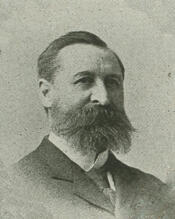
Richard Cutts Shannon (February 12, 1839 – October 5, 1920) was a Republican member of the United States House of Representatives from New York who served two terms in Congress from 1895 to 1899. His public career also encompassed distinguished military service in the Civil War, diplomatic appointments in Latin America, and leadership in American business enterprises abroad.
Shannon was born in New London, Connecticut, on February 12, 1839. During his youth he moved to Maine, where he completed his early education. He was graduated from the grammar and high schools at Biddeford, Maine, and then attended Waterville College in Waterville, Maine, an institution later renamed Colby College. His education in Maine provided the foundation for his subsequent military, diplomatic, legal, and political careers.
With the outbreak of the American Civil War, Shannon entered the Union Army. He enlisted in Company H of the Fifth Regiment, Maine Volunteer Infantry, on June 24, 1861. Demonstrating ability and leadership, he was appointed first lieutenant on October 10, 1861. On March 15, 1862, he was detailed as aide-de-camp to Major General Henry W. Slocum, one of the prominent corps and army commanders in the Army of the Potomac. Shannon later served as captain and assistant adjutant general of Volunteers beginning October 2, 1862, performing staff and administrative duties in support of Union operations. He remained in service through the later years of the war and was honorably discharged on February 10, 1866, concluding nearly five years of continuous military duty.
After the war, Shannon entered the diplomatic service of the United States. In 1871 he was appointed secretary of the United States legation at Rio de Janeiro, Brazil. He served in that capacity until March 1875, when he resigned. Remaining in Brazil, he turned to private enterprise and in 1876 took charge of the Botanical Garden Railroad Company, an American-controlled railway enterprise in Rio de Janeiro. Over time he became vice president, general manager, and ultimately president of the company, overseeing its operations during a period of expanding urban transportation and commercial development in Brazil.
Shannon returned to the United States in 1883 and undertook formal legal training. He enrolled in the law department of Columbia College in New York City and was graduated in 1885. The following year, in 1886, he was admitted to the New York bar and commenced the practice of law in New York City. His combined experience in military service, diplomacy, business management, and the law positioned him for further responsibilities in international affairs. In 1891 he was appointed Envoy Extraordinary and Minister Plenipotentiary of the United States to Nicaragua, El Salvador, and Costa Rica, representing American interests in Central America. He served in this diplomatic post until April 1893.
Turning to elective office, Shannon was chosen as a Republican to represent New York in the United States House of Representatives. He was elected to the Fifty-fourth and Fifty-fifth Congresses and served from March 4, 1895, to March 3, 1899. As a member of the House of Representatives, Richard Cutts Shannon participated in the legislative process during a significant period in American history, contributing to debates and decisions as the nation confronted questions of economic policy, industrial growth, and expanding international engagement. He represented the interests of his New York constituents and took part in the broader democratic process of lawmaking in the late nineteenth century. After two terms in office, he declined to be a candidate for renomination in 1898.
Following his congressional service, Shannon resumed the practice of law in New York City, returning to his legal career and private affairs. He continued in professional life until his retirement in 1903, after which he moved to Brockport, New York. There he lived in retirement for the remainder of his life. Richard Cutts Shannon died in Brockport on October 5, 1920, and was interred in Lake View Cemetery, closing a career that had encompassed military, diplomatic, legal, business, and legislative service to the United States.
Congressional Record