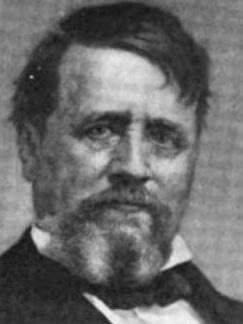
Richard Dudley Hubbard (September 7, 1818 – February 28, 1884) was a United States Representative from Connecticut and the 48th Governor of Connecticut. A prominent Democratic lawyer, legislator, and orator, he played a significant role in state and national politics during the mid-nineteenth century, participating in the legislative process during one term in Congress and later guiding Connecticut through important legal and social reforms as governor.
Hubbard was born in Berlin, Connecticut, on September 7, 1818. Orphaned at a young age, he was raised under circumstances that required early self-reliance and determination. He pursued preparatory studies at East Hartford before entering Yale College. At Yale he distinguished himself academically and socially, becoming a member of the Skull and Bones society, and he graduated in 1839. Following his graduation, he turned to the study of law, preparing for a career that would define much of his public life.
After reading law, Hubbard was admitted to the bar in 1842 and commenced the practice of law in Hartford, Connecticut. He quickly established a reputation as a skilled advocate and orator, attributes that would later be reflected in his political career and in the public memorials to his service. He married Mary Juliana Morgan, and together they had six children, anchoring his professional life in a substantial family setting in Hartford. His legal practice grew steadily, and his abilities at the bar led naturally to repeated calls to public office.
Hubbard’s political career began early. In 1842, the same year he was admitted to the bar, he was elected to the Connecticut House of Representatives, marking the start of a long association with state government. He returned to the state House in 1855 and again in 1858, participating in legislative deliberations during a period of growing sectional tension in the United States. From 1846 to 1868 he served as prosecuting attorney for Hartford County, a post he held for more than two decades. A lifelong Democrat, he nonetheless firmly supported the Federal government throughout the Civil War, aligning himself with the Union cause despite the divisions that the conflict created within the Democratic Party.
Hubbard’s national service came with his election as a Democrat to the Fortieth Congress. Representing Connecticut in the U.S. House of Representatives, he served one term from March 4, 1867, to March 3, 1869, a significant period in American history marked by Reconstruction and the reshaping of federal policy after the Civil War. As a member of the Democratic Party representing Connecticut, he contributed to the legislative process during this term in office, participating in the democratic process and representing the interests of his constituents during the early Reconstruction era. He declined to be a candidate for renomination in 1868 and, upon leaving Congress, resumed the practice of law in Hartford. In 1872 he was nominated by the Democrats for governor of Connecticut but was defeated by the Republican incumbent, Marshall Jewell.
Hubbard remained active in party affairs and public life after this defeat. He served as a delegate from Connecticut to the Democratic National Convention in 1876 and was a member of the convention’s Resolutions Committee, helping to shape the party’s national platform during a closely contested presidential election year. In November 1876 he was elected Governor of Connecticut, becoming the first governor of the state to be elected to a two-year term. His administration, which began in 1877, was notable for several significant reforms. He successfully advocated legislation altering the property rights of married women, “making husband and wife equal in property rights,” a major step forward in the legal status of women in Connecticut. Under his leadership, a bill was enacted that created the State Board of Health, reflecting growing concern with public health and sanitation. His administration also oversaw the formation of a commission to manage Connecticut’s dams and reservoirs, addressing issues of water supply and infrastructure, and supported amendments to regulations that benefited and modernized the state’s insurance industry.
In January 1878, while still a leading figure in the legal profession, Hubbard served on the committee that established the American Bar Association, contributing to the creation of a national professional organization that would shape standards and ethics for lawyers across the United States. He was an unsuccessful candidate for reelection as governor in 1878, but he continued to be regarded as one of Connecticut’s foremost lawyers and public men. After leaving the governorship, he engaged in the practice of law in Hartford from 1877 until his death, maintaining his influence as a lawyer, orator, and counselor.
Hubbard died of Bright’s disease in Hartford on February 28, 1884. He was interred at Cedar Hill Cemetery in Hartford, a resting place for many of the state’s leading citizens. His legacy in Connecticut is reflected not only in the legal and social reforms of his administration but also in the public commemoration of his career. A statue of Richard D. Hubbard stands on the east lawn of the Connecticut State Capitol in Hartford, bearing a plaque that describes him as “Lawyer, Orator, Statesman,” a succinct tribute to his enduring role in the political and legal history of Connecticut.
Congressional Record