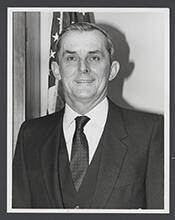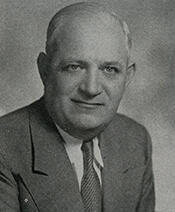
Richard William Hoffman (December 23, 1893 – July 6, 1975) was a U.S. Representative from Illinois who served four consecutive terms in the United States House of Representatives from 1949 to 1957. A member of the Republican Party, he represented his Illinois constituency during a significant period in American history, contributing to the legislative process in the early years of the Cold War and the post–World War II era.
Hoffman was born on December 23, 1893, in Chicago, Illinois. Details of his early schooling are not extensively documented in public sources, but his later professional and civic activities indicate a strong connection to the educational and commercial life of the Chicago area. As a young man, he entered military service during World War I, becoming a veteran of that conflict. His wartime experience placed him among the generation of Americans whose public and private careers were shaped by service in the First World War.
Following his military service, Hoffman engaged in the printing and publishing business in the Chicago area, establishing himself in the commercial sector at a time when print media played a central role in public communication. Expanding his interests into emerging forms of mass communication, he owned and operated radio stations in Chicago, Illinois. His involvement in both print and radio reflected the broader transformation of American media in the first half of the twentieth century and gave him experience in business management, public outreach, and community engagement.
Hoffman also developed a substantial record of local public service before entering national politics. He served as president of the board of education of J. Sterling Morton High School and Junior College, an important suburban educational institution serving communities west of Chicago, from 1933 to 1936 and again from 1939 to 1948. In this role, he helped oversee the administration and development of secondary and junior college education during the challenging years of the Great Depression and World War II. His long tenure on the board and repeated selection as its president underscored his prominence in local civic affairs and his interest in educational policy and governance.
Building on his business and educational leadership, Hoffman was elected as a Republican to the Eighty-first Congress and to the three succeeding Congresses, serving from January 3, 1949, to January 3, 1957. During his four terms in the House of Representatives, he participated in the democratic process and represented the interests of his Illinois constituents as the nation confronted issues of postwar economic adjustment, the onset of the Cold War, and domestic political realignment. His service in Congress coincided with the administrations of Presidents Harry S. Truman and Dwight D. Eisenhower, and he took part in the legislative deliberations characteristic of that era. He was not a candidate for renomination in 1956 to the Eighty-fifth Congress, thereby concluding his congressional career at the end of his fourth term.
After leaving Congress, Hoffman resumed his former business activities, returning to the printing, publishing, and broadcasting enterprises that had defined his precongressional career. He made his home in Riverside, Illinois, a suburban community near Chicago, where he continued to reside in his later years. Richard William Hoffman died in Maywood, Illinois, on July 6, 1975. He was interred in Forest Home Cemetery in Forest Park, Illinois, closing a life marked by military service, business leadership, local educational governance, and eight years in the United States House of Representatives.
Congressional Record