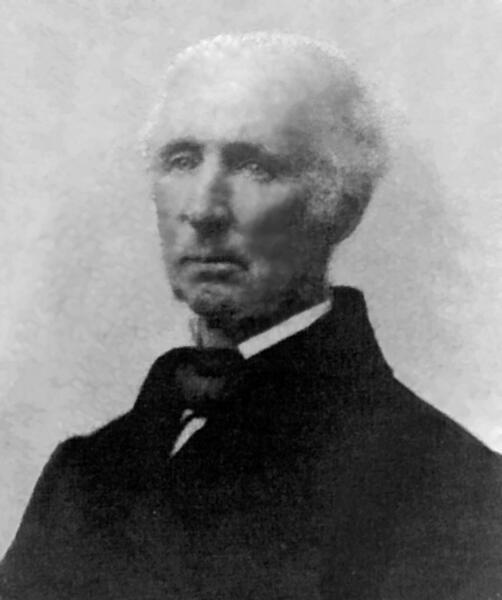
Richard Hawes Jr. (February 6, 1797 – May 25, 1877) was a United States representative from Kentucky and the second Confederate governor of Kentucky. Born near Bowling Green in Caroline County, Virginia, he was one of eleven children of Richard Hawes and Clara Walker Hawes. The Hawes family was politically prominent: his brother Albert Gallatin Hawes, his uncle Aylett Hawes, and his cousin Aylett Hawes Buckner all served in the U.S. House of Representatives, and his grandson Harry B. Hawes later became a United States senator from Missouri. In 1810 the family migrated west to Kentucky, settling in Fayette County near Lexington. Part of his early education was obtained at a Jessamine County school conducted by Samuel Wilson. Hawes was a slaveholder.
Hawes pursued classical studies at Transylvania University in Lexington and then read law under Robert C. Wickliffe, a leading Kentucky attorney and politician. On November 13, 1818, he married Hetty Morrison Nicholas of Lexington. That same year he was admitted to the bar, and he and Wickliffe entered into a law partnership. Because the legal profession in Lexington was overcrowded, Hawes moved in 1824 to Winchester in Clark County, where he continued his practice and became part owner of a rope and bagging factory with Benjamin H. Buckner. His early legal and business activities helped establish him as a figure of some prominence in central Kentucky.
Hawes began his formal political career in 1828 when he was elected as a Whig to represent Clark County in the Kentucky House of Representatives. He served in the state militia and saw limited service in the Black Hawk War in 1832, then returned to the Kentucky House in 1834. That same year he was an unsuccessful candidate for the U.S. House of Representatives, but in 1837 he was elected as a Whig to represent Henry Clay’s “Ashland District” in Congress. He served in the Twenty-fifth and Twenty-sixth Congresses from March 4, 1837, to March 3, 1841. After leaving Congress he moved in 1843 to Paris, in Bourbon County, Kentucky, where he resumed the practice of law. An ardent Whig, Hawes was for many years a close friend and ally of Henry Clay, the party’s principal founder and national leader. Their relationship cooled, however, when Hawes supported Zachary Taylor rather than Clay for the Whig presidential nomination in 1848. When the Whig Party declined and dissolved in the 1850s, Hawes became a Democrat, supporting James Buchanan for president in 1856 and John C. Breckinridge in 1860, and his personal and political ties with Clay’s circle further diminished.
The election of Abraham Lincoln in 1860 alarmed Hawes, but he initially opposed secession and instead supported Kentucky’s doctrine of armed neutrality, under which the Commonwealth sought to remain in the Union while not permitting the use of its territory by either Union or Confederate forces. In May 1861 he joined Breckinridge and Governor Beriah Magoffin in representing the Southern Rights viewpoint at a convention called to determine Kentucky’s course in the emerging Civil War; he attended another such convention in September 1861, though neither meeting produced a decisive policy. In July 1861 he helped author an address to the people of Bourbon County that blamed Republicans for starting the war, denounced federal coercion of the states, warned that the Lincoln administration would seek to end slavery, and called for an end to hostilities, recognition of the Confederate States of America as a sovereign nation, and an equitable division of the national debt and federal property. As the Whig Party disappeared, Hawes’s alignment with the Democratic Party and his sympathy for Southern rights solidified.
When Kentucky’s neutrality was breached in September 1861 by the movement of Union and Confederate forces into the state, Hawes, fearing imprisonment by Federal authorities, fled to Virginia. There he enlisted as brigade commissary under Confederate Brigadier General Humphrey Marshall and was commissioned a major. He proved adept at securing supplies for Marshall’s brigade under difficult conditions, but his age—he was then in his mid-sixties—and lack of military experience limited his usefulness in the field. His tendency to bypass the chain of command and correspond directly with Confederate Secretary of War Judah P. Benjamin also strained his relationship with Marshall. In November 1861, the self-appointed Russellville Convention, which organized a provisional Confederate government for Kentucky, appointed Hawes state auditor, but he declined the civil post in order to continue his military service. On January 25, 1862, he wrote to President Jefferson Davis that he was traveling to Bowling Green at the request of Confederate Governor George W. Johnson to assist in administering the state government; he resigned his military commission two days later, though his departure was delayed when he contracted typhoid fever.
Governor Johnson was killed while participating in the Battle of Shiloh in April 1862. Under the provisions adopted by the Russellville Convention, the provisional government’s ten legislative councillors, who were barred from choosing one of their own, selected Hawes to succeed Johnson as Confederate governor of Kentucky. He joined the now leaderless, itinerant Confederate government, which was traveling with the Army of Tennessee, at Corinth, Mississippi, and took the oath of office on May 31, 1862. The army’s commander, General Braxton Bragg, was contemplating an invasion of Kentucky, and on August 27 Hawes was sent to Richmond, Virginia, to recommend the plan to President Davis; Davis remained noncommittal, but Bragg and General Edmund Kirby Smith proceeded with the campaign. The leaders of Kentucky’s Confederate government stayed in Chattanooga, Tennessee, awaiting Hawes’s return, then departed on September 18 and joined Bragg and Smith in Lexington, Kentucky, on October 2.
Bragg, seeking to enforce the Confederate Conscription Act in Kentucky and to lend legitimacy to the provisional regime, decided to install Hawes’s government in the captured state capital at Frankfort. On October 4, 1862, an inauguration ceremony was held there. Humphrey Marshall delivered the opening remarks, and Bragg introduced Hawes, who gave a lengthy address declaring that “the late Union cannot be restored,” promising to call a convention to frame a permanent government when feasible, and denouncing the Union’s aim of emancipating enslaved people. The celebratory atmosphere led Confederate forces to relax their guard, and the ceremony was abruptly interrupted when Union troops under Major General Don Carlos Buell advanced on the city. The Confederates were forced to withdraw, and following their defeat at the Battle of Perryville later that month, Bragg’s army and the Confederate state government retreated from Kentucky. Hawes later denied that he had formally taken the oath of office at Frankfort and became a vocal critic of Bragg’s conduct of the campaign.
After the Confederate withdrawal, Hawes and the provisional government operated in exile, moving among Confederate-held areas in Tennessee and the Deep South. The legislative council dispersed to locations where members could support themselves or live with relatives, reconvening only when summoned by Hawes. Sparse surviving records indicate that on December 30, 1862, he called the council, auditor, and treasurer to meet at Athens, Tennessee, on January 15, 1863. Hawes continued to lobby President Davis for a renewed invasion of Kentucky and pressed for the removal of his former superior, Humphrey Marshall, from command, though without success. In a letter of March 4, 1863, he assured Davis that “our cause is steadily on the increase” and argued that another foray into Kentucky would fare better than the first. The provisional government’s finances were in disarray; Hawes was embarrassed to admit that no one could account for approximately $45,000 transferred from Columbus to Memphis during the Confederate occupation of Kentucky, and Davis refused to allow him to expend $1 million secretly appropriated in August 1861 to help maintain Kentucky’s neutrality, reasoning that the funds could no longer be used for their original purpose now that Kentucky had formally joined the Confederacy.
By 1864 Hawes had joined his sister at Nelly’s Ford, a small settlement in Virginia, where his wife and daughter later joined him. The location, about 100 miles from Richmond, enabled him to travel to the Confederate capital for conferences with President Davis, and records show that as late as September 16, 1864, he still hoped for another Confederate advance into Kentucky. That summer Colonel R. A. Alston of the Ninth Tennessee Cavalry requested Hawes’s assistance in investigating alleged crimes committed by General John Hunt Morgan during an unauthorized raid into Kentucky, but Morgan was suspended from command on August 10 and killed by Union troops on September 4, 1864, before Hawes needed to act. With the collapse of the Confederacy in 1865, the Kentucky government in exile ceased to function. Hawes remained at Nelly’s Ford until May 1865, when he deemed it safe to return to Kentucky.
Hawes returned to Paris, Kentucky, to find that his home had been burned by Union troops. Four of his sons had served in the Confederate Army, including James Morrison Hawes, who rose to the rank of brigadier general; only three of his sons survived the war and returned home. On September 18, 1865, Hawes took an oath of allegiance to the United States and was permitted to resume his law practice. In 1866 he was elected county judge of Bourbon County, a position he held until his death. As county judge he issued a notable ruling nullifying apprenticeship contracts arranged under the authority of the Freedmen’s Bureau in Kentucky, holding that the Bureau’s statutory powers extended only to states that had been in rebellion, and that Kentucky, a loyal state, did not fall within that category. That same year he was chosen master commissioner of the circuit court. He remained active in Democratic politics, was mentioned in 1871 as a possible candidate for governor of Kentucky, and in 1876 helped frame his party’s response to the disputed Hayes–Tilden presidential election. Richard Hawes Jr. died in Paris, Kentucky, on May 25, 1877, while still serving as county judge, and was interred in Paris Cemetery.
Congressional Record