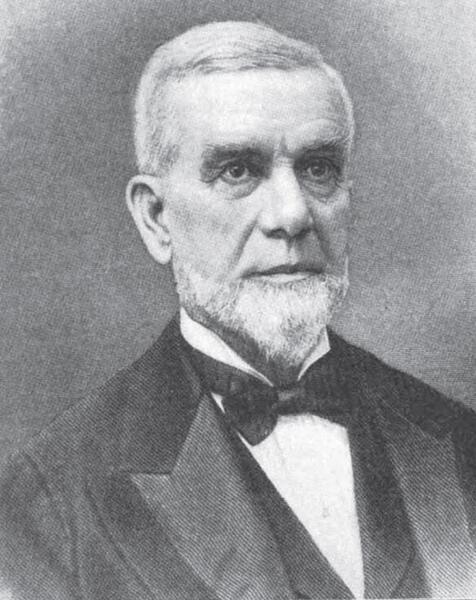
Richard Almgill Harrison (April 8, 1824 – July 30, 1904) was an American politician and jurist from Ohio who served in the Ohio General Assembly and in the United States House of Representatives during the early years of the Civil War. A lawyer of wide repute, particularly in railroad and constitutional law, he was several times considered for a seat on the Supreme Court of Ohio and was at one point mentioned for appointment to the Supreme Court of the United States, but declined or was passed over for these honors.
Harrison was born in Thirsk, England, on April 8, 1824, to Robert and Mary (Almgill) Harrison. His father was both a Methodist minister and a mechanic, and in 1832 the family immigrated to the United States, settling first in Waynesville, Ohio, and later in Springfield, Ohio. Raised in the public schools of Ohio, Harrison graduated from Springfield High School. As a youth he worked as a printer’s devil in the office of the Springfield Republic, an influential Whig newspaper, an experience that acquainted him early with politics and public affairs. After completing his schooling, he read law successively under William A. Rodgers and William White before entering the Cincinnati Law School. He completed the school’s six‑month course of study and was admitted to the Ohio bar on April 8, 1846. The following year, in 1847, he married Maria Louisa Warner, daughter of Henry Warner; the couple had seven children.
Harrison began the practice of law in London, the county seat of Madison County, Ohio, where he maintained his practice from 1846 to 1873. Initially aligned with the Whig Party, he later joined the emerging Republican Party as the political realignments of the 1850s unfolded. In 1857 he was elected to the Ohio House of Representatives from Madison County by a narrow majority of 24 votes, marking his formal entry into elective office. Two years later, in 1859, he was elected to the Ohio Senate. His senatorial term coincided with the 1860 presidential election and the secession crisis that immediately preceded the American Civil War, placing him at the center of intense debates over the Union and slavery.
During the January 1861 session of the Ohio legislature, Harrison introduced resolutions firmly supporting the Union. Reflecting the conservative position associated with President James Buchanan, he denounced secession as “revolutionary,” disclaimed any intention to interfere with slavery in the states where it already existed, and called for the repeal of “enactments … conflicting with, or rendering less efficient, the Constitution or laws of the United States.” In February 1861 he was among the party that received President‑elect Abraham Lincoln in Columbus during Lincoln’s journey to Washington for his inauguration. Harrison also supported the Peace Conference of 1861, an ultimately unsuccessful effort to negotiate a compromise that might avert civil war.
Following the appointment of Representative Thomas Corwin as United States minister to Mexico, Harrison was nominated by the Union Party—a coalition of War Democrats and conservative Republicans—for Corwin’s vacant seat in the U.S. House of Representatives. In a closely contested race he narrowly defeated Aaron Harlan, the candidate of the Radical Republicans, and was elected to serve the remainder of Corwin’s term. He took his seat in the Thirty‑seventh Congress and attended the special session that convened on July 4, 1861, as Congress grappled with the outbreak of the Civil War. Harrison served in the House from 1861 to 1863 but was not a candidate for re‑election in 1862; he was succeeded by Democrat Samuel S. Cox. During the 1864 presidential campaign, he publicly denied rumors that he intended to vote for the Democratic nominee, General George B. McClellan, and declared his support for President Lincoln’s re‑election.
After leaving Congress, Harrison continued his legal career and gradually shifted his political allegiance. He practiced law in London until 1873, when he moved his practice to Columbus, Ohio. Although he had earlier been a Republican, he later became associated with the Democratic Party and was its candidate for a seat on the Supreme Court of Ohio in 1870; he was defeated along with the rest of the Democratic state ticket. Over the years he was several times considered for a position on the Ohio Supreme Court. In 1887 Governor Joseph B. Foraker offered him an appointment to the state’s highest court, but Harrison declined. In 1893 he was again mentioned for judicial advancement, this time as a possible appointee to the Supreme Court of the United States, but he was passed over on account of his advanced age.
In his later career Harrison won wide acclaim as a corporate attorney specializing in railway law. His work in the Boesel Railroad Cases in 1872 established his national reputation as an authority on constitutional issues, particularly those involving corporate and transportation regulation. He followed closely the federal government’s efforts to regulate large corporations and publicly praised President Theodore Roosevelt and Attorney General Philander C. Knox for their handling of the Northern Securities antitrust case, accurately predicting that the Supreme Court would uphold the administration’s position. Harrison continued to reside and practice in Columbus, where he remained a respected figure in legal and political circles. He died in Columbus, Ohio, on July 30, 1904, at the age of 80.
Congressional Record