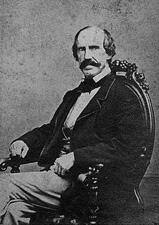
Richard Stockton Field (December 31, 1803 – May 25, 1870) was an Attorney General of New Jersey, a United States senator from New Jersey, and a United States district judge of the United States District Court for the District of New Jersey. He was born on December 31, 1803, at White Hill Mansion in Burlington County, New Jersey, and in 1810 moved with his mother to Princeton, New Jersey. Field was the great-grandson of Richard Stockton, a New Jersey delegate to the Continental Congress and signer of the Declaration of Independence, and the grandson of Richard Stockton, a United States senator from New Jersey, thus belonging to a prominent New Jersey political family.
Field pursued a classical education and graduated from the College of New Jersey (now Princeton University) in 1821. He read law and completed his legal studies in 1825, after which he was admitted to the bar. That same year he entered private practice in Salem, New Jersey, where he practiced law from 1825 to 1832. In 1831, he married Mary Ritchie. They became the parents of several children, including Helen Field Conover, the wife of Francis Stevens Conover and mother of Richard Field Conover; Colonel Edward Field, a veteran of the American Civil War and a career United States Army officer; and Annis Thomson, the wife of Professor Charles McMillen.
Field’s public career began in state politics. He was elected a member of the New Jersey General Assembly, serving from 1833 to 1834 and again in 1837. During this period, he relocated his practice to Princeton, resuming private practice there from 1834 to 1838. He was appointed Attorney General of New Jersey in 1838 and held that office until 1841, playing a central role in the administration of state law. After leaving the attorney generalship, he again returned to private practice in Princeton from 1842 to 1847. In 1844, he served as a member of the New Jersey constitutional convention, contributing to the revision of the state’s fundamental law.
In addition to his legal and political work, Field had a significant academic and educational career. From 1847 to 1855, he was a professor in the law department of the College of New Jersey (Princeton), helping to shape the institution’s early legal instruction. After leaving the faculty, he resumed private practice in Princeton from 1855 to 1862. His contributions to education extended beyond the university: he was a founder of the New Jersey Historical Society and served as its president; a founder of the State Normal School, now known as The College of New Jersey, where he served as president of the board of trustees; and a founder of the Farnham School in Beverly, New Jersey, which served as a preparatory school for prospective students of the State Normal School. In recognition of his professional and civic achievements, Princeton University conferred upon him the honorary degree of Doctor of Laws (LL.D.) in 1859.
Field’s service in the United States Congress occurred during a significant period in American history. A member of the Republican Party, he was appointed as a Republican to the United States Senate from New Jersey to fill the vacancy caused by the death of Senator John Renshaw Thomson. He served from November 21, 1862, to January 14, 1863, a single term in office that coincided with the midst of the Civil War. During this brief tenure, he participated in the legislative process and represented the interests of his New Jersey constituents. He was not a candidate for election to the seat in 1863, as his service in the Senate ended when a successor was elected.
On January 14, 1863, the same day his Senate service concluded, Field was nominated by President Abraham Lincoln to a seat on the United States District Court for the District of New Jersey, filling the vacancy created by the departure of Judge Philemon Dickerson. The United States Senate confirmed his nomination on January 14, 1863, and he received his commission that day. As a United States district judge, he presided over federal trial matters in New Jersey during the latter years of the Civil War and the early Reconstruction era. His judicial service continued until April 25, 1870, when he resigned from the bench.
After his resignation from the federal judiciary, Field remained in Princeton, where he had long been a central figure in the legal, educational, and civic life of the community and the state. He died in Princeton on May 25, 1870. Richard Stockton Field was interred in Princeton Cemetery, leaving a legacy that combined public service in state government, the United States Senate, and the federal judiciary with influential work in legal education and the development of New Jersey’s historical and educational institutions.
Congressional Record