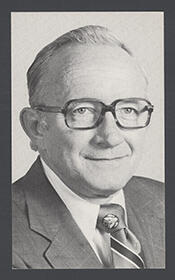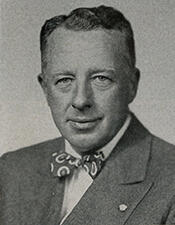
Richard Thurmond Chatham (August 16, 1896 – February 5, 1957), who usually went by Thurmond Chatham, was an American industrialist, philanthropist, and Democratic member of the U.S. House of Representatives from North Carolina. He served as a Representative from North Carolina in the United States Congress from 1949 to 1957, completing four terms in office during a significant period in American political and economic history. As a member of the House of Representatives, he participated in the legislative process and represented the interests of his constituents while contributing to national debates on foreign policy and postwar reconstruction.
Chatham was born in Elkin, North Carolina, the only son of Hugh Gwyn Chatham and Martha Lenoir Chatham. He came from a prominent industrial family; his grandfather Alexander Chatham founded the Chatham Manufacturing Company, which would become the world’s largest manufacturer of blankets. His maternal grandfather, R. J. Thurmond, was involved in a notorious incident in which he shot and killed the grandfather of author William Faulkner, a fact that linked the family to a widely noted episode in Southern history. Chatham was educated in the public schools and then at Woodberry Forest School in Orange, Virginia. He attended the University of North Carolina from 1915 to 1916 and Yale University from 1916 to 1917, but left college before completing his degree in order to enter military service in World War I.
Chatham first entered the United States Navy as a seaman during World War I and served until his discharge as an ensign in 1919. In July 1919, following his return from the war, he began working for his family’s firm, Chatham Manufacturing Company. He rose steadily through the company’s leadership, serving as treasurer before becoming president in 1929. Under his presidency, the company experienced substantial growth in capacity, profits, and product variety, consolidating its position as a leading textile manufacturer. In 1945 he became chairman of the board of directors, continuing to guide the firm’s expansion and reinforcing his reputation as a successful industrialist in North Carolina’s textile sector.
During World War II, Chatham again entered naval service, returning to active duty in February 1942 and serving until November 1945. He initially worked with the Bureau of Ordnance and in the Office of the Secretary of the Navy before being assigned to combat duty. As an officer aboard the light cruiser USS Phoenix (CL-46), he saw action in both the Southwest Pacific and Atlantic theaters. He participated in the New Guinea campaign, the Battle of Cape Gloucester, the Battle of Wakde, the Admiralty Islands campaign, and the Battle of Hollandia. For his wartime service he was decorated with the Bronze Star Medal and the Secretary of the Navy’s Commendation Medal, and he received the Royal Order of Orange-Nassau with Swords from the Dutch government. His campaign and service ribbons included the American Theater Ribbon, European Theater Ribbon, Asiatic Theater Ribbon with three battle stars, World War I Ribbon, and Victory Ribbon. He continued his association with the Navy through the Naval Reserve and, in 1950, was appointed a captain in the U.S. Naval Reserve.
Chatham’s civic and business prominence led him into public life at the local and state levels before he entered Congress. His only formal political experience prior to his congressional career was as a county commissioner in Forsyth County, North Carolina. He was active in a wide range of civic, educational, and business organizations: he served as a trustee of the University of North Carolina and of Woodberry Forest School; president of the Winston-Salem Chamber of Commerce; and a member of the National Association of Wool Manufacturers, the American Legion, and the Veterans of Foreign Wars. In 1948 he served on the North Carolina Board of Conservation and Development and was president of the North Carolina Dairymen’s Association, reflecting his broader interest in economic development and agriculture in the state.
Chatham first sought national office in 1946, when he ran unsuccessfully for the Democratic nomination for Congress. Undeterred, he remained an active contributor to the Democratic Party and a strong supporter of President Harry S. Truman during the 1948 elections. He was first elected to the U.S. House of Representatives in 1948 as a Democrat and was subsequently re-elected for three additional terms, serving continuously from January 3, 1949, to January 3, 1957. During his tenure in Congress, he served on the House Foreign Affairs Committee, where he became an advocate for recognition of China and a supporter of the Marshall Plan, aligning himself with the postwar internationalist wing of the Democratic Party. His service in Congress coincided with the early Cold War, the Korean War, and the initial stages of the civil rights movement, and he participated in the democratic process at a time of significant domestic and international change.
In matters of civil rights and regional politics, Chatham took a position that distinguished him from many Southern colleagues. In 1956 he notably declined to sign the Southern Manifesto, a document in which many Southern members of Congress protested the Supreme Court’s decision in Brown v. Board of Education (1954) and pledged resistance to school desegregation. His refusal to sign came despite the fact that school segregation remained legally required in North Carolina at the time. This stance contributed to political opposition within his party, and he subsequently lost the Democratic primary to Ralph James Scott, ending his congressional career after four terms in office.
Chatham’s personal life reflected his connections to other prominent North Carolina families and his interest in philanthropy. In 1919 he married Lucy Hodgin Hanes (1895–1949), daughter of industrialist John Wesley Hanes. The couple had two sons, Hugh Gwyn Chatham II and Richard Thurmond Chatham Jr. After Lucy’s death in 1949, Chatham married Patricia Firestone Coyner in 1950. In 1951 they purchased and remodeled Prospect House, and they had one son, Walter Firestone Chatham, born in 1952. The Thurmond and Lucy Chatham House in Winston-Salem, associated with his first marriage and family life, was later listed on the National Register of Historic Places in 2014, underscoring the family’s historical and architectural significance in the region.
Chatham died on February 5, 1957, in Durham, North Carolina. He was buried in Salem Cemetery in Winston-Salem, North Carolina, near the center of the business and civic life to which he had devoted much of his career. His estate was valued at almost $2,000,000, a substantial sum at the time. In keeping with his long-standing interest in education and public service, $250,000 of his estate was used to establish the Chatham Foundation, a charitable trust supporting education. Through his industrial leadership, military service, congressional career, and philanthropic endeavors, Chatham left a lasting imprint on North Carolina’s political, economic, and educational institutions.
Congressional Record