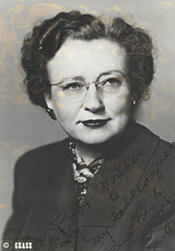
Reva Zilpha Beck Bosone (April 2, 1895 – July 21, 1983) was an American attorney, jurist, and Democratic politician who served as a U.S. Representative from Utah for two terms from 1949 to 1953. The first woman elected to Congress from Utah, she played an active role in the legislative process during a significant period in American history, representing her constituents in the House of Representatives and contributing to national debates on social welfare and civil liberties.
Bosone was born in American Fork in the Utah Territory, the daughter of a Danish immigrant father. She attended local public schools and graduated from high school in 1915. Pursuing higher education at a time when relatively few women did so, she graduated from Westminster Junior College in 1917 and from the University of California at Berkeley in 1919. She then embarked on a career in education, teaching high school from 1920 to 1927. Determined to enter the legal profession, Bosone enrolled in the University of Utah College of Law in Salt Lake City, from which she graduated in 1930. That same year she was admitted to the bar, becoming the fourteenth woman admitted to the Utah State Bar.
Following her admission to the bar, Bosone began practicing law in Helper, Utah, from 1931 to 1933, and then in Salt Lake City from 1933 to 1936. Her legal career quickly intersected with public service. She was elected to the Utah House of Representatives, serving from 1933 to 1935, and in 1935 she served as floor leader, an early demonstration of her leadership within the state legislature. In 1936 she was elected a judge of the Salt Lake City court, becoming one of Utah’s pioneering women jurists. She served on the bench from 1936 until her election to Congress, gaining public visibility and a reputation for legal acumen.
During the Second World War, Bosone expanded her public service beyond the courtroom. She served as chairman of the Women’s Army Corps Civilian Advisory Committee of the Ninth Service Command, helping to support and advise on the integration and utilization of women in the wartime military structure. In 1945 she served as an official observer at the United Nations Conference in San Francisco, which drafted the United Nations Charter, giving her direct exposure to emerging postwar international institutions. In the 1940s she also hosted a weekly radio program on KDLY titled “Her Honor, the Judge,” in which she presented and discussed legal case studies for a general audience. In 1947 and 1948 she served as the first director of the Utah State Board for Education on Alcoholism, reflecting her interest in public health and social issues.
Bosone was elected as a Democrat to the Eighty-first and Eighty-second Congresses, serving from January 3, 1949, to January 3, 1953. As a member of the House of Representatives, she participated fully in the democratic process and represented the interests of her Utah constituents during a period marked by the early Cold War, domestic anti-communist legislation, and the expansion of federal social programs. From 1949 to 1951 she served on the Committee on Public Lands, where she dealt with issues of federal land management and Western resource policy. From 1951 to 1953 she also served on the House Administration Committee. In her legislative work she advocated for social welfare measures, including efforts to extend Social Security benefits to military personnel, and she voted against the Subversive Activities Control and Communist Registration Act, reflecting her concern for civil liberties amid the era’s anti-communist pressures. She was an unsuccessful candidate for reelection in 1952 to the Eighty-third Congress and again for election in 1954 to the Eighty-fourth Congress.
After leaving Congress, Bosone remained active in law and public affairs. She resumed the practice of law in Salt Lake City from 1953 to 1957. From 1957 to 1960 she served as legal counsel to the Safety and Compensation Subcommittee of the House Committee on Education and Labor, returning to Capitol Hill in a professional staff capacity and working on issues related to workplace safety and compensation. She was a delegate to the Democratic National Conventions in 1952 and 1956, maintaining her influence within the party. In 1961 she was appointed a judicial officer of the Post Office Department, a position she held until 1968, adjudicating administrative and regulatory matters within the federal postal system.
In recognition of her pioneering role in Utah’s legal and political history, as both the state’s first woman judge and its first woman member of Congress, Bosone received an honorary doctorate from the University of Utah in 1977. She spent her later years in the Washington, D.C., area, residing in Vienna, Virginia. Reva Zilpha Beck Bosone died in Vienna on July 21, 1983, leaving a legacy as a trailblazer for women in the law and in elective office, and as a notable participant in mid-twentieth-century American public life.
Congressional Record