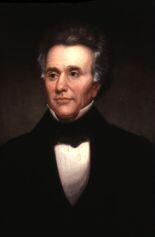
Reuben Hyde Walworth (October 26, 1788 – November 27, 1867) was an American lawyer, jurist, and politician whose long career in New York law and politics made him one of the most influential equity judges of his era. He was born in Bozrah, New London County, Connecticut, his mother’s hometown, the third son of Benjamin Walworth (1746–1812), a merchant and American Revolutionary War quartermaster, and Apphia (Hyde Cardell) Walworth (1757–1837), a widow whom Benjamin married in 1782. He was named in honor of a maternal uncle. In 1792, after receiving a land grant for his wartime service, Benjamin Walworth moved the family to Hoosick, Rensselaer County, New York, where he operated a mill. Benjamin and Apphia had eleven children, and many of their sons became associated with the New York state courts. The eldest, John Walsworth (1784–1839), rose to the rank of major during the Revolutionary War and later served for many years as clerk of the court in Clinton County, New York, before moving to New York City in 1829 to become Assistant Registrar of the Court of Chancery. Their second son, James Clinton Walworth (1787–1871), became a merchant in Argyle, New York, and later a long-serving judge in Otsego County. Another brother, Dr. Benjamin Walworth (1792–1879), became a leading citizen of Fredonia and for decades served as a judge in Chautauqua County, while the youngest brother, Hiram Walworth (1799–1870), distinguished himself in the War of 1812 and later practiced law and worked for many years under their brother John in New York City. The family’s prominence in legal and civic affairs formed the backdrop for Reuben Walworth’s own career.
Walworth was educated in local schools and, like many young men of his generation, combined work and study from an early age. At sixteen, in 1804–1805, he taught school, then began reading law in Troy, the Rensselaer County seat, under the guidance of attorney John Russel. Although he lacked formal classical or collegiate training, he pursued legal study with sufficient rigor to gain admission to the New York bar in 1809. His later eminence as a jurist was recognized by leading institutions: Princeton University awarded him an honorary LL.D. in 1835, Yale University followed with an honorary LL.D. in 1839, and Harvard University conferred the same degree in 1848. His father died in 1812, reportedly killed by one of his horses, while his mother survived another quarter-century, cared for by family in upstate New York.
In January 1810, shortly after his admission to the bar, Walworth moved to Plattsburgh, the county seat of Clinton County, where his eldest brother Major John Walsworth served as clerk of the court. In 1811 he was appointed a master in chancery, a local judicial officer whose responsibilities included protecting the interests of widows and orphans and issuing injunctions against nuisances. During the War of 1812, Walworth served in the New York militia as adjutant-general and as aide to General Benjamin Mooers. He attained the rank of colonel and headed the division’s judge advocate general corps by the war’s end. In September 1814, during the British invasion of Plattsburgh, he observed from the shore of Lake Champlain the American naval victory under Commodore Thomas Macdonough in the Battle of Lake Champlain. His youngest brother Hiram gained distinction in the fighting at the Saranac bridge, and a midshipman in that engagement, Charles Theodore Platt, would later become Walworth’s brother-in-law.
Walworth’s political career began in the era of the Democratic-Republican ascendancy. Voters elected him as a Democratic-Republican to the Seventeenth Congress, where he represented what was then New York’s 12th congressional district. He served alongside fellow Democratic-Republican Nathaniel Pitcher, a future governor of New York, from December 3, 1821, to March 3, 1823. His single term in the House of Representatives occurred during a formative period in American politics, and he participated in the legislative process and represented the interests of his New York constituents. He did not seek re-election after census-based redistricting converted his district into a single-member constituency. Although later associated with the Republican Party in the broader sense of American politics, his formal congressional service was as a member of the Democratic-Republican Party representing New York for one term in office.
Even before his congressional service ended, Walworth’s judicial career advanced rapidly. In April 1823, during his term in Congress, he was appointed Judge of the New York Fourth Circuit Court, and in October of that year he moved to Saratoga Springs, Saratoga County, New York, which would remain his principal residence. In 1828 he was appointed Chancellor of New York, the state’s highest equity judge and at that time one of the most important judicial offices in the state. He initially conducted court in his own parlor, a practice that underscored both the informality and the personal nature of early nineteenth-century equity practice. Walworth served as Chancellor from 1828 until July 1847, when the New York State Constitution of 1846 abolished the Court of Chancery and the office of Chancellor. During his nearly two decades in that position, he became known nationally for his efforts to simplify and systematize equity law in the United States. His treatise, Rules and Orders of the New York Court of Chancery, first published in Albany in 1829 and revised in several subsequent editions, exerted wide influence on equity practice throughout the country. His opinions on evidence, pleadings, civil procedure, and arbitration were widely respected and helped shape American jurisprudence in the antebellum period.
Walworth’s judicial reputation brought him to national attention. President John Tyler, seeking to fill a vacancy on the Supreme Court of the United States, nominated Walworth to the Court three times in 1844. However, Tyler’s strained relations with both Whigs and Democrats in the Senate meant that the nominations were repeatedly postponed, and the Senate never proceeded to a confirmation vote. Walworth thus remained in New York rather than ascending to the federal bench. In 1848, as the Second Party System reached its height, he became the candidate of the conservative Democratic faction in New York known as the “Hunkers” for governor. In a three-way race that reflected the deep factional divisions within the state’s Democratic Party, he was defeated by Whig candidate Hamilton Fish. Two years later, in 1850, the United States Supreme Court appointed him as a commissioner (now termed a special master) in the important litigation over the Wheeling Suspension Bridge, the first bridge to cross a major river west of the Appalachian Mountains. The case, brought by the Commonwealth of Pennsylvania and Pittsburgh interests against the Wheeling Bridge Company, raised complex questions about the Commerce Clause, federal and state powers, and the obstruction of navigable waterways. Justice Robert C. Grier, after initially refusing to order removal of the bridge and referring the matter to the full Court, joined his colleagues in appointing Walworth to gather evidence and make findings.
As commissioner in the Wheeling Suspension Bridge case, Walworth took extensive testimony and received both scientific and commercial evidence, including a report from U.S. Army engineer William Jarvis McAlpine. In December 1851 he issued a 770-page report. He refused to recommend removal of the bridge, disappointing Pittsburgh interests, but concluded that the structure obstructed navigation and recommended raising it an additional twenty feet, a change that would have entailed great technical difficulty and expense. Both sides filed exceptions, and after further argument and additional reporting by McAlpine, the Supreme Court declined to order the bridge removed, instead modifying the required height to 111 feet. In May 1854, a windstorm destroyed the bridge, which was rebuilt within eight weeks despite an injunction by Justice Grier, leading to further litigation resolved in 1856. Walworth’s report undergirded the Court’s decisions in both the 1852 and 1856 phases of the case, the latter also relying on new federal legislation. The completion of the Baltimore and Ohio Railroad to Wheeling and competition from a new steamboat line between Wheeling and Louisville soon undermined the steamboat companies that had initiated the suit, and additional bridges across the Ohio and Mississippi rivers followed in subsequent years.
After his service as commissioner, Walworth returned to private legal practice and grew wealthy representing railroads and other corporate interests in significant litigation. He expanded his Saratoga Springs mansion, known as Pine Grove, into a 55-room residence that included a courtroom and became a local landmark. As sectional tensions mounted in the late 1850s, he advocated peace and conciliation between North and South. In 1861, after the election of President Abraham Lincoln and on the eve of the Civil War, he served as a delegate to the Washington Peace Conference, a last-ditch effort to avert conflict; his speech at the conference was published and circulated. During the war, his family was divided in its experiences: his son Mansfield Tracy Walworth failed to secure a deferment from conscription, obtained a staff position in 1863, and was imprisoned for three months in 1864 in the Capitol Prison as a suspected Confederate spy before being released on the orders of General John C. Frémont and restricted to the vicinity of Saratoga Springs. By contrast, Walworth’s stepson, Martin Davis Hardin (1837–1892), a West Point graduate, remained in the Union Army throughout the conflict, distinguished himself in battle, and was promoted to the rank of general.
Walworth married twice and had a complex and often troubled family life. On January 16, 1812, he married Maria Ketchum Averill (1795–1847). They had four daughters and two sons. Both sons initially followed their father into the law and then turned to writing, each becoming involved in widely noted controversies. The elder son, Clarence A. Walworth (1820–1900), was admitted to the New York bar in 1841 and studied at the General Theological Seminary in New York. Originally an Episcopalian, he converted to Roman Catholicism in an era of intense anti-Catholic sentiment associated with the Know Nothing movement, a step that was regarded as scandalous in some circles. He became a Catholic missionary in the United States, helped convert members of his own family, including his brother and sister-in-law, and published works on Catholic doctrine and history, including accounts of his own family. He was one of the five founders of the Paulist Fathers, a new Catholic religious community devoted to evangelization. The younger son, Mansfield Tracy Walworth (1830–1873), graduated from Harvard Law School and became a novelist, writing lurid popular fiction rather than the legal history his father had hoped he would produce. In 1852 he married his stepsister, Ellen Hardin, daughter of Walworth’s future second wife, and they had several children. His abusive treatment of his wife led to a notorious family tragedy: in 1873, their son Francis Hardin “Frank” Walworth (1853–1883) lured his father to a New York City hotel room and shot him four times, killing him. At the sensational trial, the defense introduced Mansfield’s abusive letters to his wife, and the jury convicted Frank of a lesser charge; his mother ultimately secured his release in 1877. Mansfield himself had earlier been disinherited by his father in favor of his wife/stepsister and their children.
After mourning Maria Averill’s death in 1847 for four years, Walworth remarried in 1851. In Harrodsburg, Mercer County, Kentucky, he wed Sarah Ellen (Smith) Hardin, widow of Congressman John J. Hardin (1810–1847), who had been killed in the Mexican-American War. Sarah Ellen’s daughter, Ellen Hardin, later became Walworth’s daughter-in-law through her marriage to Mansfield. Through this marriage, Walworth became stepfather to Martin Davis Hardin, later a Union general. His extended family connections also included Frances Fuller Victor, a pioneering historian of the Pacific Northwest, who was described as a “close relative” of Walworth. These family ties, together with his own genealogical interests, reinforced his engagement with American history and lineage.
In addition to his legal and political work, Walworth was active in religious and civic organizations. A devout Presbyterian, he served as an elder and was known for his charity toward the poor. He was a Freemason and rose to the position of Grand Master of the Grand Lodge of New York in 1853. He served as vice president of both the Bible Society and the Tract Society and for a long period was president of the American Temperance Union, reflecting his commitment to the antebellum temperance movement. He also devoted considerable effort to genealogical research, culminating in the publication of Hyde Genealogy in two volumes in 1864, a major compilation of the descendants of his mother’s family. In recognition of his scholarly and civic contributions, he was elected a member of the American Antiquarian Society in 1865.
Reuben Hyde Walworth died at Saratoga Springs on November 27, 1867, after a long and distinguished career in law, politics, and public service. His stepdaughter inherited Pine Grove, the enlarged family mansion he had created, which remained a prominent structure in Saratoga Springs for about a century before being demolished after the death of his granddaughter, as the town evolved into a racing and gambling center. Several rooms from the house have been recreated in the Saratoga Springs History Museum. His legacy is also reflected in place names: Walworth County, Wisconsin, and the town of Walworth, New York, were named in his honor.
Congressional Record