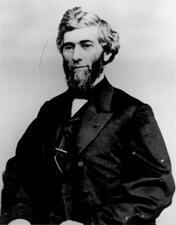
Reuben Eaton Fenton (July 4, 1819 – August 25, 1885) was an American merchant and politician from New York who, in the mid-19th century, served as a U.S. Representative, a U.S. Senator, and Governor of New York. Born near Frewsburg in Chautauqua County, New York, on July 4, 1819, he was the son of farmer and schoolteacher George Washington Fenton (1783–1860) and Elsey (née Owen) Fenton (1790–1875). He had four siblings—Roswell Owen Fenton, George Washington Fenton Jr., William H. H. Fenton, and John Freeman Fenton. His paternal grandparents were Roswell Fenton and Deborah (née Freeman) Fenton, and his maternal grandfather was John Owen of Carroll, New York. Through his paternal aunt, Hannah Fenton, who married Lambert Van Buren of Kinderhook, New York, he was connected by marriage to a prominent Hudson Valley family.
Fenton was educated in local district schools, at Cary’s Academy near Cincinnati, Ohio, and at the Fredonia Academy in western New York, an institution that later evolved into the State University of New York at Fredonia. In 1840, he was named commander of the New York Militia’s 162nd Infantry Regiment with the rank of colonel, an early mark of local confidence in his leadership. He became a lumber merchant, studied law, and was admitted to the bar in 1841, though his primary pursuits remained in business and public affairs. Entering politics as a Democrat, he served as Town Supervisor of Carroll, New York, from 1843 to 1850, building a regional reputation that would carry him into national office.
Fenton’s congressional career began when he was elected as a Democrat to the 33rd United States Congress, serving from March 4, 1853, to March 3, 1855. During this first term in the House of Representatives, he strongly opposed the Kansas-Nebraska Act of 1854 and made an unsuccessful effort to persuade President Franklin Pierce and Secretary of State William L. Marcy to oppose the bill. His stance contributed to his defeat for re-election in 1854, but it also marked his break with the Democratic Party. He left the Democrats to help organize the emerging Republican Party and was later elected, as a Republican, to the 35th, 36th, 37th, and 38th United States Congresses, serving from March 4, 1857, to March 3, 1865. Over the course of these five terms in the House, he served on the Committee on Invalid Pensions during the 36th Congress and on the Committee on Claims during the 37th Congress, participating in the legislative response to the Civil War and the needs of veterans and claimants.
In 1864, Fenton was elected Governor of New York as a Republican and took office in 1865, serving two consecutive terms until 1868 after winning re-election in 1866. His governorship coincided with the closing phase of the Civil War and the beginning of Reconstruction. During his tenure, Cornell University was founded; a free public school system was initiated; and relief measures were sanctioned that benefited returning Civil War veterans, reinforcing his reputation as “The Soldiers’ Friend.” He worked to remove tuition charges for public education and helped to establish six schools for training teachers, reflecting his long-standing interest in educational improvement. In 1868, he was among the Republicans considered for the vice-presidential nomination, although the nomination ultimately went to Schuyler Colfax. Fenton and Colfax had previously been allied in discussions with President Abraham Lincoln about public concern over General George B. McClellan’s perceived inactivity during the Civil War. Fenton’s gubernatorial career ended when he lost the November 1868 election to John T. Hoffman, a Tammany Hall–backed Democrat.
In January 1869, Fenton was elected to the United States Senate from New York, succeeding Edwin D. Morgan. He served as a Senator from 1869 to 1875, when he was succeeded by Francis Kernan. His service in Congress thus extended over a significant period in American history, encompassing the antebellum era, the Civil War, and Reconstruction. As a member of the Senate, Reuben Eaton Fenton participated in the democratic process and represented the interests of his New York constituents, contributing to the legislative process during six terms in federal office—five in the House of Representatives and one in the Senate—from 1853 to 1875. While in the Senate, he served as chair of the Committee to Audit and Control the Contingent Expenses during the 42nd Congress and also served on the Committee on Manufactures and the Committee on Territories. In 1870, he became embroiled in a major political conflict when President Ulysses S. Grant nominated Thomas Murphy to be New York Customs House Collector, a post rich in patronage. Fenton opposed the nomination but was defeated after Senator Roscoe Conkling delivered a speech producing documentary evidence that Fenton had, as a young man, failed to deliver $12,000 entrusted to him as a courier, a sum he had claimed was stolen. According to later accounts, Fenton slumped over his desk upon seeing the documents, and the episode greatly diminished his political influence while solidifying Conkling’s leadership of the Republican machine in New York. In 1872, Fenton joined other Republicans opposed to President Grant in the short-lived Liberal Republican Party, reflecting his willingness to break with his party over issues of patronage and reform.
After leaving the Senate in 1875, Fenton remained active in public affairs. In 1878, he represented the United States at the International Monetary Conference in Paris, an assignment that drew on his experience in national finance and economic policy. He continued to be remembered for his advocacy on behalf of Civil War veterans and for his work in expanding public education, including his role in signing the charter for Cornell University and in promoting teacher-training institutions. His long career made him one of the notable American politicians who switched parties in office, moving from the Democratic to the Republican and later to the Liberal Republican ranks as national issues and party alignments shifted.
Fenton’s personal life was marked by two marriages and several children. In 1840, he married Jane W. Frew (1821–1842), the daughter of John and Isabelle (Armstrong) Frew. They had one daughter, Jane Frew Fenton, who, after her mother’s death in 1842, went to live with her maternal grandparents. On June 12, 1844, Fenton married Elizabeth Scudder (1824–1901). Together they were the parents of Josephine Fenton (1845–1928), who married Frank Edward Gifford (1845–1934); Jeannette Fenton (1849–1924), who married Albert Gilbert (1851–1912); and Reuben Earle Fenton (1865–1895), who married Lillian Mai Hayden, daughter of Charles H. Hayden, in 1890. The family resided in an Italian Villa–style house built for Fenton in 1863 in Jamestown, New York, which became a local landmark.
Reuben Eaton Fenton died on August 25, 1885, in Jamestown, New York, and was buried in Lake View Cemetery. His legacy is reflected in several commemorations across the state. The town of Fenton in Broome County, New York, is named after him. His Jamestown residence, later acquired by the city in 1919 after a period of abandonment following his wife’s death, has housed the Fenton History Center since 1964 and serves as a museum dedicated to the history of Chautauqua County; it was listed on the National Register of Historic Places in 1972. At the State University of New York at Fredonia, Fenton Hall bears his name in recognition of his attendance at the earlier Fredonia Academy and his support for education. Fenton Avenue in the Bronx, New York, is also named in his honor, underscoring his enduring association with the state he served in Congress and as governor.
Congressional Record