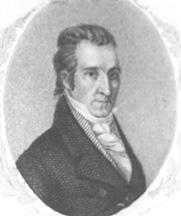
Return Jonathan Meigs Jr. (November 17, 1764 – March 29, 1825) was a Democratic-Republican politician from Ohio who served as a United States senator, the fourth governor of Ohio, and the eighth United States Postmaster General. A member of the Republican (Democratic-Republican) Party, Return Jonathan Meigs served as a senator from Ohio in the United States Congress from 1808 to 1810, contributing to the legislative process during two terms in office and representing the interests of his constituents during a significant period in early American history.
Meigs was born in Middletown in the Colony of Connecticut on November 17, 1764. He was the son of Return J. Meigs Sr. and a descendant of early Puritan settlers in Massachusetts, coming from a family long established in New England public and military life. He graduated from Yale College in 1785 and remained there to study law. After being admitted to the bar in Connecticut in 1788, he moved west to Marietta, in the Ohio Country, where his father had been one of the first settlers, arriving earlier that same year as part of the initial organized American settlement in the Northwest Territory.
In Marietta, Meigs pursued a varied early career as a lawyer, storekeeper, and farmer, while quickly assuming public responsibilities in the new community. In 1788 he was appointed the first court clerk for the court established at Marietta, marking the beginning of his long judicial and administrative service. When a post office was established in Marietta in 1794, he became its first postmaster, an early association with the postal service that foreshadowed his later national role. In 1798 he was named to a judgeship on the Northwest Territory’s territorial court, and in 1799 he won election to the territorial legislature, participating in the formative legal and political development of the region that would become Ohio and neighboring states.
With the admission of Ohio to the Union, Meigs’s judicial career advanced further. In 1803 he was appointed the first chief justice of the Ohio State Supreme Court, placing him at the head of the new state’s highest tribunal at the outset of its judicial history. In October 1804 he resigned this position to accept a federal military and administrative post as commandant of United States troops in the St. Charles district of the Louisiana Territory. He attained the rank of brevet colonel and retained this command until 1806, helping to establish American authority in the recently acquired Louisiana Purchase. During this period he was also chosen in 1805 as a judge of the Supreme Court of Louisiana, and in 1807 he was appointed judge of the United States District Court for the Michigan Territory, extending his judicial influence across several frontier jurisdictions.
Meigs returned to Ohio in 1807 to seek the governorship and won the election, but he was declared ineligible because he did not meet the state’s residency requirements. Following this setback, he was appointed to the United States Senate to fill the unexpired term of Senator John Smith of Ohio. He took his seat as a senator from Ohio in 1808 and was re-elected to his own term a year later, serving in the Senate from 1808 to 1810. During these two terms in office, as a member of the Republican (Democratic-Republican) Party, Return Jonathan Meigs contributed to the legislative process at a time of growing tensions that would culminate in the War of 1812. He resigned from the Senate in late 1810 after winning election as governor of Ohio.
As governor, Meigs served two two-year terms as the fourth governor of Ohio, guiding the state through the challenging years surrounding the War of 1812. He resigned the governorship in April 1814 when President James Madison appointed him the eighth United States Postmaster General. In that national executive post, which he held from 1814 until 1823, Meigs oversaw a period of rapid expansion in the postal system. The size of the Post Office effectively doubled during his tenure, greatly extending mail service but also contributing to financial difficulties for the department. His administration was the subject of two congressional investigations; on both occasions he was cleared of wrongdoing, and he continued in office until retiring due to ill health. In 1823 he returned to Marietta, closing a long career in public service.
In his personal life, Meigs married Sophia Wright in 1788. They had one child, a daughter, Mary, who in 1810 married Congressman and federal judge John George Jackson of Clarksburg, Virginia. Return J. Meigs Jr. had no direct male heir, but his name and family prominence continued through the next generation. Two of his younger brothers, John and Timothy, each named a son Return Jonathan Meigs. John’s son, known as Return J. Meigs III, passed the bar in Frankfort, Kentucky, commenced law practice in Athens, Tennessee, and became prominent in Tennessee state affairs before the Civil War; he left Tennessee for Staten Island, New York, at the time of Tennessee’s secession in 1861, and among those who read law under his tutelage was William Parish Chilton, later Chief Justice of the Alabama Supreme Court. Timothy’s son, Return J. Meigs IV, married Jennie Ross, daughter of principal Cherokee chief John Ross, and emigrated to present-day Oklahoma on the Trail of Tears.
Meigs spent his final years in Marietta, where he had first established himself on the Ohio frontier. He died there on March 29, 1825, and was buried in Marietta’s Mound Cemetery. His grave is marked by a large monument bearing a lengthy inscription that records his many public offices and his devotion to family. His legacy is reflected geographically as well as institutionally: Meigs County, Ohio, is named in his honor, while Meigs County, Tennessee, commemorates his father. Fort Meigs in Perrysburg, Ohio, constructed during the War of 1812 under General William Henry Harrison, was also named in his honor, underscoring his standing in the early history of the state and the nation.
Congressional Record