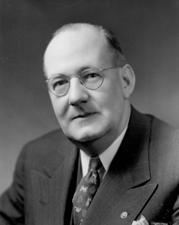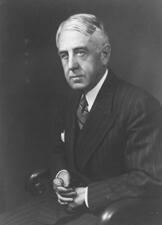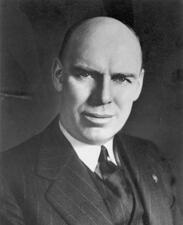
Ralph Owen Brewster (February 22, 1888 – December 25, 1961) was an American politician from Maine who served as the fifty‑fourth governor of Maine, a member of the United States House of Representatives, and a United States senator. A Republican, he served as governor from 1925 to 1929, in the U.S. House of Representatives from 1935 to 1941, and in the U.S. Senate from 1941 to 1952. Over the course of his congressional career, which encompassed five terms in Congress and spanned the New Deal, World War II, and the early Cold War, he participated actively in the legislative process and represented the interests of his Maine constituents. He became known nationally as a close confidant of Senator Joseph McCarthy of Wisconsin and as an antagonist of industrialist and aviator Howard Hughes.
Brewster was born in Dexter, Penobscot County, Maine, the son of William E. Brewster, a banker, grocery store owner, and member of the Maine House of Representatives, and Carrie S. Bridges Brewster. He was a direct lineal descendant of Love Brewster, a passenger aboard the Mayflower and a founder of Bridgewater, Massachusetts, and of Love’s father, Elder William Brewster, the Pilgrim colonist leader and spiritual elder of Plymouth Colony, who was also a Mayflower passenger and a signer of the Mayflower Compact. This New England and Pilgrim heritage formed an important part of his family identity and public image.
Brewster was educated in Maine and went on to Bowdoin College, from which he graduated summa cum laude in 1909. At Bowdoin he was elected to Phi Beta Kappa and was a member of the Delta Kappa Epsilon fraternity. Immediately after graduation he served from 1909 to 1910 as principal of Castine High School in Castine, Maine. He then entered Harvard Law School, where he studied from 1910 to 1913 and received his law degree. In 1914 he began practicing law in Portland, Maine, joining the firm of Chapman and Brewster, with which he remained associated until 1925. In 1915 he married Dorothy Foss. Alongside his legal practice, he served from 1915 to 1923 on the Portland School Committee, reflecting an early interest in public education and local governance. He also became secretary of the Chamber of Commerce–affiliated “Committee of 100,” which in 1923 led a significant overhaul of Portland’s city government structure.
Brewster’s formal political career advanced rapidly in the 1920s. A member of the Republican Party, he was elected governor of Maine and served as the state’s fifty‑fourth governor from 1925 to 1929. His tenure as governor coincided with the later years of the Roaring Twenties, a period of economic expansion and evolving state responsibilities in infrastructure and social policy. After leaving the governorship, he remained active in Republican politics and the law, positioning himself for national office as the Great Depression reshaped the political landscape.
In 1934 Brewster won election to the United States House of Representatives as a Republican from Maine and entered Congress in 1935. He served in the House from 1935 to 1941, a period marked by intense national debate over President Franklin D. Roosevelt’s New Deal programs and the growing international crisis preceding World War II. In the House he contributed to the legislative process during a critical era in American history, representing Maine’s interests on domestic economic issues and on questions of national preparedness. In 1940 he successfully sought a seat in the United States Senate, beginning his Senate service in 1941 as the nation entered World War II.
Brewster served in the U.S. Senate from 1941 to 1952. His Senate career covered the entirety of the American involvement in World War II and the early years of the Cold War, including the onset of McCarthyism. During these years he participated in wartime and postwar legislation affecting defense, foreign policy, and economic reconversion. He became a close confidant of Senator Joseph McCarthy of Wisconsin, aligning himself with McCarthy’s anti‑Communist crusade and gaining a reputation as one of McCarthy’s key allies in the Senate. Brewster also came to national attention through his highly publicized conflict with Howard Hughes, particularly over aviation contracts and alleged wartime profiteering. Their antagonism culminated in widely covered hearings, and Hughes later heavily funded the campaign of Frederick G. Payne, who challenged Brewster in the 1952 Republican primary. Brewster was defeated by Payne in that primary, ending his Senate career.
After leaving the Senate in 1952, Brewster remained active in conservative and civic organizations. A Christian Scientist, he had earlier served a one‑year term, from 1932 to 1933, as president of The First Church of Christ, Scientist in Boston, a largely honorary but symbolically important role within the denomination. He was for many years a member of First Church of Christ, Scientist in Portland, Maine, and later helped establish a Christian Science Society in his native Dexter. Professionally and socially, he maintained memberships in the American Bar Association, the Grange, the American Legion, the Freemasons, the Elks, the Odd Fellows, and his college fraternity, Delta Kappa Epsilon. In retirement he continued to lend his name and efforts to various conservative causes and organizations, reflecting his long‑standing ideological commitments.
Ralph Owen Brewster died unexpectedly of cancer on December 25, 1961, in Brookline, Massachusetts. He was buried at Mount Pleasant Cemetery in Dexter, Maine. His former home in Dexter, listed on the National Register of Historic Places, was later converted into the Brewster Inn, a bed and breakfast that preserves the memory of his life and career. Archival materials, including a filmed interview, “Longines Chronoscope with Sen. Owen Brewster (October 19, 1951),” remain available to researchers and the public, documenting his role in mid‑twentieth‑century American politics.
Congressional Record