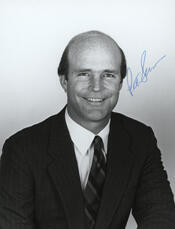
Preston Murdoch “Pete” Geren III (born January 29, 1952) is an American attorney and politician who served as a Democratic Representative from Texas in the United States Congress from 1989 to 1997 and later as the 20th United States Secretary of the Army from July 16, 2007, to September 16, 2009. He was born in Fort Worth, Texas, to Preston Geren Jr., and grew up in a family that would become deeply involved in public service; his older brother, Charlie Geren, later became a Republican member of the Texas House of Representatives from District 99 in Tarrant County. Geren’s early years in Fort Worth laid the foundation for a career that would span law, elective office, and senior civilian leadership roles in the Department of Defense.
Geren began his higher education at the Georgia Institute of Technology in Atlanta, Georgia, where he attended from 1970 to 1973. While at Georgia Tech, he was the starting center for the football team, balancing athletics with his academic pursuits. He subsequently returned to Texas and completed his undergraduate studies at the University of Texas, receiving a Bachelor of Arts degree in 1974. He continued at the University of Texas School of Law, earning his Juris Doctor in 1978. After law school, Geren entered the legal profession as an attorney, establishing himself in private practice and becoming active in civic and political affairs in the Fort Worth area.
Geren’s political career advanced with his election to the United States House of Representatives as a Democrat from Texas’s 12th congressional district. He served four consecutive terms in Congress from 1989 to 1997. During this period, he participated in the legislative process at a time of significant change in American and global affairs, including the end of the Cold War and the Gulf War era. As a member of the House of Representatives, Geren represented the interests of his Fort Worth–area constituents and contributed to national policy debates, engaging in the democratic process that shaped federal legislation over the course of his eight years in office. His service in Congress established his reputation in defense and public policy matters that would later inform his work in the executive branch.
After leaving Congress in 1997, Geren remained engaged in public service and, in September 2001, joined the Department of Defense as Special Assistant to the Secretary of Defense. In that role, he was responsible for inter-agency initiatives, legislative affairs, and special projects, working at the Pentagon during a period marked by the September 11 attacks and the ensuing military operations in Afghanistan and Iraq. On July 29, 2005, President George W. Bush appointed Geren as Acting United States Secretary of the Air Force, a position he held until November 2005, when Michael Wynne was confirmed as Secretary. Geren was subsequently nominated by President Bush and confirmed by the Senate as the 28th Under Secretary of the Army, assuming that post on February 21, 2006. As Under Secretary, he served as the Army’s second-ranking civilian official, acting as deputy and senior adviser to the Secretary of the Army and serving as Acting Secretary in the Secretary’s absence.
In March 2007, following the resignation of Army Secretary Francis J. Harvey amid the Walter Reed Army Medical Center scandal, Secretary of Defense Robert Gates named Geren Acting Secretary of the Army. The United States Senate confirmed him as Secretary of the Army on July 16, 2007. As Secretary, Geren oversaw the Army during a critical phase of the Iraq and Afghanistan conflicts and undertook efforts to address systemic challenges in Army management and support systems. On August 30, 2007, he established the independent Commission on Army Acquisition and Program Management in Expeditionary Operations to investigate and reform contingency contracting and acquisition practices in expeditionary environments, responding to concerns about the effectiveness and integrity of wartime contracting. He served as Secretary of the Army until September 16, 2009, concluding a tenure marked by attempts to improve oversight, accountability, and support for soldiers and their families.
Following his service in the Department of Defense, Geren returned to Texas and continued his involvement in civic and philanthropic work. He became president of the Sid W. Richardson Foundation in Fort Worth, Texas, a major philanthropic institution supporting education, health, human services, and cultural initiatives in the region. In addition to his foundation leadership, he has served as a member of the board of trustees of the Institute for Defense Analyses in Alexandria, Virginia, contributing his experience in defense policy and management to an organization that provides independent, federally funded research and analysis to the Department of Defense and other federal agencies. Through his roles in Congress, the Pentagon, and the nonprofit sector, Preston M. Geren has maintained a long career in public service, spanning legislative, executive, and philanthropic leadership.
Congressional Record