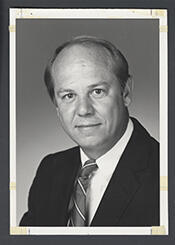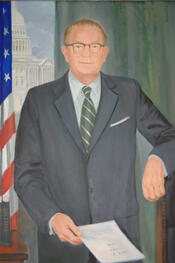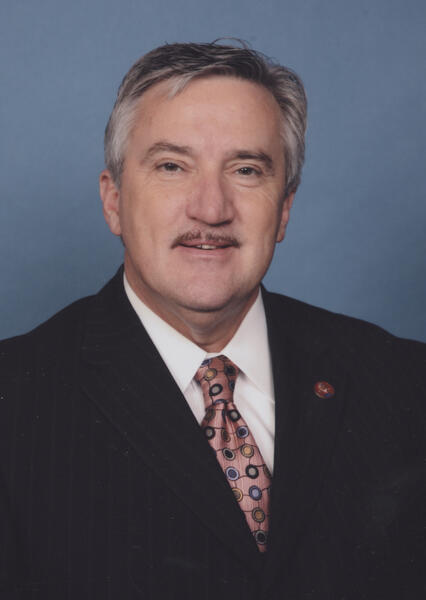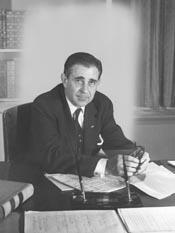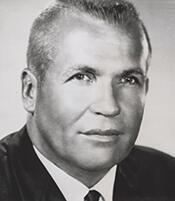
Prentiss Lafayette Walker (August 23, 1917 – June 5, 1998) was an American farmer, businessman, and politician from Mississippi. A member of the Republican Party and a staunch segregationist, he became in 1964 the first Republican to be elected to the United States House of Representatives from Mississippi during the twentieth century. He served one term as a Representative from Mississippi in the United States Congress from January 3, 1965, to January 3, 1967, during a significant period in American history marked by the civil rights movement and major realignments in Southern politics.
Walker was born in Taylorsville, Smith County, Mississippi, on August 23, 1917. He attended public schools in Taylorsville and nearby Mize, Mississippi, and later in Las Cruces, New Mexico, reflecting an early life spent in small, rural communities. In 1936, he attended Mississippi College in Clinton, Mississippi. His upbringing in central Mississippi and his exposure to agricultural life would shape both his professional pursuits and his political outlook in the decades that followed.
Before entering national politics, Walker established himself as a farmer and businessman. He operated as a chicken farmer in Smith County and became president of Walker Egg Farms, Inc., based in Mize, Mississippi, building a substantial enterprise in the poultry industry. From 1937 to 1963, he was the owner of Walker’s Supermarket, further entrenching his reputation as a local businessman. His prominence in state affairs grew when, in 1960, he served on the executive committee of the Mississippi Game and Fish Commission under Governor Ross Barnett, a position that linked him to the segregationist political establishment of the era.
During World War II, Walker served in the United States Army in the Pacific Theater of Operations. After the war, he returned to Mississippi and resumed his work in agriculture and business, continuing to expand Walker Egg Farms and maintaining his supermarket. By the early 1960s, his profile as a conservative businessman and farmer aligned with the emerging Republican strategy in the South, which sought to capitalize on white opposition to federal civil rights initiatives and to the national Democratic Party.
In 1964, Walker entered national politics as a delegate to the Republican National Convention in San Francisco, California, and became the Republican candidate for Mississippi’s 4th congressional district, in the central eastern part of the state. Running as an outspoken segregationist, he challenged and unseated 11-term Democratic incumbent W. Arthur Winstead by roughly 7,000 votes, an 11 percent margin. His election marked the first Republican breakthrough in Mississippi congressional politics since Elza Jeffords had served a term in Congress from 1883 to 1885. Walker’s victory was facilitated by white Mississippians’ anger at the national Democratic Party’s support for civil rights legislation, which led many white voters to support Republican presidential nominee Barry Goldwater. Goldwater carried Mississippi in the 1964 presidential election with 87 percent of the vote, and in Walker’s district he won many counties with more than 90 percent of the vote; in Holmes and Noxubee Counties he received 96.6 percent, tied for his best showing in the nation and a level of support never since equaled by any presidential candidate in any county nationwide. At the same time, widespread suppression of African Americans’ right to vote—only 6.7 percent of eligible Black Mississippians were registered in 1964—helped secure Walker’s election. After winning, his first public appearance as congressman-elect was to speak at a meeting organized by Americans for the Preservation of the White Race, underscoring his alignment with segregationist politics.
As a member of the House of Representatives from 1965 to 1967, Walker participated in the legislative process and represented the interests of his Mississippi constituents during a period of intense national debate over civil rights, federal authority, and the direction of Southern politics. His presence in Congress symbolized the emerging Republican foothold in Mississippi and the broader partisan realignment of the South. His political persona later became part of Republican lore; at a Republican fundraiser at the Mississippi Coliseum in Jackson on June 20, 1983, President Ronald Reagan recounted an anecdote from Walker’s first campaign, in which Walker joked about giving a speech from a pile of “fertilizer” on a farm and quipped that it was the first time he had ever spoken from a “Democratic platform,” a story that highlighted both his novelty as a Republican in Mississippi and the state’s long-standing Democratic dominance.
Walker relinquished his House seat after only one term, choosing not to seek reelection in 1966. Instead, he mounted a challenge to powerful Democratic U.S. Senator James O. Eastland. Running well to Eastland’s right, Walker criticized the veteran senator for being too friendly with President Lyndon B. Johnson and for not being sufficiently aggressive in blocking integration-friendly judicial nominees in his capacity as chairman of the Senate Judiciary Committee. In the 1966 general election, Walker received 105,652 votes, or 26.7 percent of the total. In a development that surprised many observers, his supporters included some Black voters in southwestern Mississippi, particularly in Claiborne and Jefferson Counties, who backed Walker in protest against Eastland as a “Democratic Regular” after Black Mississippians began entering the political process under the Voting Rights Act of 1965. Years later, Wirt Yerger, chairman of the Mississippi Republican Party in the 1960s, described Walker’s decision to give up his relatively secure House seat for a difficult Senate race against Eastland as “very devastating” to the growth of the Republican Party in Mississippi. In the contest to succeed Walker in the House, state Representative Lewis McAllister of Meridian, the first Republican elected to the Mississippi House of Representatives since Reconstruction, attempted to hold the 4th District seat for the GOP, but was defeated by Democratic state Representative Gillespie V. “Sonny” Montgomery, also of Meridian, who went on to hold the seat for 30 years.
Walker continued to seek public office after leaving Congress but was unable to regain a foothold. In 1968, he attempted to unseat Montgomery in the 4th District but received only about 30 percent of the vote. In 1972, he again challenged Senator Eastland, this time running as an Independent rather than as a Republican. In that race he drew only 14,662 votes, or 2.3 percent, while Republican nominee Gil Carmichael, a more moderate “Rockefeller-style” Republican and former critic of Walker, received 249,779 votes (38.7 percent). Eastland was reelected comfortably with 375,102 votes, or 58.1 percent. These later campaigns underscored both Walker’s declining political influence and the gradual evolution of Mississippi’s Republican Party away from his brand of politics.
In his later years, Walker returned to private life in Smith County, remaining associated with his agricultural and business interests and with local Republican politics. He and his wife, the former Dimple Howell, had two daughters: Treta Walker Butler, married to James Butler of Mize, and Jan Walker Magee of Magee. Walker died on June 5, 1998. He and his wife are interred at Zion Hill Missionary Baptist Church Cemetery in Mize, Mississippi. In recognition of his prominence in local affairs, Prentiss Walker Lake near Mize—originally called Ross Barnett Lake—was named in his honor, reflecting his enduring, if controversial, place in the political and civic history of Mississippi.
Congressional Record