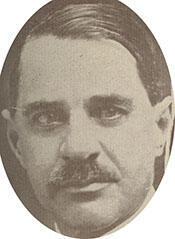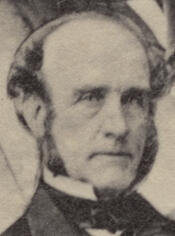
Portus Baxter (December 4, 1806 – March 4, 1868) was a nineteenth-century banker, farmer, and politician from Vermont who served as a Republican Representative in the United States Congress from 1861 to 1867. Over the course of three consecutive terms, he represented Vermont’s 3rd Congressional District in the U.S. House of Representatives during the critical years of the American Civil War and early Reconstruction, participating in the national legislative process and advocating for the interests of his constituents.
Born on December 4, 1806, Baxter came of age in the early years of the nineteenth century, a period marked by the expansion of the American republic and the growth of New England’s agricultural and commercial economy. He established himself in Vermont, where he became engaged in both farming and banking, occupations that reflected the mixed agrarian and financial character of the region. Through these pursuits he gained experience in local economic affairs and community leadership, which helped lay the groundwork for his later political career.
Baxter’s professional life before entering Congress combined agriculture with financial activity, as he worked as a farmer and banker in Vermont. In these roles he would have been closely involved with the practical concerns of rural communities, including land use, credit, and local development. His familiarity with the economic conditions of his state, together with his growing involvement in public affairs, positioned him as a credible representative of Vermont’s interests at the national level.
Affiliated with the Republican Party, which had risen to prominence in the 1850s on a platform that included opposition to the expansion of slavery and support for economic modernization, Baxter was elected to the U.S. House of Representatives as a Republican from Vermont’s 3rd Congressional District. He entered Congress at the outset of the Civil War, beginning his first term on March 4, 1861. He was subsequently reelected, serving three full terms until March 3, 1867. During this period he took part in the legislative deliberations of the 37th, 38th, and 39th Congresses, years that encompassed the Union war effort, the passage of major wartime measures, and the initial stages of Reconstruction policy.
While in the House of Representatives, Baxter participated in the democratic process at a time when Congress was central to determining the course of the Union war strategy, the financing of the conflict, and the postwar settlement. As a member of the Republican majority, he contributed to the legislative work that shaped national policy in areas such as the conduct of the war, the support of soldiers and their families, and the broader transformation of the federal government’s role in the economy and society. Throughout his tenure he represented the concerns of his Vermont constituents, whose interests included agriculture, local industry, and loyalty to the Union cause.
Baxter left Congress at the conclusion of his third term in 1867, as the nation continued to grapple with the challenges of Reconstruction and the reintegration of the former Confederate states. After his congressional service, he returned to private life in Vermont, where his earlier experience as a banker and farmer and his years in national office had made him a well-known public figure in the state. He died on March 4, 1868, one year to the day after the end of his final term in Congress, closing a career that had spanned local economic leadership and national legislative service during one of the most consequential eras in American history.
Congressional Record