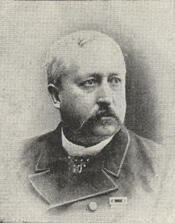
Philip Sidney Post (March 19, 1833 – January 6, 1895) was an American diplomat, politician, and decorated Army officer who served as a United States Representative from Illinois and as a distinguished Union officer during the American Civil War. A member of the Republican Party, he represented Illinois in the United States House of Representatives for five consecutive terms, serving eight years from March 4, 1887, until his death on January 6, 1895. His congressional service took place during a significant period in American history, and he participated actively in the legislative process while representing the interests of his constituents. Many years after the Civil War, on March 8, 1893, he received the Medal of Honor for his gallantry at the Battle of Nashville.
Post was born in Florida, Montgomery County, New York, on March 19, 1833. He pursued classical studies and attended Union College in Schenectady, New York, from which he graduated in 1855. Seeking a legal career, he studied at the Poughkeepsie Law School and was subsequently admitted to the bar in Illinois in 1856. After his admission, he traveled through the northwestern regions of the country and eventually settled in Kansas, where he engaged in the practice of law. In addition to his legal work, he established and edited a newspaper, reflecting an early interest in public affairs and communication that would later inform his political and diplomatic service.
At the outbreak of the American Civil War, Post entered the Union Army and was commissioned as a second lieutenant in the 59th Illinois Volunteer Infantry Regiment. He rose rapidly through the ranks and was promoted to colonel in 1862. During the Battle of Pea Ridge in March 1862, he was severely wounded and, with great difficulty and suffering, made his way to St. Louis, Missouri, for treatment. Before he had fully recovered, he rejoined his regiment in front of Corinth, Mississippi, and was assigned to command a brigade. From May 1862 until the close of the war, he was almost continuously at the front, participating in major campaigns and engagements in the Western Theater.
Within the Army of the Cumberland, as first organized, Post commanded the 1st Brigade, 1st Division, 20th Army Corps from its formation until its dissolution. He took part in the Battle of Stones River, where his command began the engagement, drove back Confederate forces several miles, and captured the position known as Leetown. During the Atlanta Campaign, he was transferred to the division of Major General Thomas J. Wood in the 4th Army Corps. When General Wood was wounded at the Battle of Lovejoy’s Station in 1864, Post assumed command of the division and led it in operations opposing the Confederate advance toward the north. On December 16, 1864, during the Battle of Nashville, he led a charge on Overton Hill and was struck by grapeshot that crushed through his hip, causing a wound that was for some days thought to be mortal. For his conspicuous gallantry in this action, he was later awarded the Medal of Honor on March 8, 1893. In recognition of his wartime service, President Abraham Lincoln nominated him on March 11, 1865, for appointment to the brevet grade of brigadier general of volunteers, to rank from December 16, 1864, and the United States Senate confirmed the appointment.
After the surrender at Appomattox Court House in April 1865, Post was appointed to command the western district of Texas, an area of strategic importance due to the concentration of United States troops along the Mexican border during the period of French intervention in Mexico. He remained in that command until near the beginning of 1866, when the withdrawal of French forces from Mexico reduced the likelihood of military complications. Although he was strongly recommended by General George H. Thomas and other senior officers for appointment as a colonel in the Regular Army, Post declined a permanent military career. He resigned his commission, was mustered out of the volunteer service on December 8, 1865, and returned to Illinois to resume civilian life.
In 1866, Post entered the diplomatic service of the United States when he was appointed consul to Vienna in the Austrian Empire. He was promoted to consul general to Austria-Hungary in 1874, a position he held until his resignation in 1879. His long tenure in Vienna reflected both his administrative ability and his capacity to represent American interests abroad during a period of significant political and social change in Central Europe. Returning to Illinois, he remained active in veterans’ affairs and civic life. He served as commander of the Department of Illinois of the Grand Army of the Republic in 1886 and was a Companion of the Illinois Commandery of the Military Order of the Loyal Legion of the United States. He was also an early member of the Sons of the American Revolution, underscoring his continuing engagement with organizations honoring military service and the nation’s founding legacy.
Post was elected as a Republican to the Fiftieth Congress and to the four succeeding Congresses, serving from March 4, 1887, until his death in office during the Fifty-third Congress. Over the course of his five terms, he contributed to the legislative process at a time when the nation was grappling with issues of industrial expansion, veterans’ affairs, and post-Reconstruction adjustment. As a member of the House of Representatives from Illinois, he participated in the democratic process and worked to represent the interests of his district and state, drawing on his extensive military and diplomatic experience in shaping his approach to national policy.
Philip Sidney Post died in office in Washington, D.C., on January 6, 1895. His death placed him among the members of Congress who have died while serving. He was interred in Hope Cemetery in Galesburg, Illinois, where his grave marks the resting place of a soldier, diplomat, and legislator whose career spanned the Civil War, Reconstruction, and the emergence of the United States as an increasingly influential power on the world stage.
Congressional Record