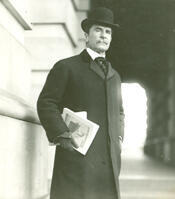
Perry Belmont (December 28, 1851 – May 25, 1947) was an American politician, lawyer, diplomat, and military officer who served four terms as a Democratic Representative from New York in the United States Congress from 1881 to 1889. He was born in New York City on December 28, 1851, the son of Caroline Slidell (née Perry) and prominent financier August Belmont. Through his mother he was the grandson of Commodore Matthew C. Perry and a descendant of Captain Christopher Raymond Perry, a privateer during the American Revolution and father of Commodores Oliver Hazard Perry and Matthew C. Perry. His brothers included Oliver Hazard Perry Belmont and August Belmont Jr., both of whom were notable figures in finance and society.
Belmont received his early education at the Everest Military Academy in Hamden, Connecticut. He then attended Harvard College, from which he graduated in 1872. Pursuing legal studies, he attended the law school of the University of Berlin and subsequently enrolled at Columbia Law School in New York City, graduating from Columbia in 1876. He was admitted to the bar that same year and commenced the practice of law in New York City. Belmont became a member of the Rhode Island Society of the Sons of the Revolution by virtue of his descent from Captain Christopher Raymond Perry, and in 1929 he was elected an honorary member of the Rhode Island Society of the Cincinnati. He was also a member of the Veteran Corps of Artillery, reflecting his ongoing interest in military and patriotic organizations.
In his early professional career, Belmont practiced law in New York City for approximately five years. He was a partner in the firm of Vinton, Belmont & Frelinghuysen, alongside his cousin, the writer Arthur Dudley Vinton, and George Frelinghuysen, who later became president of the Ballantine Brewing Company. Outside the legal profession, Belmont and his brother August Belmont Jr. were among the founding members of The Jockey Club, underscoring the family’s long-standing association with horse racing and high society. His growing prominence in legal, financial, and social circles in New York laid the groundwork for his subsequent political career.
Elected as a Democrat to the Forty-seventh Congress and reelected to the three succeeding Congresses, Belmont represented New York’s first congressional district from March 4, 1881, until his resignation on December 1, 1888. His service in Congress thus extended over four terms, during a significant period in American political and economic development. During his first term he served on the House Committee on Foreign Affairs, where he gained notice for his searching cross-examination of former Secretary of State James G. Blaine regarding Blaine’s relations with a syndicate of American capitalists interested in guano deposits in Peru. The inquiry sought to determine whether Blaine’s efforts at mediation between Chile and Peru had been influenced by private financial motives. From 1885 to 1887, Belmont served as chairman of the Committee on Foreign Affairs, playing a leading role in shaping the House’s approach to international issues and contributing to the legislative process on foreign policy matters while representing the interests of his New York constituents.
Belmont resigned from Congress upon his appointment as United States Minister to Spain in November 1888, a diplomatic post he held until May 1889. His service in Madrid came at a time of evolving relations between the United States and Spain in the late nineteenth century. In recognition of his broader public and diplomatic standing, on October 6, 1890, he was invested as a Commander of the French Legion of Honor. Belmont also remained active in financial affairs; when the Consolidated National Bank of New York was organized on July 1, 1902, he was among the fourteen original directors, a group that included figures such as John W. Griggs, Henry C. Brewster, George Crocker, and Mortimer H. Wagar. In 1906 he became the “permanent president” of the National Publicity Bill Organization, an advocacy group that worked for campaign finance disclosure and greater transparency in political funding.
In addition to his political and diplomatic activities, Belmont undertook military service in two major American conflicts. During the Spanish–American War in 1898, he served for six weeks in the United States Volunteers as Inspector General of the First Division, Second Army Corps, with the rank of major. Despite being 65 years old at the time of American entry into the First World War, he again entered uniformed service. On May 5, 1917, he was commissioned a captain in the U.S. Army Quartermaster Corps and assigned to the Remount Division in Washington, D.C., where he served until his discharge on May 21, 1920. For his service he was entitled to the Spanish War Service Medal and the World War I Victory Medal, and he was listed among the members of the American Legion, reflecting his status as a veteran of both conflicts.
Belmont’s personal life attracted public attention at the turn of the twentieth century. In 1899, after seventeen years of marriage, Jessie Ann Robbins (1858–1935) divorced her husband, Henry T. Sloane, son of William Sloane, founder of the firm W. & J. Sloane. Only five hours after the divorce decree was granted, she married Perry Belmont, an event that was widely reported and considered scandalous in contemporary society. Belmont continued to divide his time among New York, Washington, and Newport, Rhode Island, where his family maintained long-standing social and residential ties. His Washington residence later acquired a distinctive institutional role when it became the International Temple for the Order of the Eastern Star.
Perry Belmont lived to an advanced age and remained a figure of historical interest due to his family connections, his congressional and diplomatic service, and his unusual record of military service in later life. He died in Newport, Rhode Island, on May 25, 1947, at the age of 95 years and 148 days. He was interred in the Belmont family plot in Island Cemetery in Newport, where he is buried alongside his parents and his brother August Belmont Jr. His long life spanned from the immediate aftermath of the Civil War through the Second World War, and his career reflected the intertwining of politics, diplomacy, finance, and military service characteristic of his prominent American family.
Congressional Record