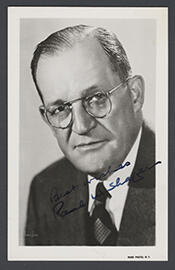
Paul Werntz Shafer (April 27, 1893 – August 17, 1954) was a politician and judge from Michigan who served as a Republican member of the United States House of Representatives from 1937 until his death in 1954. Over the course of nine consecutive terms in Congress, he represented Michigan’s 3rd congressional district and participated actively in the legislative process during a period marked by the Great Depression, World War II, and the early Cold War.
Shafer was born in Elkhart, Indiana, on April 27, 1893, the son of John McClellan Shafer and Sarah (Werntz) Shafer. During his childhood, his parents relocated the family to Three Rivers, Michigan, where he was raised and attended the public schools. His early years in the Midwest shaped his familiarity with small-town and industrial communities that he would later represent in Congress.
After completing his public schooling, Shafer pursued further education at Ferris Institute in Big Rapids, Michigan (now Ferris State University). He also studied law by correspondence through the Blackstone Institute of Chicago, Illinois, reflecting a combination of formal and self-directed legal training. Before entering public office, he worked extensively in journalism, serving as a reporter, editor, and publisher of newspapers in Elkhart, Indiana, as well as in Battle Creek and Bronson, Michigan. This experience in the press gave him a platform in public affairs and a close view of local and regional issues.
Shafer’s early public service included military involvement and judicial office. He was a member of the Indiana Army National Guard in 1916 and 1917 and served on the Mexican border during the Pancho Villa Expedition. When the United States entered World War I, he attempted to serve but was rejected on medical grounds. Returning to civilian life, he continued his legal and civic activities and, from 1929 to 1936, served as a municipal judge in Battle Creek, Michigan. His tenure on the bench established his reputation as a local public official and provided a springboard for his subsequent congressional career.
In the Republican primary elections of September 1936 for Michigan’s 3rd congressional district, Shafer defeated the incumbent Verner W. Main, securing the party’s nomination. He was then elected to the 75th United States Congress and to the eight succeeding Congresses, serving from January 3, 1937, until his death on August 17, 1954. As a member of the House of Representatives, Shafer represented the interests of his Michigan constituents through the New Deal era, World War II mobilization and demobilization, and the onset of the Cold War. His long tenure reflected sustained electoral support and positioned him as a consistent Republican voice in national debates.
During his congressional service, Shafer engaged in issues related to education and political ideology. Together with John Howland Snow, he authored “The Turning of the Tides,” an exposé on the education system of the United States, which he delivered in the House of Representatives on March 21, 1952. In this work, Shafer and Snow argued that the American education system had come under the influence of what they described as an alien collectivist, or socialist, philosophy, much of it derived from European thought. They contended that this philosophy had brought radical changes in economics, politics, and education, and alleged that these developments were funded by several wealthy American families and their tax-exempt foundations. This publication reflected Shafer’s staunchly conservative and anti-collectivist views during the early Cold War period.
Shafer’s years in Congress were not without personal hardship. In March 1940, while traveling in Columbiana County, Ohio, he was injured in an automobile accident. He sustained head and spinal injuries and spent several weeks receiving treatment in hospitals in Salem and Youngstown, Ohio. He was later flown back to Michigan from Akron aboard an army plane, an indication of the seriousness of his condition and the concern for his recovery while serving as a sitting member of Congress.
In his personal life, Shafer married Ila P. Mack of Detroit in 1917. The couple had no children but maintained a long marriage that spanned his careers in journalism, the judiciary, and Congress. Shafer continued to serve in the House of Representatives until the end of his life. He died in Washington, D.C., on August 17, 1954, two weeks after being re-nominated in the Republican primary election to the 84th Congress. His death in office placed him among the members of Congress who died while still serving. He was interred in Memorial Park Cemetery in Battle Creek, Michigan, closing a public career that had extended from local judicial service to nearly eighteen years in the national legislature.
Congressional Record