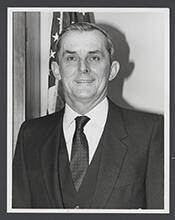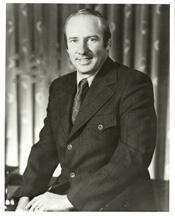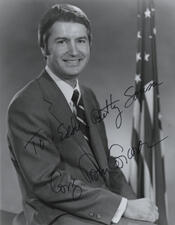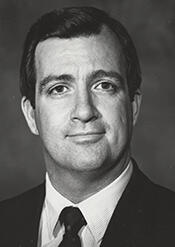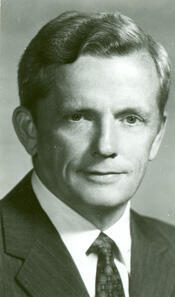
Paul Augustus Findley (June 23, 1921 – August 9, 2019) was an American writer, naval officer, and Republican politician who represented Illinois in the United States House of Representatives for 11 consecutive terms from 1961 to 1983. Serving as the Representative for Illinois’s 20th Congressional District, he was first elected in 1960 and became known as a moderate Republican, a supporter of civil rights, an early opponent of the U.S. war in Vietnam, and a persistent critic of aspects of American foreign policy in the Middle East. Over the course of his long public career, he combined legislative service with prolific writing and advocacy on issues ranging from agriculture and war powers to U.S.–Israel relations and the rights of Palestinians.
Findley was born in Jacksonville, Illinois, on June 23, 1921, the son of Florence Mary (Nichols) and Joseph S. Findley. He attended the public schools of Jacksonville and remained closely tied to his hometown throughout his life. He later enrolled at Illinois College in Jacksonville, from which he received his bachelor’s degree. Illinois College would eventually become home to The Paul Findley Congressional Office Museum, a collection of manuscripts and artifacts documenting his life and political career and one of the few congressional office museums in the United States. During World War II, Findley served in the United States Navy and was commissioned a lieutenant (junior grade), an experience that informed his later interest in military policy and the constitutional balance of war powers.
After the war, Findley returned to Illinois and entered public life, ultimately aligning with the Republican Party. He built a reputation in central Illinois as a thoughtful, moderate conservative with particular concern for agriculture and rural communities, reflecting the interests of his largely farming constituency. His early professional and civic activities in Jacksonville and the surrounding region laid the groundwork for his first successful run for Congress in 1960, when he won election as a Republican to the Eighty-seventh Congress from Illinois’s 20th District. He took office on January 3, 1961, beginning a congressional career that would span 22 years and 11 terms.
In Congress, Findley served from 1961 to 1983, a period encompassing the Kennedy, Johnson, Nixon, Ford, Carter, and early Reagan administrations and marked by the Cold War, the civil rights movement, and the Vietnam War. He was known as an advocate for the farmers of his district, frequently focusing on agricultural policy, food production, and rural economic issues. He supported civil rights measures and, as a moderate Republican, often worked across party lines. An early critic of U.S. military involvement in Southeast Asia, he emerged as one of the first members of Congress to question the escalation of the Vietnam War. In 1969, he and his staff pioneered a tactic that became emblematic of the peace movement: he arranged for the Congressional Record to publish the names of all Americans who had died in the Vietnam War to that point, then numbering over 31,000. Soon afterward, Quaker peace groups and other anti-war activists began reading those names aloud at the U.S. Capitol and at protests and vigils across the country.
Findley’s concern with constitutional limits on executive power in matters of war led him to co-author the War Powers Act of 1973. Passed by both the House and Senate over President Richard Nixon’s veto, the measure was intended to prevent a president from committing the United States to armed conflict without the consent of Congress, reinforcing the legislative branch’s role in decisions of war and peace. During his House tenure, he also became involved in efforts to broaden participation in government and the Republican Party. In 1965, after consulting with House Republican leader Gerald R. Ford about increasing African American involvement in the party, Findley played a key role in helping Springfield, Illinois, teenager Frank Mitchell secure appointment as the first African American page in the U.S. House of Representatives since Reconstruction. Ford used one of his page appointments to name Mitchell, and, according to Findley’s son Craig, the congressman and Mitchell remained friends until Findley’s death; Findley regarded the appointment as one of his proudest accomplishments.
Over time, Findley became increasingly identified with Middle East issues, particularly his advocacy for Palestinian rights and his call for dialogue with the Palestine Liberation Organization (PLO), which he regarded as the strongest and most organized representative of the Palestinian people at the time. He was a vocal critic of American policy toward Israel and of what he viewed as the undue influence of the pro-Israel lobby in Washington, especially the American Israel Public Affairs Committee (AIPAC). These positions made him a controversial figure in foreign policy debates and contributed to intense political opposition in his later campaigns. In the 1982 election, following redistricting after the 1980 census and amid a national economic recession, he faced a strong challenge from Democrat Richard J. “Dick” Durbin, later a United States Senator from Illinois. According to The New York Times, Findley narrowly lost his bid for reelection due to a combination of factors, including a competent opponent, redistricting, the recession, and substantial support for Durbin from pro-Israel groups that enabled the challenger to match Findley’s campaign spending. A former AIPAC president labeled Findley “a dangerous enemy of Israel” during the campaign. Findley himself later cited the role of Israeli-aligned political action committees, particularly AIPAC, as a key factor in his defeat, alongside the economic downturn and the altered district boundaries. He noted that his 1982 campaign raised almost exactly the same sum as that of his opponent.
After leaving Congress in January 1983, Findley continued to engage in public policy and international affairs. From 1983 to 1994 he served on the Board for International Food and Agricultural Development (BIFAD), where he drew on his long-standing interest in agriculture and food security. In 1989 he joined with former Representative Paul “Pete” McCloskey of California to found the Council for the National Interest (CNI), a Washington, D.C.–based 501(c)(4) non-profit, non-partisan organization that advocates for Middle East policies it contends better serve the American national interest. Ten-term Illinois congressman John B. Anderson, who ran as an Independent candidate for president in 1980, served as CNI’s first executive director. The Anti-Defamation League (ADL) later criticized CNI as an “anti-Israel organization” that disseminated what it described as demonizing propaganda about Israel, including cartoons with anti-Semitic themes by Khalil Bendib, and expressed concern about Findley’s writings linking U.S. support for Israel to the September 11, 2001, terrorist attacks.
Findley’s post-congressional career was also marked by extensive writing and public commentary. He authored They Dare to Speak Out: People and Institutions Confront Israel’s Lobby (first published in 1985, with later editions in 1989 and 2003), in which he argued that the pro-Israel lobby, notably AIPAC, exerted disproportionate influence over Congress and referred to it as “the 700-pound gorilla in Washington.” Reviews of the book were mixed: The Washington Post observed that, “stripped of all the maudlin martyrdom,” his core message about strong Israeli influence in U.S. policymaking was “straightforward and valid,” while The New York Times reviewer Adam Clymer characterized the work as “an angry, one-sided book” that often read as a stringing together of incidents and as a typical reaction of a congressman offended at being seriously challenged and defeated. Findley also wrote Deliberate Deceptions: Facing the Facts About the U.S.–Israeli Relationship (1993, 1995 editions), Silent No More: Confronting America’s False Images of Islam (2001), and Speaking Out: A Congressman’s Lifelong Fight Against Bigotry, Famine, and War (2011). His earlier works included The Federal Farm Fable (1968), reflecting his agricultural interests, and Abraham Lincoln: The Crucible of Congress (1979, 2004 editions), a study of Lincoln’s legislative years. He contributed the foreword to The Transparent Cabal: The Neoconservative Agenda, War in the Middle East, and the National Interest of Israel (2008).
In the years following the September 11 attacks, Findley intensified his criticism of U.S. policy in the Middle East. In a 2002 article, he asserted that the attacks “would not have occurred” absent what he described as the United States’ uncritical support of Israel, and he contended that the 2003 invasion of Iraq was launched primarily to benefit Israel at the behest of the Israel lobby. He maintained that U.S. policy in the Middle East was effectively made in Israel rather than in Washington and listed the pro-Israel lobby as one of the principal factors behind the electoral defeats of several members of Congress, including Senators Adlai Stevenson III and Charles H. Percy and Representatives Pete McCloskey, Cynthia McKinney, Earl F. Hilliard, and himself, noting that only McKinney later regained her seat. On the 24th anniversary of the 1967 attack on the USS Liberty, in 1991, Findley and McCloskey organized a White House meeting attended by approximately 50 Liberty survivors, and he wrote several articles supporting their efforts for recognition and redress. When John J. Mearsheimer and Stephen M. Walt published their 2006 working paper “The Israel Lobby and U.S. Foreign Policy,” Findley publicly welcomed it, stating that he was “pleased” and suggesting that his own experience as a congressional target of the lobby made him a foremost expert on its operations.
Beyond his focus on Israel and Palestine, Findley was active in broader interfaith and international dialogue. He supported the work of the Council on American–Islamic Relations (CAIR) to improve the image of Muslims in the United States and spoke at a conference in Riyadh, Saudi Arabia, where he warned that what he called “the cancer of anti-Muslim and anti-Islamic sentiments” was spreading in American society and required corrective measures. In May 2006 he led a CAIR delegation to the United Arab Emirates, which resulted in a UAE proposal to build a property in the United States as an endowment for CAIR, involving tens of millions of dollars in prospective donations. He served on the boards of organizations including If Americans Knew and the Streit Council, and he endorsed the proposal for a United Nations Parliamentary Assembly, becoming one of only a small number of former members of Congress to support that initiative. Throughout these activities he remained a frequent commentator on U.S. foreign policy, civil liberties, and interreligious understanding.
Paul Findley died of heart failure on August 9, 2019, at Passavant Area Hospital in his hometown of Jacksonville, Illinois, at the age of 98. In June 2022 he was buried with military honors in Arlington National Cemetery, reflecting both his World War II naval service and his long tenure in Congress. His family’s involvement in public service continued through his son, Craig J. Findley, who served in the Illinois General Assembly. The Paul Findley Congressional Office Museum at Illinois College preserves his papers and memorabilia, documenting a career that spanned local politics, national legislative service, and decades of controversial and influential advocacy on issues of war, peace, and U.S. policy in the Middle East.
Congressional Record