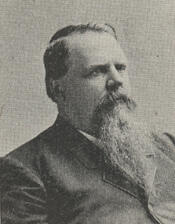
Paul Carrington Edmunds (November 1, 1836 – March 12, 1899) was a Virginia lawyer, Confederate soldier, and Democratic politician who served in the Virginia Senate and represented Virginia in the United States House of Representatives from 1889 to 1895. His congressional service spanned three terms during a significant period in American history, and he contributed to the legislative process as a member of the Democratic Party and as chairman of a key House committee.
Edmunds was born at “Springwood,” a plantation near Halifax Court House, Halifax County, Virginia, to John Richard Edmunds (1812–1873) and the former Mildred Carrington Coles (1820–1880). He was descended from the First Families of Virginia, a lineage that reflected deep roots in the political and social life of the Commonwealth. He grew up alongside his brothers Henry Edmunds (1842–1907) and Edward Carrington Edmunds (1857–1916) in a plantation environment that combined agricultural pursuits with a tradition of public service. Educated initially by a private teacher, he went on to attend the University of Virginia at Charlottesville, where he completed his studies in 1855.
Following his undergraduate education, Edmunds pursued legal training at the College of William and Mary in Williamsburg, Virginia, from which he graduated in 1857. That same year he was admitted to the bar and commenced the practice of law in Jefferson City, Missouri, marking an early professional move beyond his native Virginia. In 1859 he returned to Halifax County, Virginia, where he shifted his focus to agricultural pursuits on his family farm while maintaining his legal skills and local standing. Around this period he married Phoebe Ann Easley (1837–1898); the couple had five sons: James Easley Edmunds (1860–1952), John Richard Edmunds (1863–1902), Paul Carrington Edmunds (1865–1915), William Holt Edmunds (1867–1949), and Henry Hurt Edmunds (1869–1958).
During the American Civil War, Edmunds entered Confederate service, reflecting the allegiance of much of Virginia’s planter and professional class. He served as a first lieutenant in Company A of Montague’s Battalion in the Confederate States Army. His wartime experience, combined with his legal background and family connections, helped position him for a political career in the postwar era, as Virginia navigated Reconstruction and its aftermath.
After the war, Edmunds continued his agricultural and legal activities in Halifax County and gradually entered public life. Halifax County voters elected him to the Virginia State Senate, where he served two terms from 1881 to 1888. In the Senate he represented the interests of his largely rural constituency during a period of political realignment and economic adjustment in the South. His prominence within the Democratic Party grew, and in 1884 he served as a delegate to the Democratic National Convention, participating in the party’s national deliberations and further establishing his credentials as a party leader in Virginia.
Edmunds advanced to national office when he was elected as a Democrat to the Fifty-first Congress, beginning his service in the U.S. House of Representatives on March 4, 1889. He was elected to three consecutive terms, serving in the Fifty-first, Fifty-second, and Fifty-third Congresses, and remained in office until March 3, 1895. In the 1888 election he won his initial seat with 55.6 percent of the vote, defeating Republican Patrick H. Caull and Independent Democrat Samuel T. Hopkins. He was re-elected in 1890 with 92.8 percent of the vote against Republican William J. Shelburne, and again in 1892 with 58.42 percent of the vote, defeating Populist candidate Thomas E. Cobbs. During his tenure, he served as chairman of the Committee on Expenditures in the Department of Agriculture in both the Fifty-second and Fifty-third Congresses, overseeing and scrutinizing federal spending in an area of particular importance to his agrarian district. Throughout his three terms, he participated in the democratic process and represented the interests of his Virginia constituents during a transformative period in American political and economic life. He declined to be a candidate for renomination in 1894, thereby concluding his congressional career.
In his later years, Edmunds returned to private life in Halifax County, remaining closely associated with the community and region that had shaped his career. He died at Houston, Virginia, near Halifax, on March 12, 1899. Paul Carrington Edmunds was interred in the family plot at St. John’s Churchyard in Halifax, Virginia, closing a life that had encompassed service as a Confederate officer, state senator, and United States Representative from Virginia.
Congressional Record