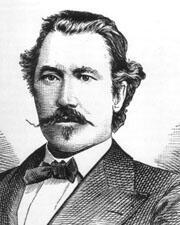
Patrick Walsh, an Irish-born American politician and journalist, served as a United States Senator from Georgia from 1893 to 1895. A member of the Democratic Party, he played a role in the legislative process during a single term in office, representing the interests of his Georgia constituents during a period of significant political and economic change in the post-Reconstruction South. His senatorial service formed only one part of a broader public career that linked journalism, local governance, and national politics.
Walsh was born on January 1, 1840, in Ballingarry, County Limerick, Ireland. He spent his early childhood in Ireland before emigrating with his family to the United States, part of the larger wave of Irish immigration in the mid-nineteenth century. The family settled in the American South, and Walsh’s formative years were shaped by both his Irish heritage and the social and political currents of his adopted country. These early experiences helped prepare him for a public life in which he would often act as a bridge between immigrant communities and the established political order.
After arriving in the United States, Walsh received his education in American schools, where he developed the literacy and rhetorical skills that would later support his work as a journalist and politician. Though detailed records of his formal schooling are limited, his subsequent career in newspaper publishing and public office indicates a solid grounding in the liberal arts and in the civic and political issues of his time. His education, both formal and self-directed, enabled him to participate effectively in public debates and to communicate with a broad readership and electorate.
Walsh’s professional life was closely tied to journalism and politics in Georgia. Settling in Augusta, Georgia, he became a prominent journalist and newspaper figure, using the press as a platform to comment on public affairs and to influence political opinion. His work in journalism brought him into close contact with local and state leaders and helped establish his reputation as a thoughtful and engaged public man. From this base, Walsh entered formal politics, aligning with the Democratic Party, which dominated Southern politics in the late nineteenth century. Over time he emerged as a significant voice in Georgia’s civic life, contributing to discussions on economic development, regional identity, and the role of the South in the reunited nation.
Walsh’s standing in Georgia politics led to his selection as a United States Senator. He served as a Senator from Georgia in the United States Congress from 1893 to 1895, filling a vacancy and thus completing a single term in office. During this period, the nation was grappling with issues such as economic instability, currency debates, and the continuing adjustment to the post-Civil War order. As a member of the Senate, Walsh participated in the democratic process at the national level, contributing to the legislative work of the chamber and representing the interests and perspectives of his Georgia constituents. His service coincided with a significant period in American history, and he took part in deliberations that reflected both regional concerns and national priorities.
After the conclusion of his Senate term in 1895, Walsh returned to his work in Georgia, resuming his role in journalism and public affairs. He remained an influential figure in Augusta and in state politics, continuing to shape opinion through the press and through his ongoing engagement in civic matters. His later years were marked by sustained involvement in the life of his community, drawing on decades of experience in both media and government. Patrick Walsh died on March 19, 1899, in Augusta, Georgia. His career, spanning from immigrant beginnings to service in the United States Senate, reflected the opportunities and complexities of American public life in the late nineteenth century.
Congressional Record