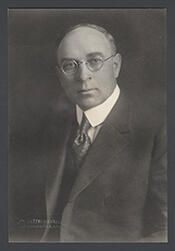
Patrick McLane was born in County Mayo, Ireland, on March 14, 1875. In 1882 he immigrated to the United States with his parents, who settled in Scranton, Lackawanna County, Pennsylvania. Growing up in an industrial city heavily dependent on coal, he entered the workforce at an early age. He worked in the coal mines of Scranton for thirteen years, gaining firsthand experience of the difficult and often dangerous conditions faced by laborers in the region’s dominant industry.
McLane’s formal education is not extensively documented, but his later public roles indicate that he was sufficiently educated to participate actively in civic affairs and Democratic Party politics. His early years in Scranton, combined with his work in the mines and later in the railroad industry, helped shape his understanding of working-class concerns and informed his subsequent public service.
During the Spanish–American War, McLane served in the Eleventh Regiment of the United States Army in 1898 and 1899. Following his military service, he became a locomotive engineer, a skilled and responsible position in the era’s expanding railroad system. His standing in the community grew, and he entered local public life. He was a member of the Scranton School Board from 1904 to 1911, participating in the oversight of public education in the city. He also became active in Democratic Party affairs, serving as a delegate to the Democratic State convention in 1905 and as a member of the Democratic State committee in 1914.
McLane’s political involvement culminated in his election to the United States House of Representatives as a Democrat from Pennsylvania. He presented credentials as a Democratic Member-elect to the Sixty-sixth Congress and was provisionally seated. His term of service in Congress began on March 4, 1919. As a Representative from Pennsylvania and a member of the Democratic Party, he contributed to the legislative process during one term in office, participating in the democratic process and representing the interests of his Scranton-area constituents during a significant period in American history following World War I.
However, McLane’s tenure in Congress was overshadowed by an election contest. The House of Representatives conducted an investigation into the circumstances of his election. The investigation concluded that, in his campaign, McLane had violated the Federal Corrupt Practices Act and that there had been widespread fraud and illegality in the election itself. Once the fraudulent returns were removed from consideration, McLane was found to have lost the election to his Republican opponent, John Richard Farr. As a result, McLane’s service in Congress ended on February 25, 1921, when he was succeeded by Farr, bringing his single term in the House to a close.
After leaving Congress, McLane remained active in politics but was unable to regain a seat in the House of Representatives. He was an unsuccessful candidate for election to Congress in 1922 and again in 1924. At the same time, he continued his career as a locomotive engineer, returning fully to the profession that had sustained him before and during his political life. He remained employed in this capacity in Scranton for the remainder of his working years.
Patrick McLane lived in Scranton until his death. He died there on November 16, 1946, at the age of 71. At the time of his death, he was still identified with the railroad profession that had long defined his civilian career. He was interred in Cathedral Cemetery in Scranton, Pennsylvania. His life reflected the trajectory of an Irish immigrant who rose from coal mining and railroad work to local educational leadership and national office, and whose congressional service, though limited to one contested term, formed part of the broader political history of Pennsylvania in the early twentieth century.
Congressional Record