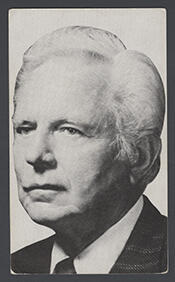
Patrick Gaines Goode (May 10, 1798 – October 17, 1862) was an American lawyer, legislator, jurist, clergyman, educator, and civic leader who represented Ohio in the United States House of Representatives in the mid-nineteenth century. He was born in Cornwall Parish, Charlotte County, Virginia, though some sources give his birthplace as adjacent Prince Edward County. He was a descendant of John Goode of Cornwall, England, who had settled in Virginia prior to 1660, linking him to one of the early colonial families of the region. In 1805 he moved with his parents, Philip and Rebekah (Hayes) Goode, to Wayne County, Ohio, as part of the early wave of migration into the Northwest Territory. The family relocated again in 1814 to Xenia, Ohio, which became the center of Goode’s formative years and early professional development.
Goode’s education combined local instruction with study in one of the nation’s principal cities. In Xenia he attended the Xenia Academy, a leading local institution, before continuing his studies at the Espy school in Philadelphia, Pennsylvania. He then turned to the study of law, reading law under Judge Joshua Collett in Lebanon, Ohio, a common path to the legal profession in the early nineteenth century. After completing his legal training, he was admitted to the bar in 1821, marking the beginning of a long career in law and public service. On July 3, 1822, in Greene County, Ohio, he married Mary Whiteman. The couple had three children: one son, Benedict Whiteman Goode, and two daughters, Catharine Rebekah Goode and Maria Louisa Goode, and his family life remained rooted in western Ohio throughout his career.
Following his admission to the bar, Goode practiced law in several growing communities of the Old Northwest. He first established himself in Madison, Indiana, and later returned to Ohio to practice in Shelby County. His legal work brought him into contact with the issues of land, settlement, and local governance that were central to the development of the region. In 1831 he was appointed a commissioner charged with locating the county seat of the newly organized Allen County, Ohio. In that capacity he had the honor of naming the newly surveyed town. He chose the name Lima, borrowing it from Lima, the capital of Peru, and it was later remarked that “to his last day [he] would not forgive the public for their resolute abandonment of the Spanish pronunciation of the name,” reflecting both his pride in the choice and his sensitivity to language and propriety.
Goode’s growing prominence in local affairs led naturally into legislative service. He was elected to the Ohio House of Representatives in 1833 and 1834, representing his region during a period of rapid growth and political realignment in the state. Within the House he was regarded as a capable parliamentarian and was put forward as a candidate for Speaker, although he was defeated after several ballots. His legislative experience and Whig political affiliation positioned him for national office, and he was elected as a Whig to the Twenty-fifth, Twenty-sixth, and Twenty-seventh Congresses, serving from Ohio’s 3rd congressional district. His service in the U.S. House of Representatives spanned the years of the late 1830s and early 1840s, a time marked by debates over banking, internal improvements, and the evolving balance between federal and state authority. He did not stand for renomination in 1842, choosing instead to return to his legal and judicial pursuits.
In addition to his legislative work, Goode was deeply involved in religious life and education. He was a local preacher in the Methodist Episcopal tradition nearly all his life, combining his legal and political activities with regular ministerial duties. During his congressional career in Washington, D.C., he occupied a pulpit almost every Sunday, reflecting a dual vocation that was unusual even in that era. His reputation for precise knowledge of parliamentary procedure, honed in the legislature and in Congress, made him a valued figure in church governance as well as in civil affairs, and he was frequently called upon to guide deliberations in Methodist conferences and meetings.
Goode’s legal and judicial career reached its peak in the 1840s. In 1844 he became judge for one term of the Court of Common Pleas in the newly created Sixteenth Judicial District of Ohio, which at that time spanned ten counties: Shelby, Mercer, Allen, Hardin, Hancock, Putnam, Paulding, Van Wert, Williams, and Defiance. When the Seventeenth Judicial District was formed in 1848, five of the northern counties were taken from the Sixteenth, but Auglaize County was added to Judge Goode’s circuit. He was regarded as one of the last of the circuit-riding judges, traveling extensively across these largely rural counties to hold court, administer justice, and help establish the rule of law in communities still in the process of formation.
At the conclusion of his term of office in 1851, Judge Goode retired from the active practice of law and entered fully into the Methodist Episcopal clergy as a member of the Central Ohio Conference. He devoted himself to preaching and pastoral work until near the close of his life. During this period he was located for a time at Anna, Ohio, and Wapakoneta, Ohio, continuing to exert influence both as a religious leader and as an experienced public man. His command of parliamentary procedure and legislative practice was shared by so few in the pulpit that he was in great demand at Conferences, where his skills contributed to the orderly conduct of church business.
Patrick Gaines Goode died in Sidney, Ohio, on October 17, 1862, two weeks after attending the Methodist Episcopal Conference at Greenville that year. He was interred in Graceland Cemetery in Sidney. Remembered as a lawyer, legislator, jurist, clergyman, educator, and civic leader, his career reflected the intertwined development of law, politics, religion, and community life in Ohio from the early settlement period through the Civil War era.
Congressional Record