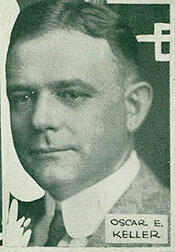
Oscar Edward Keller (July 30, 1878 – November 21, 1927) was a United States Representative from Minnesota who served in Congress from 1919 to 1927. A member of the Republican Party and initially elected as an Independent Republican, he represented a Minnesota district in the U.S. House of Representatives for four consecutive terms during a significant period in American political and economic history following World War I.
Keller was born in Helenville, Jefferson County, Wisconsin, where he attended the local public schools. He later pursued higher education at the University of Wisconsin–Madison, reflecting an early commitment to formal study that preceded his entry into business and public life. At the turn of the twentieth century, in 1901, he moved west to Minnesota and settled in St. Paul, which would remain his home and the center of his political career.
Upon his arrival in St. Paul, Keller was employed as a billing clerk, gaining practical experience in business operations and administration. He subsequently engaged in mercantile pursuits, building a background in commerce that informed his later work in municipal and federal office. In addition to his mercantile activities, he became involved in the real estate business, further broadening his understanding of urban development and local economic conditions in the growing city of St. Paul.
Keller’s public career began in municipal government. He served as a member of the city council of St. Paul from 1910 to 1914, participating in the governance of a major Midwestern city during a period of progressive-era reforms and expanding public services. He then served as a city commissioner from 1914 to 1919 and, concurrently, as commissioner of public utilities from 1914 to 1919. In these roles he was directly involved in the oversight and administration of essential services, including public utilities, at a time when cities were modernizing their infrastructure and regulatory frameworks.
Keller entered national politics in 1919. He was elected as an Independent Republican to the Sixty-sixth Congress to fill the vacancy caused by the death of Representative Carl Van Dyke, thus beginning his service in the U.S. House of Representatives on July 1, 1919. He was subsequently reelected as a Republican to the Sixty-seventh, Sixty-eighth, and Sixty-ninth Congresses, serving continuously until March 3, 1927. During his tenure, he contributed to the legislative process as the nation addressed postwar economic adjustments, transportation issues, and regulatory questions. His most prominent committee role was as chairman of the Committee on Railways and Canals during the Sixty-eighth and Sixty-ninth Congresses, where he helped oversee legislation affecting the nation’s transportation infrastructure at a time when railroads and inland waterways were central to commerce and industry.
After several terms in office, Keller sought to continue his congressional career but was an unsuccessful candidate for renomination in 1926. Following the end of his service in Congress on March 3, 1927, he remained associated with the business pursuits that had long accompanied his public life, including his involvement in real estate in St. Paul.
Oscar Edward Keller died in St. Paul, Minnesota, on November 21, 1927. He was interred in Elmhurst Cemetery in St. Paul. His career reflected a progression from local business and municipal service to national legislative responsibility, marked by his leadership on transportation issues and his representation of Minnesota constituents during a transformative era in American history.
Congressional Record