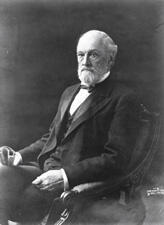
Orville Hitchcock Platt (July 19, 1827 – April 21, 1905) was a United States senator from Connecticut and a prominent conservative Republican leader in the late nineteenth and early twentieth centuries. Born in Washington, Connecticut, he attended the common schools and graduated from The Gunnery in his native town. He studied law in Litchfield, Connecticut, and was admitted to the bar in 1850. Platt initially commenced the practice of law in Towanda, Pennsylvania, but in 1850 he moved to Meriden, Connecticut, where he continued to practice law and established the base of his professional and political career. He later had a son, James Perry Platt, who became a judge of the United States District Court.
Platt’s early public service was rooted in Connecticut state government. He served as clerk of the Connecticut Senate in 1855 and 1856, and in 1857 he held statewide office as Secretary of the State of Connecticut. He was elected a member of the Connecticut Senate in 1861 and 1862, participating in state legislative affairs during the Civil War era. Platt later served in the Connecticut House of Representatives in 1864 and again in 1869, and in the latter year he was chosen speaker of the House, reflecting his growing influence within the state’s Republican Party. Alongside his legislative work, he built a reputation as a capable lawyer and public official.
In the years immediately preceding his election to the United States Senate, Platt held an important legal post at the county level. He served as state’s attorney for New Haven County from 1877 to 1879, a role that further enhanced his standing in Connecticut public life. A committed Republican, he was identified with the conservative wing of the party, and his legal and legislative experience made him a natural candidate for higher office.
Orville Hitchcock Platt served as a senator from Connecticut in the United States Congress from March 4, 1879, until his death on April 21, 1905, a span covering five consecutive terms. Elected as a Republican in 1879, he was re-elected in 1885, 1891, 1897, and 1903, and during this period he contributed significantly to the legislative process and represented the interests of his Connecticut constituents through a time of rapid industrialization, expanding American influence abroad, and major domestic policy debates. His service in Congress occurred during a significant period in American history, and by the 1890s he had become one of the “big four” key Republicans who largely controlled the major decisions of the Senate, alongside William B. Allison of Iowa, John Coit Spooner of Wisconsin, and Nelson W. Aldrich of Rhode Island.
Within the Senate, Platt held a series of influential committee assignments that reflected both his seniority and his policy interests. He served as chairman of the Committee on Patents during the Forty-seventh through Forty-ninth Congresses and again during the Fifty-fourth and Fifty-fifth Congresses, and he was a member of the Committee on Pensions in the Forty-seventh Congress. He also sat on the Committee on Territories from the Fiftieth through the Fifty-second Congresses, playing a role in the oversight of America’s western and territorial development. In the era of American expansion following the Spanish–American War, he served on the Committee on Cuban Relations in the Fifty-sixth through Fifty-eighth Congresses, and near the end of his life he was a member of the Committee on the Judiciary in the Fifty-eighth and Fifty-ninth Congresses. In late 1904 and early 1905, Platt presided in the Senate over the impeachment trial of Judge Charles Swayne, underscoring his stature as a senior legislator.
Platt’s most famous legislative legacy was in foreign policy. On March 1, 1901, the U.S. House of Representatives passed the Army Appropriation Bill with the Platt Amendment as a rider, a provision named for him that governed U.S. relations with Cuba from 1901 to 1934. The amendment defined the terms of Cuban–American relations following the Spanish–American War, including limitations on Cuban treaty-making and provisions for U.S. intervention, and it reflected Platt’s conservative and expansionist outlook. He was also an earnest advocate of abolishing secret executive sessions of the Senate, favoring greater transparency in the conduct of legislative business. At the same time, his domestic voting record placed him firmly in the conservative camp: he voted against the Sherman Antitrust Law, the Eight-Hour Labor Act, and the Anti-Injunction Bill. These positions led labor organizations to denounce him and to regard him as a reactionary, even as he remained a central figure in Republican leadership.
In addition to his work on national legislation, Platt played a notable role in the development of public lands and conservation policy. In 1902, he introduced legislation to establish the 640-acre Sulphur Springs Reservation in Murray County, Oklahoma, then part of Indian Territory, protecting about 30 mineral springs. On June 29, 1906, after his death, Congress redesignated this reservation as Platt National Park in his honor. For many years it remained one of the smallest national parks in the United States until it was abolished as a separate unit and incorporated into the larger Chickasaw National Recreation Area in 1976. The former Platt National Park thus served as a lasting reminder of his role in early federal conservation efforts. Platt was also a Compatriot of the Sons of the American Revolution, reflecting his interest in the nation’s founding heritage.
Platt’s long career brought him recognition from academic and civic institutions. Yale University conferred upon him the honorary degree of Doctor of Laws (LL.D.) in 1887, acknowledging his prominence in national affairs. His influence in the Senate, particularly in the 1890s, was such that he was widely regarded as one of the small group of Republican leaders who shaped the chamber’s major decisions. His reputation as an “old-fashioned senator” was later memorialized in L. A. Coolidge’s 1910 biography, “An Old-Fashioned Senator: Orville H. Platt,” and in the memorial addresses delivered in the House of Representatives and Senate after his death.
Orville Hitchcock Platt died in office on April 21, 1905, at the age of 77, at his summer home, “Kirby Corners,” in Washington, Connecticut. He was interred in the Cemetery on the Green in the same town. His memory continued to be honored in Connecticut; one of the two public high schools in Meriden was named for him when it opened in 1958. Platt’s decades of service in the United States Senate, his leadership within the Republican Party, and his role in shaping both domestic and foreign policy secured him a lasting place in the history of Congress.
Congressional Record