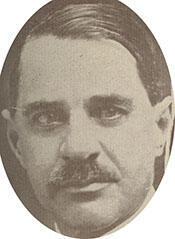
Orsamus Cook Merrill (June 18, 1775 – April 12, 1865) was a U.S. Representative from Vermont and a prominent lawyer, newspaperman, soldier, and public official whose career spanned the early national and antebellum periods. He was born in Farmington in the Connecticut Colony to James and Jerusha Seymour Merrill. He completed his preparatory studies in Farmington, receiving the education typical of a New England youth of the late eighteenth century. In 1791, as a young man of sixteen, he moved to Bennington, Vermont, which would remain his principal home for the rest of his life and the center of his professional and political activities.
Upon settling in Bennington, Merrill apprenticed as a printer, entering a trade that was closely associated with politics and public affairs in the early republic. He became an editor or publisher of several newspapers, including the Vermont Gazette and the Tablet of the Times in Bennington, and later the Berkshire Gazette in Pittsfield, Massachusetts. Through his work in journalism and printing, he helped shape public opinion in Vermont and western Massachusetts during a formative period in the nation’s political development. In the early 1800s he also served as Engrossing Clerk of the Vermont House of Representatives, a position that involved preparing official copies of legislative acts and further acquainted him with the workings of state government.
Merrill subsequently studied law, building on his experience in public life and print culture. He was admitted to the bar in 1805 and commenced practice in Bennington, where he developed a legal career that complemented his growing involvement in public service. That same year, on August 18, 1805, he married Mary Robinson, daughter of Jonathan Robinson, a leading Vermont jurist and politician. The couple had three children. Merrill’s family was closely connected to Vermont’s political establishment: his brother Timothy Merrill served as Vermont Secretary of State from 1831 to 1836, and his nephew Farrand F. Merrill, Timothy’s son, held the same office from 1849 to 1853. From 1809 to 1812, Orsamus Cook Merrill served as Postmaster of Bennington, an important local federal appointment that underscored his standing in the community and his ties to the national administration.
During the War of 1812, Merrill served in the United States Army in upstate New York and Vermont, where he saw duty in defense of the northern frontier. He held the rank of major in the 11th Infantry Regiment and was later promoted to lieutenant colonel in the 26th Infantry and again in the 11th Infantry, reflecting the confidence placed in his leadership. When Merrill received promotion to lieutenant colonel in the 26th Infantry, his replacement as major in the 11th Infantry was Zachary Taylor, who was promoted from captain in the 7th Infantry and would later become the twelfth president of the United States. Merrill’s military service during this conflict added to his public reputation and provided him with further experience in national affairs at a time when the young republic was asserting its independence and security.
After the war, Merrill continued his legal and public service career in Vermont. In 1815 he became Register of Probate for Bennington County, and in 1816 he was appointed Clerk of the Courts, positions that placed him at the center of the county’s judicial administration. His growing prominence led to his election to the United States House of Representatives. Merrill was elected as a Democratic-Republican candidate to the Fifteenth Congress, serving from March 4, 1817, until March 3, 1819. He presented credentials as a Member-elect to the Sixteenth Congress and served from March 4, 1819, until January 12, 1820, when he was succeeded by Rollin C. Mallary, who successfully contested the election. As a member of the Republican (Democratic-Republican) Party representing Vermont, Merrill contributed to the legislative process during two terms in office, participating in the democratic process and representing the interests of his constituents during a significant period in American history marked by postwar expansion and the early stirrings of sectional and party realignment.
Merrill remained active in politics after his congressional service, although he never again returned to the U.S. House. He was an unsuccessful candidate for Congress in 1822, 1826, 1827, 1830, 1832, and 1833, a pattern that reflected the shifting political landscape in Vermont as the state moved away from the Democratic-Republicans and their successors and trended toward, in succession, the Anti-Masonic Party, the Whig Party, and eventually the emerging Republican Party. Despite these electoral defeats at the federal level, Merrill continued to hold important offices in state and local government. In 1822 he served as a delegate to the Vermont constitutional convention, taking part in the revision of the state’s fundamental law. He was a member of the Vermont House of Representatives from 1822 to 1823, representing his community in the lower house of the state legislature.
In addition to his legislative roles, Merrill held several key judicial and executive positions in Vermont. He served as Bennington County’s State’s Attorney from 1823 to 1825, prosecuting criminal cases on behalf of the state. From 1824 until 1827 he was a member of the Governor’s Council, an influential advisory and executive body in Vermont’s government. He later became a member of the first Vermont State Senate after that body was created in 1836, underscoring his continued relevance in state politics as Vermont’s institutions evolved. From 1841 to 1847 he served as county Judge of Probate, overseeing the administration of estates and guardianships in Bennington County. In 1839 he ran unsuccessfully for lieutenant governor, another indication of his ongoing ambition and prominence within the Democratic ranks, even as the state’s electorate increasingly favored rival parties.
Orsamus Cook Merrill lived to an advanced age, witnessing the transformation of the United States from a young republic to a nation on the brink of the Civil War’s conclusion. He died in Bennington, Vermont, on April 12, 1865, the town where he had first arrived as a printer’s apprentice in 1791 and where he had built his multifaceted career as editor, lawyer, soldier, legislator, and judge.
Congressional Record