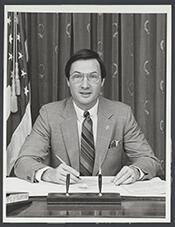
Oren Sturman Copeland (March 16, 1887 – April 10, 1958) was an American Republican Party politician who served one term in the U.S. House of Representatives from 1941 to 1943. He was born on a farm near Huron, Beadle County, South Dakota, on March 16, 1887. In 1891 he moved with his parents to Pender, Thurston County, Nebraska, where he was raised. His early years in the rural Midwest shaped his familiarity with agricultural and small-town concerns that would later inform his public service.
Copeland attended the public schools and went on to study at the University of Nebraska in Lincoln from 1904 to 1907. Although he did not complete a degree, his years at the university brought him into closer contact with the political and civic life of the state capital. After leaving the university, he remained in Lincoln and entered the workforce in a variety of positions that reflected the city’s growing commercial and industrial base.
By 1910 Copeland was employed at a Lincoln newspaper, gaining experience in communications and public affairs at a time when print journalism was central to political discourse. He soon moved into the private business sector, working in the fuel trade and related enterprises. In 1913 he was employed at a gas station, an occupation that connected him to the emerging automobile economy and the retail fuel business in which he would remain involved throughout much of his life. His engagement with Republican politics developed alongside his business activities, and he served as a delegate to the 1912 Republican National Convention, an early indication of his prominence within the party in Nebraska.
Copeland’s formal political career began at the municipal level in Lincoln. He was elected city commissioner in charge of the department of public safety, serving from 1935 to 1937. In that capacity he oversaw police, fire, and related public safety functions during the later years of the Great Depression, gaining administrative experience and a reputation as a capable local official. In 1937 he was elected mayor of Lincoln, advancing from commissioner to the city’s chief executive. His tenure as mayor further increased his visibility and influence within Nebraska’s Republican Party and provided a platform for higher office.
Resigning as mayor to pursue national office, Copeland became a candidate for Congress in 1940. Running as a Republican from Nebraska, he was elected to the Seventy-seventh United States Congress and served one term from January 3, 1941, to January 3, 1943. His service in Congress occurred during a significant period in American history, encompassing the nation’s entry into World War II following the attack on Pearl Harbor. As a member of the Republican Party representing Nebraska, Copeland contributed to the legislative process during his single term in office, participating in the democratic process and representing the interests of his constituents in a time of rapid mobilization and change.
In 1942 Copeland sought renomination but was unsuccessful in securing his party’s nomination for another term. After leaving Congress in January 1943, he returned to private life and resumed his work in the retail fuel business, drawing on the experience he had accumulated in that field before his congressional service. He remained in Lincoln, where he continued to be identified with both his business interests and his earlier record in public office.
Oren Sturman Copeland died in Lincoln, Lancaster County, Nebraska, on April 10, 1958. He was interred in Wyuka Cemetery in Lincoln, a burial place for many of the city’s and state’s notable figures. His career spanned journalism, business, municipal administration, and national legislative service, reflecting the trajectory of a Midwestern Republican politician who rose from rural beginnings to serve in the U.S. House of Representatives during a critical era in American history.
Congressional Record