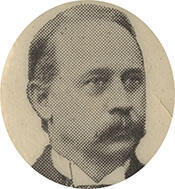
Norton Prentiss Otis (March 18, 1840 – February 20, 1905) was a Republican member of the United States House of Representatives from New York who served one term in Congress from 1903 to 1905. His congressional service occurred during a significant period in American history at the turn of the twentieth century, when industrial expansion, urban growth, and emerging national power shaped the legislative agenda. As a member of the House of Representatives, he participated in the democratic process and represented the interests of his constituents in New York’s 19th congressional district.
Otis was born on March 18, 1840, in Halifax, Vermont. He was the son of Elisha Otis, the inventor of the safety elevator, and a descendant of the prominent Otis family associated with the Boston Brahmin elite. Growing up in a family closely tied to American industrial innovation, he was exposed early to the world of manufacturing and commerce. He attended public schools in Halifax, Vermont, and later in Albany, Hudson, and Yonkers, New York, receiving a practical education that prepared him for a career in business and public life.
In his early youth, Otis entered into business with his father and became engaged in the manufacture of elevators, a field in which the Otis name would become internationally recognized. He devoted nearly fifty years to this enterprise, helping to develop and expand the elevator industry that was essential to the growth of modern urban architecture and commerce. His long involvement in manufacturing provided him with substantial experience in industrial management and economic affairs, which later informed his public service at the local, state, and national levels.
Otis’s political career began in municipal government in Yonkers, New York, where he became a leading civic figure. He served as mayor of Yonkers from 1880 to 1882, a period during which the city was experiencing rapid growth and modernization. His tenure as mayor reflected his interest in local governance and public institutions, and he remained active in Yonkers civic life for many years. He also served as president of St. John’s Riverside Hospital of Yonkers, underscoring his engagement with public health and charitable work in his community.
Building on his local experience, Otis entered state politics and was elected to the New York State Assembly as a Republican, representing Westchester County’s 1st District in 1884. In the Assembly he participated in state-level legislative deliberations during a time when New York was a center of industry, finance, and immigration. His state service, combined with his business background, positioned him as a figure who could bridge the concerns of industry, local government, and state policy.
Otis sought national office at the dawn of the new century. In 1900 he served as president of the New York State Commission to the Exposition Universelle of 1900 in Paris, reflecting his prominence in state affairs and his connection to international exhibitions that showcased industrial and technological progress. That same year he was an unsuccessful Republican candidate for election to the Fifty-seventh Congress. Undeterred, he continued his political efforts and was later elected as a Republican to the Fifty-eighth United States Congress, representing New York’s 19th congressional district. His term began on March 4, 1903, and during his time in the House of Representatives he contributed to the legislative process and represented the interests of his constituents during a transformative era in American politics and industry.
Otis’s service in Congress was cut short by illness. He died in office from cancer in Westchester County, New York, on February 20, 1905, while still serving in the Fifty-eighth Congress. His death placed him among the members of the United States Congress who died in office in the early twentieth century. He was interred at Oakland Cemetery in Yonkers, New York, a city with which he had been closely associated throughout his life. Otis was also related to the pioneering aviator Amelia Earhart, linking his family to another notable figure in American technological and exploratory history.
Congressional Record