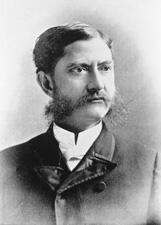
Newton Crain Blanchard (January 29, 1849 – June 22, 1922) was a United States representative, U.S. senator, and the 33rd governor of Louisiana. A member of the Democratic Party, he served in both houses of Congress and later on the Louisiana Supreme Court, playing a prominent role in state and national politics during the late nineteenth and early twentieth centuries. His service in Congress occurred during a significant period in American history, and as a member of the Senate he participated in the democratic process and represented the interests of his Louisiana constituents.
Blanchard was born in Rapides Parish in central Louisiana on January 29, 1849. He completed his early academic studies in Louisiana before turning to the law. In 1868 he began the study of law in Alexandria, Louisiana, and subsequently enrolled at the law department of the University of Louisiana in New Orleans, which later became Tulane University Law School. He graduated from that institution in 1870. The following year, in 1871, he was admitted to the bar and commenced the practice of law in Shreveport, Louisiana, where he quickly established himself in the legal profession. His early involvement in public affairs was marked by his service as a delegate to the Louisiana state constitutional convention of 1879, an experience that introduced him to statewide political life.
In his personal life, Blanchard married Mary Emma Barrett in 1873. She was the daughter of Captain William W. Barrett, an officer in the Confederate Army, reflecting the strong ties of many Louisiana political families to the Confederacy in the post–Civil War era. The couple’s daughter, Mary Ethel Blanchard, later married Leonard Rutherford Smith, further extending the family’s social and professional connections. Throughout his rising political career, Blanchard maintained his residence and legal practice in Shreveport, which served as his home base for much of his public life.
Blanchard entered national politics as a Democrat when he was elected to the United States House of Representatives. He was chosen to represent Louisiana in the 47th Congress and was reelected to the six succeeding Congresses, serving from March 4, 1881, until his resignation, effective March 12, 1894. Over these seven consecutive terms in the House, he contributed actively to the legislative process during a period of rapid economic and social change in the United States. While in the House of Representatives, he rose to a position of influence as chairman of the Committee on Rivers and Harbors during the Fiftieth through Fifty-third Congresses, where he played a key role in shaping federal policy on internal improvements and navigation, matters of particular importance to a riverine and coastal state such as Louisiana.
Blanchard’s congressional career continued in the United States Senate. He was appointed, and subsequently elected, as a Democrat to the Senate to fill the vacancy caused by the resignation of Senator Edward Douglass White, who had been appointed to the United States Supreme Court. Blanchard served as a senator from Louisiana from March 12, 1894, to March 3, 1897. During his tenure in the Senate, he was chairman of the Committee on Improvement of the Mississippi River and its Tributaries in the Fifty-third Congress, reflecting his continued focus on river and harbor development and flood control. He was not a candidate for a full Senate term in 1896, and his service in the upper chamber concluded at the expiration of his appointed and elected term in 1897.
After leaving the Senate, Blanchard returned to Louisiana and continued his public service in the judiciary. He was elected an associate justice of the Louisiana Supreme Court and served on that court from 1897 to 1903. His tenure on the state’s highest court coincided with a period of significant legal and constitutional development in Louisiana, and he resigned from the bench in 1903 as his political career again turned toward executive office. In 1904 he became the Democratic nominee for governor of Louisiana and was elected the 33rd governor, serving from 1904 to 1908. As governor, he pursued a program of reforms, including the introduction of a minimum wage law, and he oversaw administrative and military appointments such as naming Sheriff David Theophilus Stafford of Rapides Parish—son of Confederate Brigadier General Leroy Augustus Stafford—as Louisiana adjutant general.
Blanchard’s influence extended beyond state boundaries during his gubernatorial period and immediately afterward. Notably, he represented Louisiana at President Theodore Roosevelt’s White House Conference of Governors in 1908, a major national gathering on conservation and resource management. Although his term as governor had ended only a day earlier, he attended the conference and introduced a resolution calling for each state to create a commission for the conservation of natural resources. The resolution was unanimously approved, and Louisiana became the first state to establish such a commission, underscoring Blanchard’s role in the early conservation movement. After completing his term as governor, he resumed the practice of law in Shreveport, continuing to be an influential figure in legal and political circles.
In his later years, Blanchard remained engaged in constitutional and governmental reform in Louisiana. In 1913 he again served as a member of the Louisiana state constitutional convention, this time as its president, reflecting the high regard in which he was held by his contemporaries and his long experience in legislative, judicial, and executive roles. Newton Crain Blanchard died in Shreveport, Louisiana, on June 22, 1922. He was interred at Greenwood Cemetery in Shreveport, closing a public career that had spanned more than four decades and had included service as a United States representative, U.S. senator, state supreme court justice, and governor of Louisiana.
Congressional Record