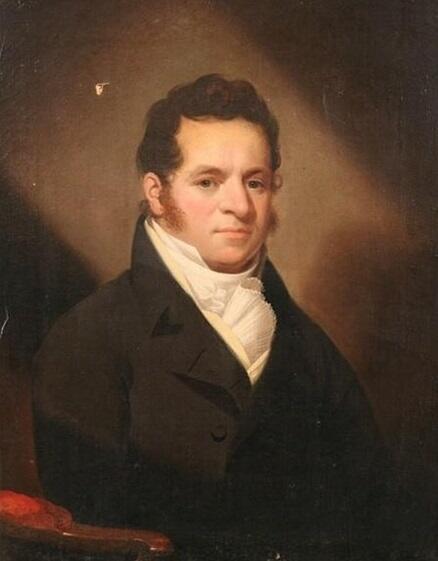
Nathaniel Allen (1780 – December 22, 1832) was an American politician and a United States Representative from New York. A member of the Republican Party, more specifically the Democratic-Republican Party of his era, he served one term in Congress during a significant period in early American history, participating in the legislative process and representing the interests of his constituents in western New York.
Allen was born in 1780, the second son of Moses Allen and Chloe Ward Allen, in what is now East Bloomfield, Ontario County, New York, before the formal establishment of the town. He attended the common schools available in the region, receiving a basic education typical of rural New York in the late eighteenth century. In his personal life, he married Hilzibeth Akin, with whom he had four children: Nathaniel, John, Hilzebeth, and Almira. His wife Hilzibeth died in 1826, leaving him a widower with their surviving children.
In his early working life, Allen learned and practiced the trade of blacksmithing. He worked as a blacksmith in Canandaigua, New York, an important local center in Ontario County, before establishing his own blacksmith shop in 1796 at Richmond, near the area known as Allens Hill. His growing prominence in the community led to his appointment as postmaster in what is now Honeoye Falls on July 1, 1811, a position that placed him at the center of local communications and commerce in the years leading up to the War of 1812.
Allen’s public service expanded significantly during the War of 1812 and the subsequent decade. In 1812 he served as a commissioner and paymaster on the Niagara frontier, a critical theater of the war along the border with British Canada. He also held a commission as a militia officer during the War of 1812, as did his brother, Peter Buell Allen, reflecting the family’s active participation in the defense of the region. That same year, 1812, he was elected to the New York State Assembly, marking his formal entry into elective office at the state level. He later served as Sheriff of Ontario County, New York, from 1814 to 1819, a role that combined administrative, judicial, and law-enforcement responsibilities in a rapidly developing part of the state.
Elected as a Democratic-Republican to the Sixteenth Congress, Allen represented New York’s twenty-first congressional district in the United States House of Representatives from March 4, 1819, to March 4, 1821. During his single term in Congress, he served as a member of the Republican Party in its early national form and contributed to the legislative process at a time when the young republic was addressing issues of postwar expansion, internal improvements, and the evolving balance between state and federal authority. Although specific details of his committee assignments and floor activity are not extensively documented, his service placed him among the cohort of frontier and upstate New York representatives who advocated for the interests of their growing communities. He was not a candidate for renomination in 1820 and returned to New York at the conclusion of his term.
After leaving Congress, Allen continued to play an active role in local affairs. He served as Supervisor of the Town of Richmond, further cementing his long-standing connection to the community where he had established his blacksmith business decades earlier. In his later years, he engaged in the prosecution of claims for money due in connection with the construction of the Louisville & Portland Canal, a major internal improvement project on the Ohio River that was intended to facilitate navigation around the Falls of the Ohio and promote regional commerce.
Nathaniel Allen died while conducting business related to these claims at the Galt House hotel in Louisville, Kentucky, on December 22, 1832, at about 52 years of age. His body was returned to New York, and he was interred at Allens Hill Cemetery in Richmond, New York, in the community where he had lived, worked, and held local office for much of his life.
Congressional Record