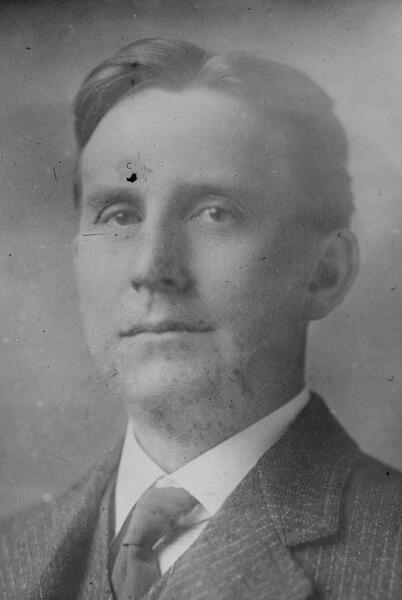
Nathan Edward Kendall (March 17, 1868 – November 5, 1936) was an American Republican politician who served as a two-term U.S. Representative from Iowa’s 6th congressional district from 1909 to 1913 and as the 23rd Governor of Iowa from 1921 to 1925. A member of the Republican Party, he contributed to the legislative process during two terms in the United States Congress and later played a central role in restructuring Iowa’s state government in the early twentieth century.
Kendall was born on a farm near Greenville, Iowa, on March 17, 1868, the youngest of six children of Elijah J. Kendall and Lucinda (Stevens) Kendall. His parents were originally from Indiana and had moved to Iowa in 1852, joining the wave of mid-nineteenth-century settlers transforming the state’s agricultural landscape. He attended rural schools until the eighth grade, receiving a basic country education typical of the period. As a young man, he moved to Albia, Iowa, where he began to pursue a legal career at an unusually early age.
At fifteen, Kendall began reading law in Albia while working as a stenographer in a law office, following the then-common practice of legal apprenticeship rather than formal law school. He was admitted to the bar in May 1889 and commenced the practice of law in Albia that same year. On April 20, 1896, he married Belle Wooden, a schoolteacher, beginning a partnership that would continue through his rise in public life. His early legal work and growing reputation in Monroe County provided the foundation for his entry into elective office.
Kendall’s public career began at the local level. He served as city attorney of Albia from 1890 to 1892, and then as Monroe County Attorney from 1893 to 1897, positions in which he gained experience in municipal and county governance as well as courtroom practice. In 1899, he was elected to the Iowa House of Representatives. He served there for ten years, during which he became one of the more influential members of the body and ultimately rose to the position of Speaker of the House in his final term. His decade of legislative service in Des Moines established him as a prominent Republican figure in state politics and prepared him for national office.
In 1908, Kendall ran as the Republican candidate for the U.S. House of Representatives from Iowa’s 6th congressional district, challenging incumbent one-term Democrat Daniel W. Hamilton. In a close race, he defeated Hamilton and entered the 61st Congress. He was re-elected in 1910, serving in the 62nd Congress. In all, he served in Congress from March 4, 1909, to March 3, 1913. During this significant period in American history, marked by the Progressive Era’s reform movements and debates over regulation and economic policy, Kendall participated in the democratic process and represented the interests of his Iowa constituents as a member of the House of Representatives. He won the Republican primary in June 1912 over two challengers, but after suffering a heart attack in August 1912, he withdrew from the race and did not seek re-election. After returning from Washington, he resumed the practice of law in Albia.
Kendall returned to statewide prominence in 1920, when he was elected Governor of Iowa as a Republican, defeating Democrat Clyde L. Herring, who would himself later become governor. Kendall served two terms as governor, from 1921 to 1925. His administration was notable for a broad restructuring of state government, including the reorganization of overlapping state boards, bureaus, and commissions in an effort to streamline administration and improve efficiency. Under his leadership, the Iowa Department of Agriculture was established, consolidating and replacing five separate state boards. His tenure also saw the imposition of licensing and assessment requirements on security brokers, the expansion of protections and financial support for orphaned, handicapped, and abused children, and significant development of the state’s park and highway systems. Kendall regarded as his proudest achievement a $2.25 million appropriation to fully fund the University of Iowa College of Medicine hospital, a major investment in the state’s medical education and public health infrastructure.
Kendall’s later years were marked by philanthropy and personal loss. In 1930, he donated his private library of between 6,500 and 7,000 volumes to the City of Albia, along with funds of $10,000 to double the capacity of the local library, reflecting his long-standing interest in education and public institutions. His first wife, Belle, died on March 18, 1926, in Naples, Italy, after suffering a stroke while the couple was on a tour of Europe. In her memory, Kendall contributed to the establishment of the Belle Kendall Community Playhouse in Des Moines, which was named in her honor. On June 28, 1928, he married Mabel Fry Bonnell, the widow of William Bonnell, in a ceremony at her parents’ home in Point Chautauqua, New York.
In his final years, Kendall resided in Des Moines, Iowa, remaining a respected figure in state political and civic circles. He died there on November 5, 1936. His remains were cremated, and his ashes were interred on the lawn of “Kendall Place,” his former home in Albia, symbolically returning him to the community where his legal and political career had begun.
Congressional Record