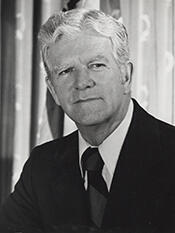
Muscoe Russell Hunter Garnett (July 25, 1821 – February 14, 1864) was a nineteenth-century politician and lawyer from Virginia who served in both the U.S. House of Representatives and the Confederate States House of Representatives. He was born on his family’s “Elmwood” estate near Loretto, Essex County, Virginia, into the First Families of Virginia. His parents were James Mercer Garnett and Maria (née Hunter) Garnett. Garnett’s father died in 1824, when Muscoe was still a small child, and he was thereafter raised principally by his grandfather, James M. Garnett, and his aunts. His extended family was deeply involved in public life; among his close relatives were his uncle, the prominent Virginia statesman Robert Mercer Taliaferro Hunter, and the congressman Robert Garnett.
Garnett received a private education appropriate to his social standing, studying under tutors before pursuing higher education. He attended the University of Virginia, where he studied law and received his law degree in 1842. That same year he was admitted to the Virginia bar and commenced the practice of law in Loretto, following the professional path of his father. His legal practice, based in his native Essex County, formed the foundation of a career that would increasingly draw him into state and national politics.
By mid-century, Garnett had emerged as an active participant in Virginia’s political life. He was elected a delegate to the Virginia Constitutional Convention of 1850–1851, where he aligned with eastern, slaveholding interests and opposed expansion of the electorate, fearing that a broader franchise and the resulting political shifts would encourage internal improvements and policies favoring the more populous and less slave-dependent western counties. In 1850 he authored a pamphlet entitled The Union, Past and Future; how it works and how to save it. By a Citizen of Virginia, in which he examined the relationship between slavery and the national government and argued from a Southern, pro-slavery constitutional perspective. Garnett further solidified his role in Democratic Party politics as a Virginia delegate to the Democratic National Conventions of 1852 and 1856. He served in the Virginia House of Delegates from 1853 to 1856, representing his home region in the state legislature, and was a member of the Board of Visitors of the University of Virginia from 1855 to 1859, maintaining close ties to his alma mater.
In national politics, Garnett was elected as a Democrat from Virginia’s 1st Congressional District to the 34th Congress in a special election held in 1856 to fill the vacancy caused by the death of Representative Thomas H. Bayly. In that contest he received 51.58 percent of the vote, defeating American Party candidate Robert Saunders. He was subsequently reelected to the 35th Congress in 1857 with 57.08 percent of the vote, defeating American John Critcher, and was reelected unopposed to the 36th Congress in 1859. Garnett served in the U.S. House of Representatives from December 1, 1856, to March 3, 1861, completing three terms in office. As a member of the Democratic Party representing Virginia, he contributed to the legislative process during a period of mounting sectional tension, participating in debates over slavery, states’ rights, and the future of the Union, and representing the interests of his constituents in eastern Virginia. He left Congress at the outbreak of the Civil War, as Virginia moved toward secession.
With his sympathies firmly aligned with the South, Garnett became a delegate to the Virginia secession convention in 1861 and then to the state constitutional convention held that same year, where he supported the state’s withdrawal from the Union and the reorganization of its government under the Confederacy. Following Virginia’s secession, he continued his political career at the national level of the new Confederate government. From 1862 to 1864, he served as a member of the First Confederate Congress, representing Virginia in the Confederate States House of Representatives. During this period, his uncle Robert M. T. Hunter served first as Confederate States Secretary of State and later as a Confederate senator, underscoring the family’s prominent role in the leadership of the Confederacy.
Garnett’s personal life intersected with notable American families as well. On July 26, 1860, he married Mary Picton Stevens (1840–1903), the daughter of New Jersey industrialist and philanthropist Edwin Augustus Stevens. The couple had two children: a son, James Mercer Garnett, born July 7, 1861, and a daughter, Mary Barton Picton Garnett, born May 28, 1863. After Garnett’s death, his widow married Edward Parke Custis Lewis, a diplomat and great-great nephew of George Washington, further linking the Garnett family to prominent national lineages.
While attending the Confederate Congress in early 1864, Garnett contracted typhoid fever. His health declined rapidly, and he returned to his family home. He died at “Elmwood” on February 14, 1864, at the age of forty-two, and was buried in the family cemetery on the estate. In later years, recognition of the historical significance of his ancestral home led to “Elmwood” being listed on the National Register of Historic Places in 1970. Garnett’s career, spanning service in the Virginia House of Delegates, the U.S. House of Representatives from 1856 to 1861, and the Confederate States House of Representatives from 1862 to 1864, placed him at the center of some of the most consequential political conflicts in American history.
Congressional Record