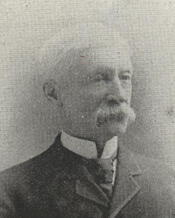
Moses Tyler Stevens (October 10, 1825 – March 25, 1907) was an American textile manufacturer, banker, and Democratic U.S. Representative from Massachusetts who served in Congress from 1891 to 1895. He was born in North Andover (then a part of Andover), Essex County, Massachusetts, the son of textile manufacturer Nathaniel Stevens. He was part of a politically prominent New England family: his brother Charles Abbot Stevens and his cousin Isaac Ingalls Stevens both served as U.S. Representatives, the latter also becoming the first governor of Washington Territory.
Stevens was educated in the public schools of North Andover and attended Franklin Academy. He then studied at Phillips Academy in Andover, from which he graduated in 1842. Later that year he entered Dartmouth College in Hanover, New Hampshire, and remained there for one year, attending during 1842 and 1843. Leaving college to enter business, he returned to North Andover to join his father’s woolen goods manufacturing enterprise, gaining practical experience in the textile industry that would shape his career.
By 1850 Stevens had become a partner in his father’s firm, which operated under the name Nathaniel Stevens & Son in North Andover. He married Charlotte Emeline Osgood in 1853, and the couple had three sons and three daughters. As the textile business grew, Stevens emerged as a leading manufacturer in the region. In 1876 the firm of Nathaniel Stevens & Son was dissolved, and Stevens and his brothers continued the family’s textile operations separately. His three sons—Nathaniel, Samuel, and Moses—entered the business as partners in 1886, at which time the firm took the name M. T. Stevens & Sons, reflecting the continuation of the enterprise into a second generation.
Alongside his manufacturing interests, Stevens became active in public affairs and finance. He served as a member of the Massachusetts House of Representatives in 1861, participating in state governance at the outset of the Civil War. In 1868 he served in the Massachusetts State Senate, taking part in the work of the 89th Massachusetts General Court. He also held the presidency of the Andover National Bank, a position that underscored his standing in the local business community and his influence in regional financial matters.
Stevens’s state-level experience and prominence in industry and banking led to his election to the national legislature. A member of the Democratic Party, he was elected as a Democrat to the Fifty-second and Fifty-third Congresses and served as a Representative from Massachusetts in the United States Congress from March 4, 1891, to March 3, 1895. During his two terms in office, he contributed to the legislative process and represented the interests of his constituents during a significant period in American history marked by debates over tariffs, monetary policy, and industrial regulation. While in the House of Representatives, Stevens served as a member of the influential Committee on Ways and Means, which oversaw taxation and revenue measures and played a central role in shaping national economic policy. He was not a candidate for renomination in 1894 to the Fifty-fourth Congress, concluding his congressional service after two terms.
After retiring from Congress, Stevens resumed his interests in the manufacturing business, returning to the management of M. T. Stevens & Sons and maintaining his role as a leading figure in the textile industry of northeastern Massachusetts. He continued to reside in North Andover, where his estate, known as Osgood Hill, became a notable local landmark. Stevens died in North Andover on March 25, 1907, and was interred in Ridgewood Cemetery. In the years following his death, Osgood Hill was preserved from destruction and came under the ownership of the town of North Andover. Now listed on the National Register of Historic Places, the estate serves as a conference center, reflecting both the historical significance of Stevens’s life and the enduring legacy of his presence in the community.
Congressional Record