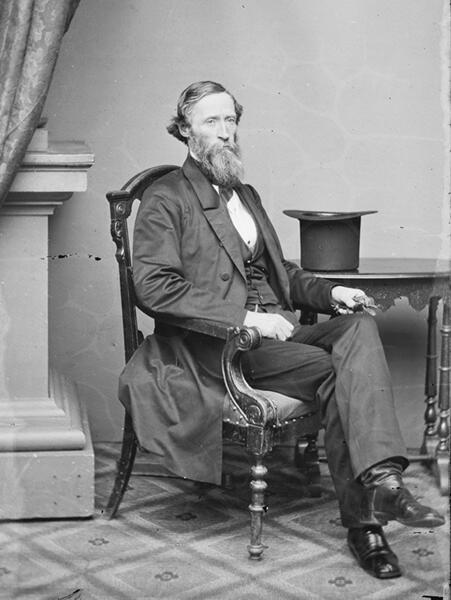
Moses Kimball Armstrong (September 19, 1832 – January 11, 1906) was an American surveyor, newspaper editor, territorial legislator, and Democratic delegate from Dakota Territory to the United States House of Representatives. He was born in Milan, Erie County, Ohio, where he spent his early years before pursuing formal education. Armstrong attended the Huron Institute in Milan and later studied at Western Reserve College in Cleveland, Ohio, receiving the academic training that would support his later work in surveying, public affairs, and politics.
In 1856 Armstrong moved west to the Minnesota Territory, part of the broader mid-nineteenth-century migration into the Upper Midwest. Soon after his arrival he was elected surveyor of Mower County, Minnesota, and was assigned to survey federal lands. This work placed him at the center of the region’s development, as accurate land surveys were essential to settlement, land sales, and the organization of local government. His experience as a surveyor would remain a defining feature of his career and later public service.
When Minnesota was admitted to the Union in 1858, Armstrong relocated further west to Yankton in Dakota Territory, then a small Native American village that was emerging as a focal point of territorial administration and settlement. He quickly became active in territorial politics. In 1861 he was elected to the first Territorial House of Representatives of Dakota Territory, and he was reelected in 1862 and 1863. During the 1863 session he served as speaker of the territorial House, reflecting the confidence his colleagues placed in his leadership and parliamentary abilities.
Armstrong’s public activities in Dakota Territory extended beyond legislative service. In 1864 he became editor of the Dakota Union newspaper, a position that allowed him to shape public opinion and report on the rapid political and economic changes in the territory. The following year, in 1865, he was appointed clerk of the territorial Supreme Court, further integrating him into the legal and institutional framework of Dakota’s government. He was elected to the territorial council, the upper chamber of the legislature, in 1866 and 1867, and during this period he served as president of the council, presiding over its deliberations at a time of expansion and reorganization in the territory.
In 1867 Armstrong also served as secretary of the Indian peace commission in Dakota Territory, participating in efforts to negotiate and maintain peace between the United States government and Native American nations amid ongoing tensions on the frontier. Continuing his professional work as a surveyor, he established the great meridian and standard lines for United States surveys in southern Dakota and in the northern Red River Valley, work that provided the foundational grid for subsequent land division and settlement. He was again elected to the territorial council in 1869, underscoring his sustained influence in territorial governance.
Armstrong’s territorial career led naturally to national office. As a member of the Democratic Party representing Dakota Territory (DK), he was elected in 1870 as a Democratic delegate to the United States House of Representatives. He was reelected in 1872 and served two terms in Congress from March 4, 1871, to March 3, 1875. During these years he contributed to the legislative process at a significant period in American history, participating in the democratic process during the post–Civil War and Reconstruction era and representing the interests of his constituents in Dakota Territory. As a non-voting delegate, he advocated for territorial concerns such as land policy, infrastructure, and governance, working to secure recognition and support for the developing region.
In 1874 Armstrong was an unsuccessful candidate for reelection to Congress. After leaving federal office in 1875, he moved to St. James, Watonwan County, Minnesota. There he turned to private enterprise, engaging in banking and real estate, activities that reflected both his familiarity with land and development issues and the economic opportunities of a growing Midwestern state. His later years were spent in Minnesota, where he remained connected to the communities shaped in part by the surveys and policies he had helped to advance.
Moses Kimball Armstrong died on January 11, 1906, in Albert Lea, Minnesota. He was interred in Lakewood Cemetery in Minneapolis, Minnesota. His career spanned surveying, journalism, territorial governance, and national legislative service, marking him as a significant figure in the political and developmental history of Dakota Territory and the Upper Midwest.
Congressional Record