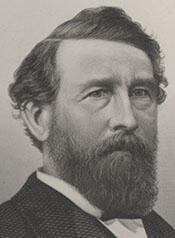
Morton Craig Hunter (February 5, 1825 – October 25, 1896) was an American lawyer, Union Army officer during the Civil War, and Republican politician who served as a U.S. Representative from Indiana for four terms between 1867 and 1879. He was born in Versailles, Indiana, where he experienced the hardships of life in a pioneer home. His family background was steeped in military service: his father, John Hunter, served as a soldier in the War of 1812, and his Scottish immigrant grandfather had fought in the American Revolutionary War. These early influences, combined with the rigors of frontier life, helped shape his sense of duty and public service.
Hunter pursued higher education in law and attended Indiana University at Bloomington. He graduated from the law department of Indiana University in 1849. Immediately upon completing his legal studies, he married and began the practice of law in Bloomington, Indiana. Establishing himself as an attorney in the growing community, he soon entered public life. In 1858 he was elected to represent Monroe County in the Indiana State House of Representatives, marking his first significant role in elective office and providing him with legislative experience that would later inform his service in Congress.
With the outbreak of the American Civil War, Hunter responded to President Abraham Lincoln’s call for volunteers. In the summer of 1862 he organized the 82nd Indiana Infantry, drawing heavily on his leadership skills and local standing. On August 27, 1862, he was commissioned a colonel of volunteers by Indiana Governor Oliver P. Morton. Under his command, the 82nd Indiana Infantry saw hard service in the Western Theater. At the Battle of Chickamauga in September 1863, when Confederate General James Longstreet’s assault routed the right wing of the Union Army of the Cumberland, Hunter, acting on his own initiative, was the first officer to form a new defensive position on Horseshoe Ridge. This line became the critical position that helped save the Union army from destruction. His commanding officer, John Connell, later wrote of Hunter’s stubborn resistance on that ridge, crediting his actions with “truly and most fortunately” changing the fortunes of that disastrous day and saving the army from worse than defeat.
Hunter further distinguished himself at the Battle of Missionary Ridge in November 1863. There, his regiment, the 82nd Indiana, together with the 99th Ohio, formed part of the initial assault on the Confederate center under General Braxton Bragg. They were ordered to halt after taking the Confederate line at the base of Missionary Ridge, but, exposed to heavy fire from the heights above, the attacking units pressed forward without waiting for further orders. In the ensuing charge up the ridge, Hunter’s 82nd Indiana was the first regiment of its division to reach the summit and occupy the Confederate works. The initiative of his regiment and the accompanying Ohio units in breaking Bragg’s center proved a pivotal moment in the battle and contributed significantly to the Union victory. For his gallantry that day, Hunter received the commendation of his commanders. He was subsequently promoted to command his regiment’s brigade, the First Brigade, Third Division, Fourteenth Army Corps, under Major General George H. Thomas, and he led his brigade during General William T. Sherman’s March to the Sea. Hunter was mustered out of the volunteer service on June 24, 1865. On January 13, 1866, President Andrew Johnson nominated him for appointment as a brevet brigadier general of volunteers, to rank from March 13, 1865, and the United States Senate confirmed the appointment on March 12, 1866.
Following the Civil War, Hunter turned to national politics as a member of the Republican Party. He was elected as a Republican to the Fortieth Congress and served from March 4, 1867, to March 3, 1869, representing Indiana in the U.S. House of Representatives. His service in Congress took place during the critical Reconstruction era, when the nation was grappling with the political, legal, and social consequences of the Civil War. After leaving office for a four-year interval, he returned to the House as a Republican and was elected to the Forty-third, Forty-fourth, and Forty-fifth Congresses, serving from March 4, 1873, to March 3, 1879. In total, Morton Craig Hunter served four terms in Congress between 1867 and 1879, participating in the legislative process and representing the interests of his Indiana constituents during a significant period in American history.
After concluding his congressional service, Hunter returned to private pursuits in Indiana. He became involved in business enterprises and operated a quarry in the Indiana limestone district, an industry that was increasingly important to the state’s economy in the late nineteenth century. He continued to reside in Bloomington, maintaining his ties to the community where he had long practiced law and from which his political and military careers had largely been launched.
Morton Craig Hunter died in Bloomington, Indiana, on October 25, 1896. He was interred in Rose Hill Cemetery in Bloomington. His life encompassed service as a frontier-born lawyer, state legislator, Civil War officer, brevet brigadier general of volunteers, and four-term Republican member of the United States House of Representatives from Indiana, reflecting a career closely intertwined with some of the most consequential events of nineteenth-century American history.
Congressional Record