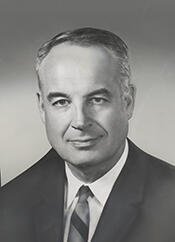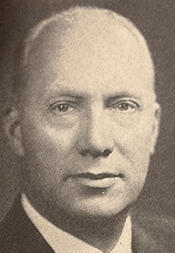
Morris Blaine Peterson (March 26, 1906 – July 15, 1985) was a U.S. Representative from Utah and a member of the Democratic Party who served one term in the United States Congress from 1961 to 1963. Born in Ogden, Weber County, Utah, his father was an immigrant from Norway, and Peterson was raised in the public school system of his hometown. As a young man he served as a missionary for the Church of Jesus Christ of Latter-day Saints in Leipzig, Germany, an experience that would later shape his continued involvement in church leadership and international service.
Peterson pursued higher education at Weber College in Ogden before enrolling at the University of Utah, from which he graduated in 1931. Seeking a career in law and public service, he continued his studies in Washington, D.C., earning a degree from Georgetown Law School in 1938. On May 18, 1932, he married M. Lucile Parry; the couple had four children. His legal training and growing family life coincided with the early stages of his professional career in Utah’s legal and political spheres.
After completing his law degree, Peterson became a law clerk to Justice Eugene E. Pratt of the Utah Supreme Court, gaining firsthand experience in appellate practice and judicial decision-making. He subsequently served as Weber County attorney, where he was responsible for representing the county in legal matters and overseeing prosecutions. In 1941 he entered the private practice of law, establishing himself as a practicing attorney in Ogden. His interest in public affairs led him into elective office at the state level, and he served in the Utah State Legislature from 1955 to 1957, participating in the legislative process and building a reputation that would support his later bid for national office.
Peterson was elected as a Democrat to the Eighty-seventh Congress, serving in the U.S. House of Representatives from January 3, 1961, to January 3, 1963. Representing Utah in the House, he participated in the democratic process and contributed to the legislative work of a Congress that met during a significant period in American history, including the early years of the Kennedy administration and the height of Cold War tensions. His election was notably close: he defeated Republican A. Walter Stevenson by a margin of just 68 votes, underscoring the competitiveness of Utah politics at the time. During his single term, he represented the interests of his constituents and took part in the broader national debates of the era.
In 1962 Peterson was an unsuccessful candidate for reelection to the Eighty-eighth Congress, ending his formal congressional service after one term. Following his departure from the House of Representatives, he remained active in public and civic affairs. He served as chairman of the Weber County, Utah, Taxpayers Association, where he focused on issues of local taxation and fiscal policy. In 1963 he was appointed special consultant to the director of the Food for Peace Program, a federal initiative aimed at using U.S. agricultural abundance to promote economic development and humanitarian relief abroad, reflecting his continued engagement with national and international public service.
Peterson also maintained a long-standing commitment to his church. Building on his early missionary experience in Leipzig, Germany, he later returned to Germany in a leadership capacity, serving as president of the Southern Germany Mission of the Church of Jesus Christ of Latter-day Saints from 1970 to 1973. In this role he oversaw missionary work and church administration in a region that, during the Cold War, was of particular geopolitical and cultural significance, further linking his life to international concerns and cross-cultural engagement.
Throughout his life, Peterson remained closely tied to his native Ogden. He continued to reside there in his later years, remaining a prominent figure in local legal, civic, and religious circles. Morris Blaine Peterson died in Ogden on July 15, 1985, and was interred in Ogden City Cemetery, closing a career that spanned local, state, national, and international service.
Congressional Record