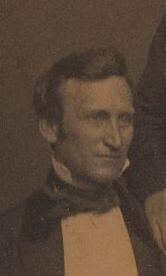
Mordecai Baldwin Oliver (October 22, 1819 – April 25, 1898) was an attorney and two-term U.S. Representative from Missouri from 1853 to 1857. He was born in Anderson County, Kentucky, where he attended the common schools before deciding to pursue a legal career. His early years in Kentucky provided the foundation for his later professional life on the Missouri frontier, as he combined basic formal schooling with self-directed legal study in preparation for admission to the bar.
After completing his legal studies, Oliver was admitted to the bar in 1842. He moved to Missouri and commenced the practice of law in Richmond, in Ray County, where he quickly established himself as a capable attorney. His growing reputation in the legal community led to his appointment as prosecuting attorney for the Fifth Judicial Circuit in 1848, a position in which he was responsible for representing the state in criminal matters and which helped introduce him to public life and regional politics.
Oliver’s legal and prosecutorial experience provided a springboard to national office. As a member of the Independent Party representing Missouri, he contributed to the legislative process during two terms in the U.S. House of Representatives. More specifically, he was elected as a Whig to the Thirty-third Congress and reelected as an Opposition Party candidate to the Thirty-fourth Congress, serving from March 4, 1853, to March 3, 1857. His service in Congress occurred during a significant period in American history, in the years leading up to the Civil War, when sectional tensions over slavery and states’ rights were intensifying. During these terms he participated in the democratic process and represented the interests of his Missouri constituents in a period of shifting party alignments, as the Whig Party fractured and new political coalitions emerged.
After leaving Congress in 1857, Oliver returned to his legal career in Missouri. As the national crisis deepened and the Civil War approached, he remained engaged in public affairs. In 1861, amid the secession crisis and internal divisions within Missouri, he was elected as a Unionist Secretary of State of Missouri. In that capacity he was associated with the pro-Union state government during one of the most turbulent periods in Missouri’s history, when questions of loyalty, governance, and civil authority were sharply contested.
Following his service as Secretary of State, Oliver resumed the practice of law, relocating to St. Louis, Missouri. There he continued his legal work in a major urban center that had become a focal point of commerce and politics in the postwar era. His long experience at the bar and in public office culminated in a judicial appointment: from 1889 to 1893 he served as judge of the criminal court in St. Louis. In this role he presided over criminal proceedings in a rapidly growing city, applying his decades of legal knowledge and public service to the administration of justice.
In his later years, Oliver moved to Springfield, Missouri. He spent his final period of life there and died in Springfield on April 25, 1898. He was interred in Hazelwood Cemetery, a prominent burial ground in the city. His career, spanning work as a local prosecutor, congressman, statewide executive officer, and judge, reflected the political transformations of mid-nineteenth-century America and the evolving public life of Missouri before, during, and after the Civil War.
Congressional Record