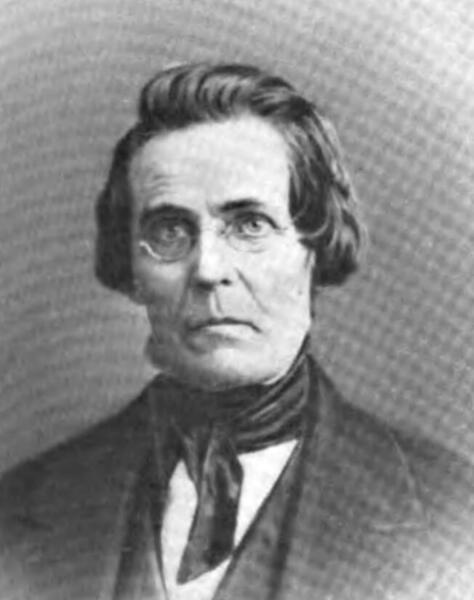
Mordecai Bartley (December 16, 1783 – October 10, 1870) was a Whig politician from northeastern Ohio who served as the 18th governor of Ohio and as a member of the United States House of Representatives. Notably, he succeeded his son, Thomas W. Bartley, as governor, one of the few instances in United States history in which a father directly followed his son in a high public office.
Bartley was born on December 16, 1783, in Fayette County, Pennsylvania. In his youth he attended local schools in Virginia, reflecting the mobility of his family in the early national period. In 1804 he married Elizabeth Welles, and shortly thereafter the couple moved west to Jefferson County, Ohio, as part of the broader migration into the Ohio Country in the early nineteenth century. This relocation marked the beginning of Bartley’s long association with the developing state of Ohio, where he would establish himself as a farmer, soldier, and public official.
During the War of 1812, Bartley entered military service and advanced through the ranks, first serving as a captain and later as an adjutant. He served under General William Henry Harrison, participating in the defense of the Northwest frontier during a critical phase of the conflict. After the war, Bartley moved to Richland County, Ohio, settling near Mansfield. There he engaged in farming and became a prominent local citizen, his wartime experience and frontier leadership helping to launch his political career.
While continuing his agricultural pursuits, Bartley entered state politics and was elected to the Ohio State Senate, where he served one term from 1816 to 1818. His legislative work at the state level led to his election to the United States House of Representatives in 1822. As a member of the Unknown Party representing Ohio, Mordecai Bartley contributed to the legislative process during four terms in office. His service in Congress extended from March 4, 1823, through March 3, 1831, a significant period in American history marked by debates over internal improvements, economic policy, and the evolving balance between federal and state authority. During these four terms, he participated in the democratic process and represented the interests of his Ohio constituents before declining to be renominated in 1830.
After leaving Congress, Bartley returned to private life in Ohio, resuming his farming and local affairs. He remained active in Whig Party politics and served as an Ohio Whig presidential elector in 1836, casting his vote for William Henry Harrison. His continued engagement with public questions and party organization kept him a figure of statewide prominence even while he was formally retired from office.
In 1844, Bartley reentered public life at a high level when he became the Whig candidate for governor of Ohio. He accepted the nomination after David Spangler, the original Whig nominee, declined to run. Bartley won the election and served a single term as the 18th governor of Ohio from 1844 to 1846. His tenure was notable for Ohio’s response to the Mexican–American War; under his administration, the state raised forty companies totaling approximately 7,000 men for national service. Bartley’s governorship was also historically distinctive because he succeeded his son, Thomas W. Bartley, who had served briefly as governor, making their succession an unusual familial transition in American political history. At the conclusion of his term in 1846, Mordecai Bartley retired again from public office.
In his later years, Bartley lived quietly in Ohio, his long career having spanned the early frontier period, the War of 1812, the formative decades of the federal Congress, and the rise of the Whig Party. He died on October 10, 1870, leaving a legacy as a soldier, legislator, and governor who helped shape Ohio’s political development in the first half of the nineteenth century.
Congressional Record