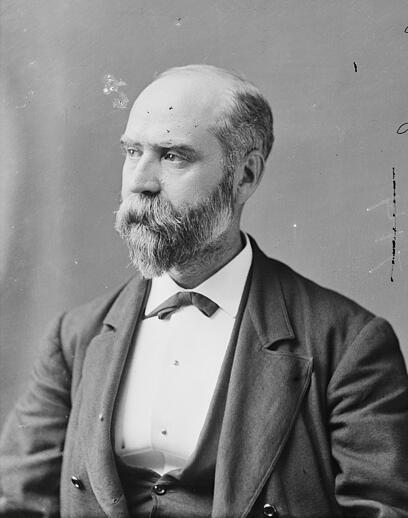
Milton Sayler (November 4, 1831 – November 17, 1892) was an American lawyer and Democratic politician who served as a three-term U.S. Representative from Ohio from 1873 to 1879. He was born in Lewisburg, Ohio, where he attended the public schools before pursuing higher education. Sayler was a cousin of Henry B. Sayler, who also served in the United States Congress, representing the state of Indiana, reflecting a broader family involvement in national politics.
After completing his early schooling in Lewisburg, Sayler pursued classical studies and enrolled at Miami University in Oxford, Ohio. He was graduated from Miami University in 1852, receiving a traditional classical education that prepared him for the study of law and public service. Following his undergraduate studies, he moved to Cincinnati to continue his professional training and enrolled in the Cincinnati Law School, one of the leading legal institutions in the state at the time.
Upon completion of his legal studies, Sayler was admitted to the bar and commenced the practice of law in Cincinnati, Ohio. His legal career in Cincinnati provided the foundation for his entry into public life and helped establish his reputation within the Democratic Party. As a practicing attorney, he became engaged in local affairs and developed the professional and political connections that would lead to his election to public office.
Sayler’s formal political career began at the state level. He served as a member of the Ohio House of Representatives in 1862 and 1863, participating in state governance during the Civil War era, a period of significant political and social upheaval. Following his service in the state legislature, he continued his involvement in public affairs at the municipal level, serving as a member of the Cincinnati City Council in 1864 and 1865. These roles allowed him to gain experience in both state and local government and to build a record as a Democratic officeholder.
In national politics, Sayler was elected as a Democrat to the Forty-third, Forty-fourth, and Forty-fifth Congresses, serving in the U.S. House of Representatives from March 4, 1873, to March 3, 1879. Representing Ohio in the House of Representatives, he participated in the legislative process during a significant period in American history, in the decade following the Civil War and during the later years of Reconstruction. During his three terms in office, he contributed to the work of Congress and represented the interests of his Ohio constituents as a member of the Democratic Party. In the Forty-fourth Congress he served as chairman of the Committee on Public Lands, a position that placed him at the center of debates over federal land policy and western development. He was an unsuccessful candidate for reelection in 1878 to the Forty-sixth Congress, which brought his congressional service to a close in March 1879.
After leaving Congress, Sayler moved to New York City, where he resumed the practice of law. In New York he continued his professional career as an attorney, remaining active in his chosen field until his death. Although no longer in elective office, his earlier service in the Ohio legislature, Cincinnati city government, and the U.S. House of Representatives marked him as a figure of note in Democratic politics of the post–Civil War era.
Milton Sayler died in New York City on November 17, 1892. His remains were returned to Ohio, and he was interred in Spring Grove Cemetery in Cincinnati, one of the city’s most prominent burial grounds. His career, spanning local, state, and national office, reflected the trajectory of a nineteenth-century lawyer-politician who played a role in shaping public policy during a transformative period in United States history.
Congressional Record