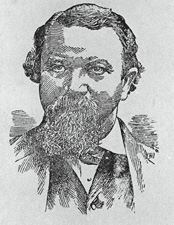
Milton Slocum Latham (May 23, 1827 – March 4, 1882) was an American politician who served as the sixth governor of California and as both a U.S. representative and U.S. senator from that state. A member of the Democratic Party and identified with the pro-slavery Lecompton wing of the party, he holds the distinction of having the shortest governorship in California history, serving only five days between January 9 and January 14, 1860, before resigning to enter the United States Senate. His service in Congress occurred during a significant period in American history, as sectional tensions over slavery escalated toward the Civil War, and he participated in the legislative process as a representative and later as a senator, representing the interests of his California constituents.
Latham was born in Columbus, Ohio, on May 23, 1827. He pursued classical studies at Jefferson College in Washington, Pennsylvania, from which he graduated in 1845. Shortly after completing his education, he moved to Russell County, Alabama, where he worked briefly as a schoolteacher while studying law. He was admitted to the Alabama bar in 1848 and served as the circuit court clerk of Russell County for two years. In 1850, drawn by the opportunities created by the California Gold Rush, Latham relocated to San Francisco, California, marking the beginning of his long association with that state.
Upon his arrival in California, Latham continued his legal and public service career. He became a recording clerk for San Francisco County and, in 1851, was elected district attorney of Sacramento. After serving for one year as district attorney, he entered national politics. In 1852 he ran as a Democrat for the U.S. House of Representatives and was elected, serving a single two-year term in the Thirty-third Congress from March 4, 1853, to March 3, 1855. Although he was renominated by state Democrats, Latham declined to run for a second term and returned to California to resume the practice of law. In 1855 President Franklin Pierce appointed him U.S. collector of customs for the Port of San Francisco, a position he initially protested but ultimately accepted; he held that post until 1857.
During the 1850s, the Democratic Party was increasingly divided over the issue of slavery, and California politics reflected the national turmoil. The state’s Democratic organization was dominated by the pro–states’ rights “Chivalry” faction, and nationally the party fractured into Lecompton and Anti-Lecompton factions over the Kansas Lecompton Constitution, which would have allowed slavery in that territory. The collapse of the Whig Party and the rise of the American (Know-Nothing) Party and, later, the Republican Party further complicated the political landscape. In California, Know-Nothings gained control of the legislature and elected J. Neely Johnson governor in 1855. Against this backdrop, in the 1859 general elections the Lecompton Democrats nominated Latham, who had briefly lived in the American South and was aligned with their pro-slavery views, as their candidate for governor. The Anti-Lecompton Democrats nominated John Currey, while the emerging Republican Party, contesting its first gubernatorial race in California, nominated businessman Leland Stanford. The campaign was overshadowed by the killing of U.S. Senator David C. Broderick, an Anti-Lecompton Democrat, in a duel with former state supreme court justice David S. Terry on September 13, 1859. Despite the party split and the Republican challenge, Latham won decisively, receiving about sixty percent of the vote.
Latham was inaugurated as governor of California on January 9, 1860. In his inaugural address he identified the reduction of the state’s mounting public debt as his principal objective, an issue that had troubled his predecessors John Bigler, J. Neely Johnson, and John Weller. He advocated curtailing legislative expenses, completing needed public buildings such as the new State Capitol without increasing taxes, and improving U.S. mail connections between the eastern United States and California to promote commerce and personal communication. He also argued that the powers of the governor should remain limited and be firmly checked by the legislature and the courts. However, within days of taking office, Latham made clear his desire for advancement to the U.S. Senate. The legislature was required to select a successor to Senator David C. Broderick, whose seat had been temporarily filled by Henry P. Haun after Broderick’s death. Latham actively sought the position, and the California legislature elected him to complete Broderick’s term. On January 14, 1860, only five days after his inauguration, he resigned the governorship to assume the Senate seat, becoming the second California governor to resign from office. His five-day tenure remains the shortest of any California governor, and it stood as the briefest service by any California constitutional officer until 2010, when Sean Wallentine served three days as an acting member of the State Board of Equalization.
Latham traveled to Washington, D.C., later in 1860 to take his seat in the United States Senate. A Democrat, he served from January 1860 until the expiration of Broderick’s original term on March 3, 1863. His Senate service thus fell during the critical years leading into and encompassing the early period of the Civil War. Although the existing record sometimes erroneously extends his congressional service from 1853 to 1863 as a senator, his federal legislative career in fact comprised one term in the House of Representatives from 1853 to 1855 and one partial term in the Senate from 1860 to 1863. When his Senate term ended, political power in California had shifted away from the Democrats toward Unionist Republicans, who controlled the state legislature and denied him reelection. He was succeeded in the Senate by John Conness, a former Anti-Lecompton Democrat who aligned with the Unionist cause.
After leaving the Senate, Latham turned to finance and railroads, pursuits that would occupy the remainder of his career. He traveled to Europe and became associated with the London and San Francisco Bank Ltd. (a predecessor of MUFG Union Bank), eventually serving as the bank’s chief officer in San Francisco. During the late 1860s and into the 1870s he played a significant role in financing the California Pacific Railroad and the North Pacific Coast Railroad, activities that earned him recognition as one of California’s “rail barons.” In 1872 he purchased a large 50-room mansion in Menlo Park known as Thurlow Lodge as a gift for his bride and began extensive renovations. The estate burned before the work was completed, but it was entirely rebuilt in 1873. In 1874 Latham commissioned noted photographer Carleton Watkins to document the expansive property, resulting in two presentation albums of mammoth-plate photographs of the house and grounds.
In his later years Latham shifted his base of operations to the East Coast. In 1879 he moved to New York City, where he became president of the New York Mining Stock Exchange, reflecting his continued involvement in finance and resource-based enterprises. He died in New York City on March 4, 1882, at the age of 54. Latham was originally buried at Laurel Hill Cemetery in San Francisco, a burial ground later removed to make way for urban development; in 1940 his remains were reinterred at Cypress Lawn Memorial Park in Colma, California.
Congressional Record