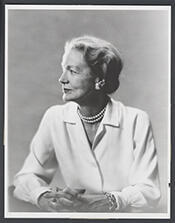
Millicent Vernon Fenwick (née Hammond; February 25, 1910 – September 16, 1992) was an American fashion editor, politician, and diplomat who served as a Representative from New Jersey in the United States Congress from 1975 to 1983. A four-term Republican member of the House of Representatives, she became nationally known for her energy, colorful enthusiasm, and independence, and was widely regarded as a moderate and progressive within her party. Outspoken in favor of civil rights and the women’s movement, she earned a reputation for integrity and moral values that led broadcaster Walter Cronkite to call her the “conscience of Congress.”
Fenwick was born Millicent Vernon Hammond in New York City, the middle of three children of Ogden Haggerty Hammond, a New York financier who later served as United States Ambassador to Spain, and his first wife, Mary Picton Stevens of Hoboken, New Jersey. Both parents came from prominent families deeply involved in American public life. Her paternal grandparents were General John Henry Hammond, who served as chief of staff to General William Tecumseh Sherman during the Vicksburg Campaign, and Sophia Vernon Wolfe, daughter of Louisville lawyer and legislator Nathaniel Wolfe. On her mother’s side, she was a granddaughter of John Stevens, eldest son of Edwin Augustus Stevens, founder of Stevens Institute of Technology, and a great-granddaughter of the inventor John Stevens. Her mother, heir to a substantial Hoboken real estate fortune, died when the British liner RMS Lusitania was torpedoed and sunk in 1915; Millicent, then five years old, lost her mother in the disaster, although her father survived. In the subsequent litigation over the sinking, the Hammond children were among those compensated, receiving more than $60,000. Ogden Hammond remarried in 1917 to Marguerite McClure “Daisy” Howland, and Fenwick acquired a stepbrother, McClure (“Mac”) Howland, but her relationship with her stepmother was strained. After their mother’s death, Millicent developed a particularly close bond with her sister, Mary Stevens Hammond, and her brother, Ogden H. Hammond Jr.; she was also a cousin of the noted record producer John Hammond.
Raised in comfortable circumstances in Bernardsville, New Jersey, Fenwick was educated at elite institutions. She attended the Nightingale-Bamford School in Manhattan and then Foxcroft School, a private boarding school in Middleburg, Virginia. She later studied at Barnard College and at the New School for Social Research in New York City, although she did not complete a formal high school diploma. In 1931 she met Hugh McLeod Fenwick, an aviation enthusiast and future lieutenant in the flying section of the New Jersey National Guard, who had briefly attended Harvard University and was then working in aviation in Pensacola, Florida. Their relationship, begun while he was still married to Dorothy Ledyard, daughter of New York attorney Lewis Cass Ledyard, provoked disapproval within her family, particularly from her devoutly Catholic stepmother. Nonetheless, Millicent Hammond and Hugh Fenwick married on June 11, 1932, initially renting a house in Bedminster, New Jersey, before settling in Bernardsville.
The Fenwicks had two children: a daughter, Mary Stevens Fenwick, born on February 25, 1934—her mother’s twenty-fourth birthday—and a son, Hugo Hammond Fenwick. Motherhood did not come easily to Millicent, who hired a nanny to assist in raising the children. The marriage deteriorated over time, strained by Hugh Fenwick’s financial irresponsibility and dishonesty; he eventually relocated to Europe, leaving behind substantial debts that Millicent assumed. The couple separated and ultimately divorced in 1945. Hugh later remarried and had another daughter, while Millicent did not remarry, instead devoting herself to supporting and caring for her children. During the marriage she had briefly modeled for Harper’s Bazaar, but as a divorced woman without a high school diploma she struggled to find work that would sustain her family. She eventually secured a position at Vogue magazine as a caption editor and rose through several editorial roles over more than a decade, concluding her career there in 1948. She compiled Vogue’s Book of Etiquette, which sold a million copies and led to a national speaking tour, cementing her public reputation as an arbiter of style and manners. By 1952, with her children grown and supported in part by an inheritance from her mother and income from family real estate holdings, she was able to retire from paid employment.
Fenwick’s entry into public life came through her engagement with the Civil Rights Movement in the 1950s. Often described as exceptionally intelligent, striking in appearance, and armed with a sharp wit, she rose rapidly in the ranks of the New Jersey Republican Party despite her socially prominent background. She was elected to the Bernardsville Borough Council in 1957 and served there until 1964. Concurrently, she was appointed to the New Jersey Committee of the United States Commission on Civil Rights, serving from 1958 to 1974 and building a record as a staunch advocate of racial equality and civil liberties. In 1969 she won election to the New Jersey General Assembly and served from 1970 until December 1972, when she resigned to become director of the New Jersey Division of Consumer Affairs under Governor William T. Cahill. In that post she developed a reputation as a vigorous defender of consumers and an opponent of corruption and special interests.
Elected to Congress from New Jersey in 1974 at the age of sixty-four, Fenwick began her service in the House of Representatives on January 3, 1975, and served four consecutive terms, leaving office on January 3, 1983. A member of the Republican Party, she represented her district during a significant period in American history marked by the aftermath of Watergate, the end of the Vietnam War, and the emergence of new debates over human rights and economic policy. In her initial 1974 House race she defeated Democrat Frederick Bohen with 53.4 percent of the vote to his 43.5 percent. She consolidated her position in subsequent campaigns, winning reelection in 1976 with 66.9 percent of the vote against Democrat Frank Nero, in 1978 with 72.6 percent against Democrat John Fahy, and in 1980 with 77.5 percent against Democrat Kieran Pillon Jr., who received 20.5 percent. In Washington she quickly became a media favorite, known for her opposition to corruption in both parties and to the influence of political action committees, as well as for her refusal to support congressional pay raises. Her principled stands and independent voting record placed her among the most liberal Republicans in the House. She was especially outspoken on civil rights, women’s rights, and human rights abroad, and she gained attention for her sharp rejoinders on the House floor, including a famous retort to a male colleague who had described women as “kissable, cuddly, and smelling good”: “That’s what I’ve always thought about men, and I hope for your sake that you haven’t been disappointed as many times as I’ve been.”
Fenwick played a notable role in the international human rights movement associated with the Helsinki Accords. In 1975, shortly after the accords were signed in Helsinki, Finland, she traveled to Moscow as a junior member of a congressional delegation. There she met with Soviet “refuseniks” seeking to emigrate and held an unofficial meeting with dissident physicist Yuri Orlov. Convinced that the accords could be used as a tool to pressure the Soviet Union on human rights, she raised specific cases with General Secretary Leonid Brezhnev at a final press conference before leaving the Soviet Union. Upon her return to the United States, she was instrumental in initiating the establishment of the Commission on Security and Cooperation in Europe (CSCE), commonly known as the U.S. Helsinki Commission, which was charged with monitoring compliance with the Helsinki Accords. Despite her patrician background, she approached her congressional duties with what observers described as a blue-collar work ethic, often remaining in her Capitol Hill office late into the night long after many colleagues had departed, and consistently making herself available to the press to explain her positions.
In 1982, rather than seek a fifth House term, Fenwick ran for the United States Senate from New Jersey. She defeated conservative Jeffrey Bell in the Republican primary but narrowly lost the general election to Democratic businessman Frank Lautenberg, the chief executive officer of Automatic Data Processing, in what was widely regarded as an upset. Lautenberg received 51 percent of the vote to Fenwick’s 48 percent. She later remarked that she had not prepared a concession speech because she “never expected to lose.” Years afterward, when Lautenberg’s age became an issue in his 2008 reelection campaign, some Republicans claimed he had raised similar concerns about Fenwick’s age in 1982; Lautenberg denied that he had made her age an issue, stating that he had only questioned her ability to do the job. Following her Senate defeat, Fenwick left the House of Representatives at the conclusion of her term in January 1983, ending eight years of congressional service during which she had consistently represented the interests of her New Jersey constituents while maintaining a strong national profile on ethics and human rights.
After departing Congress, Fenwick continued her public service on the international stage. President Ronald Reagan appointed her United States Ambassador to the Food and Agriculture Organization (FAO) of the United Nations in Rome, Italy, a post she held from June 1983 until March 1987. Fluent in Italian, French, and Spanish, she was well suited to the diplomatic environment and worked on issues of global food security and agricultural development until her retirement from public life at age seventy-seven. She then returned to Bernardsville, where she remained an admired public figure. On September 16, 1992, Millicent Fenwick died of heart failure at her home in Bernardsville.
Fenwick’s legacy endured in both political culture and popular imagination. She was widely cited as a model of integrity and independence in public office, and biographer Amy Schapiro emphasized that her opposition to congressional pay raises and to PAC money, along with her unwavering adherence to her ideals, underpinned Cronkite’s description of her as the “conscience of Congress.” New Jersey Governor Thomas Kean observed that she was “the only really ambitious seventy-year-old” he had ever met, noting that she loved serving in office, marveled at being chosen to represent the people, and remained a maverick who hated hypocrisy and abuses of public trust. Many observers have considered her the inspiration for the character of Congresswoman Lacey Davenport in Garry Trudeau’s comic strip Doonesbury, though Trudeau has said the character was not based on any single individual. In October 1995 a sculpture, the Millicent Fenwick Monument by Dana Toomey, funded by voluntary donations, was unveiled near the Bernardsville train station and is regularly decorated by local admirers. Her family’s public-service tradition continued into later generations: she is the grandmother of Jonathan Reckford, chief executive officer of Habitat for Humanity International, and the great-grandmother of U.S. Olympic rower Molly Reckford.
Congressional Record