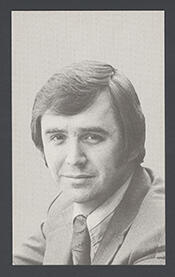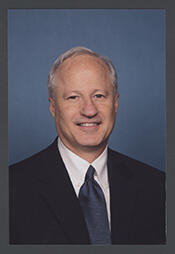
Michael Harold Coffman (born March 19, 1955) is an American politician, businessman, and veteran of both the U.S. Army and the U.S. Marine Corps who has served as Mayor of Aurora, Colorado, since December 2, 2019. A member of the Republican Party, Coffman represented Colorado’s 6th congressional district in the U.S. House of Representatives for five terms from 2009 to 2019, and previously held statewide office as Colorado State Treasurer and Secretary of State. Over the course of his career, he has combined military service, business experience, and a long record in elective office at the state, local, and federal levels.
Coffman was born in Missouri, the son of a soldier, and moved with his family to Aurora, Colorado, when he was nine years old. Growing up in a military household shaped his early interest in public service and national defense. At age 17, he enlisted in the U.S. Army, serving on active duty for two years before transferring to the Army Reserve in order to pursue higher education. He later transferred to the U.S. Marine Corps Reserve, continuing a military career that would span decades and include service in two major conflicts.
Coffman attended the University of Colorado Boulder, where he earned a Bachelor of Arts degree. In addition to his undergraduate studies, he participated in special programs at Harvard University and the University of Veracruz in Mexico, broadening his academic and cultural experience. While continuing his reserve military service, Coffman entered the private sector and in 1983 founded a property management company in Aurora, reflecting an early engagement with local economic and community issues. His military obligations continued alongside his civilian work, and he served in the Gulf War and later in the Iraq War as a member of the Marine Corps Reserve, experiences that informed his later positions on defense and veterans’ affairs.
Coffman’s political career began in the Colorado General Assembly. He was first elected to the Colorado House of Representatives in 1988 and was reelected in 1990. In December 1994 he was appointed to the Colorado State Senate, where he continued to build his profile as a Republican legislator. In 1998, Coffman was elected Colorado State Treasurer, a statewide office in which he oversaw the state’s investments and financial management. After two terms as treasurer, he successfully ran for Colorado Secretary of State in 2006, assuming responsibility for the administration of elections, business registrations, and other official records. He resigned as Secretary of State after winning election to the U.S. House of Representatives, and Governor Bill Ritter designated State Representative Bernie Buescher, a Democrat, to succeed him in that office.
In 2008, Coffman announced his candidacy for the U.S. House seat in Colorado’s 6th congressional district being vacated by retiring Republican Representative Tom Tancredo. He faced a competitive Republican primary against Wil Armstrong, the son of former U.S. Senator Bill Armstrong, as well as State Senators Ted Harvey and Steve Ward. Coffman won the August 2008 primary with a plurality of 40 percent of the vote, defeating runner-up Wil Armstrong by seven points. The Denver Post endorsed him on October 10, 2008. In the November general election, he defeated Democratic nominee Hank Eng, an Appleton, Wisconsin, city common councilman, by a margin of 61 percent to 39 percent. Coffman took office in January 2009 and went on to serve five consecutive terms in Congress, participating in the legislative process during a significant period in American history and representing the interests of his constituents in the House of Representatives.
During his congressional tenure, Coffman secured reelection in a series of increasingly competitive races as Colorado’s 6th district evolved demographically and politically. In 2010, he defeated Democratic challenger John Flerlage by a margin of 66 percent to 31 percent. Following redistricting, the 6th district was redrawn to include Aurora and became more favorable to Democrats. In 2012, Democratic State Representative Joe Miklosi challenged Coffman in the newly configured district; Coffman prevailed 48 percent to 46 percent, a difference of 6,992 votes. In 2014, he ran unopposed in the Republican primary and faced Democrat Andrew Romanoff in the general election, winning 52 percent to 43 percent. In 2016, Coffman again sought reelection, this time against Democratic State Senator Morgan Carroll. He defeated Carroll 51 percent to 42 percent, while outside groups such as Americans for Prosperity mounted major advertising campaigns opposing his opponent. Over these cycles, national observers noted Coffman’s efforts to adapt to a more diverse and competitive district, including outreach to immigrant and minority communities and occasional breaks with his party on issues such as immigration.
Coffman’s engagement with his constituents was highlighted in a widely covered town hall meeting in April 2017, where he fielded pointed and often hostile questions from residents of his district and others in attendance. His willingness to remain on stage and debate policy issues drew praise from local media; KUSA commentator Kyle Clark observed that Coffman was “clearly prepared to debate the issues, his positions, and his policies.” At the same event, Coffman drew national attention when he stated that White House Press Secretary Sean Spicer “needs to go” following Spicer’s historically inaccurate remarks about the Holocaust, underscoring Coffman’s occasional public divergence from the Trump administration.
In 2018, Coffman faced Democratic challenger Jason Crow, an attorney and fellow Iraq War veteran. Crow defeated Levi Tillemann in the Democratic primary by a margin of 66 percent to 34 percent, setting up a high-profile general election contest in a district that had become a key national battleground. On July 2, 2018, The New York Times reported on the difficulty Democrats had previously faced in unseating Coffman in a district increasingly populated by Somalis, Japanese, Koreans, Latinos, and other minority communities, noting that Coffman had “kept winning in part because he has sought to show he embraced the needs of his newer constituents” and had become “a renegade Republican on immigration issues.” By the fall of 2018, however, Coffman was trailing in most public polls, and on October 19, 2018, the National Republican Congressional Committee confirmed that it had pulled the remaining $1 million in television advertising for the race, signaling a bleak assessment of his prospects. In the November 2018 general election, Crow defeated Coffman by a vote of 54.1 percent to 42.9 percent. At a press conference the following day, President Donald Trump publicly criticized Coffman for distancing himself from the administration, remarking that some Republicans who chose to “stay away” had done poorly and citing Coffman by name.
After his defeat for reelection to Congress in 2018, Coffman turned his attention back to local government. In 2019, he announced his candidacy for Mayor of Aurora, Colorado. He was elected in November 2019 and assumed office on December 2, 2019, returning to lead the city where he had grown up and built his business career. He was reelected to a second term as mayor in the 2023 election. Throughout his career—as a state legislator, statewide officeholder, member of Congress, and municipal executive—Coffman has drawn on his military background, business experience, and long familiarity with Aurora and the Denver metropolitan area in shaping his approach to public service.
Congressional Record