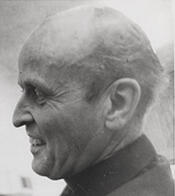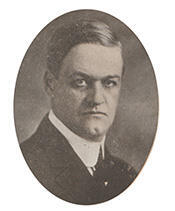
Michael Francis Phelan (October 22, 1875 – October 12, 1941) was a Democratic U.S. Representative from Massachusetts who served four consecutive terms in Congress from 1913 to 1921. Born in Lynn, Essex County, Massachusetts, he was raised in that industrial city and attended the local public schools. He completed his secondary education at Lynn Classical High School before entering Harvard College, from which he graduated in 1897. He continued his studies at Harvard Law School, earning his law degree in 1900.
Upon his admission to the bar in 1900, Phelan commenced the practice of law in his native Lynn. He quickly became active in local and state politics as a member of the Democratic Party. In 1903 he was a candidate for the Massachusetts House of Representatives. In that election Phelan received 1,307 votes, while Asa T. Newhall received 1,371 votes and Republican candidate John W. Blaney led the field with 1,434 votes. Because the district elected two representatives to the Massachusetts House, Newhall, who finished second, secured one of the seats, while Phelan fell short of election. Undeterred, Phelan ran again and in 1904 was elected as a Democrat to serve in the Massachusetts House of Representatives for the 1905 legislative session, marking his first successful bid for public office.
Phelan’s state legislative experience and his growing prominence in Democratic politics in Massachusetts helped pave the way for his election to the United States House of Representatives. He was elected as a Democrat to the Sixty-third Congress and to the three succeeding Congresses, serving from March 4, 1913, to March 3, 1921, as a Representative from Massachusetts. His eight years in the House coincided with a significant period in American history, encompassing the Progressive Era, the First World War, and the immediate postwar adjustment. During his tenure he contributed to the legislative process and represented the interests of his constituents in Massachusetts, participating actively in the democratic process at the national level.
During the Sixty-fifth Congress, Phelan served as chairman of the House Committee on Banking and Currency, a key committee with jurisdiction over national financial and monetary legislation. In this capacity he was involved in oversight and development of policies affecting the banking system during and after World War I. Phelan was also known for his strong identification with Irish nationalism and used his position in Congress to draw attention to the cause of Irish independence from the United Kingdom. His foreign policy views shaped his stance on major national questions; he opposed American entry into World War I in part because he did not want the United States to fight on the same side as the United Kingdom.
Phelan’s record and views also reflected pronounced prejudices that informed his political outlook. He was described as “deeply antisemitic,” harboring a lifelong bigotry against Jewish people. He lamented the outcome of the 1916 United States presidential election on the grounds that “both candidates were England-lovers and Jew sympathizers,” and he regarded both Republican nominee Charles Evans Hughes and Democratic President Woodrow Wilson as “profanely flawed” because they were, in his view, “pro-British” in foreign policy and outspokenly opposed to antisemitism. Phelan supported efforts to limit Jewish immigration to the United States, a position that brought him into direct conflict with President Wilson, who opposed such restrictions; Phelan later characterized Wilson’s opposition as “unforgiveable.” These views, while part of his public and private political life, stood in stark contrast to evolving national debates over tolerance, immigration, and civil rights in the early twentieth century.
In 1920 Phelan was an unsuccessful candidate for reelection to the Sixty-seventh Congress, bringing his congressional service to a close on March 3, 1921. After leaving the House of Representatives, he resumed the practice of law. Over the following years he maintained law offices and practiced in Lynn and Boston, Massachusetts, as well as in Washington, D.C., drawing on his legislative experience and connections in the nation’s capital. He remained engaged in public affairs in Massachusetts and continued his association with leading Democratic figures in the state, including his close friend David Ignatius Walsh, who served as both governor and U.S. senator from Massachusetts.
In the later years of his life, Phelan held several public appointments at the state and regional level. In 1937 he served as a member of the Merrimac Valley Sewage Commission, reflecting ongoing efforts to address environmental and public health concerns in the region. That same year he was appointed a member of the Massachusetts Labor Relations Board, a body charged with administering and enforcing state labor relations laws during a period of intense labor organization and industrial change. He served on the Massachusetts Labor Relations Board from 1937 until his death. In his private life during this period, Phelan remained aligned with far-right and antisemitic currents; near the end of his life he was a frequent reader of Social Justice, the periodical published by the controversial and antisemitic Catholic priest Charles Coughlin.
Michael Francis Phelan died in Boston, Massachusetts, on October 12, 1941, just ten days short of his sixty-sixth birthday. He was interred in St. Mary’s Cemetery in his hometown of Lynn, Massachusetts, closing a career that had spanned local, state, and national office and reflected both the political currents and the prejudices of his era.
Congressional Record