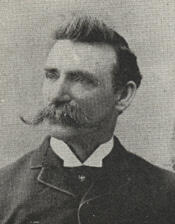
Michael Joseph McEttrick (June 22, 1848 – December 31, 1921) was a United States Representative from Massachusetts and a long-serving Democratic legislator in the Massachusetts General Court. He was born in Roxbury, Massachusetts, then an independent municipality later annexed to Boston. He attended local schools and completed his early education at Washington Grammar School and the Roxbury Latin School, institutions that prepared many young men in the Boston area for professional and public life.
After finishing his schooling, McEttrick entered the field of journalism. His work as a journalist placed him in close contact with civic affairs and public debate in Boston during the late nineteenth century, a period of rapid urban growth and political realignment. This experience helped to shape his interest in politics and public service and provided him with a platform from which to enter elective office.
McEttrick first held public office as assistant assessor of Boston in 1884, a position that involved responsibility for local tax assessment and municipal finance. Building on this administrative experience, he was elected to the Massachusetts House of Representatives, where he served from 1885 to 1891. During his tenure in the House he became chairman of the Democratic members, reflecting his prominence within the party caucus and his influence in legislative deliberations. In 1892 he advanced to the Massachusetts State Senate, serving that year and representing his party in the upper chamber of the state legislature.
In 1892 and 1894 McEttrick sought election to the United States House of Representatives from Massachusetts’s 10th Congressional District as an Independent Democrat, reflecting both his Democratic affiliation and a measure of independence from the regular party organization. In the 1892 election he won a four-way race, defeating Republican Harrison H. Atwood and securing a seat in the Fifty-third Congress. He was elected as an Independent Democrat, sometimes described as a member of the Independent Party, and served one term in the U.S. House of Representatives from March 4, 1893, to March 3, 1895. During this period, which was marked by significant economic and political challenges nationally, he participated in the legislative process and represented the interests of his Boston-area constituents.
McEttrick’s congressional service coincided with a significant period in American history, including the economic turmoil of the Panic of 1893 and the debates over monetary policy, tariffs, and labor conditions that dominated the Fifty-third Congress. As a member of the House of Representatives, he took part in the democratic process at the federal level and contributed to deliberations on issues affecting both Massachusetts and the nation. In 1894 he was an unsuccessful candidate for renomination to the Fifty-fourth Congress, losing the general election that year to Republican Harrison H. Atwood, whom he had previously defeated.
Following his single term in Congress, McEttrick returned to state politics and resumed service in the Massachusetts House of Representatives. He was again a member of the House in 1906, 1907, and 1913, continuing his long association with the state legislature and the Democratic Party. In 1908 he served once more in the Massachusetts State Senate, this time representing the Fourth Suffolk District. These later legislative terms extended his influence in Massachusetts public life well into the early twentieth century and underscored his sustained commitment to state and local governance.
Alongside his political career, McEttrick engaged in the real estate business in Boston, Massachusetts. He remained active in this field until his death in Boston on December 31, 1921. Michael Joseph McEttrick was interred in Calvary Cemetery, leaving a record of service that spanned municipal administration, state legislation, and a term in the United States Congress.
Congressional Record