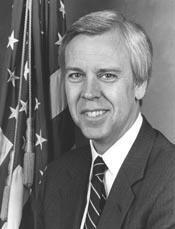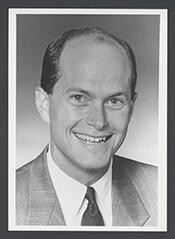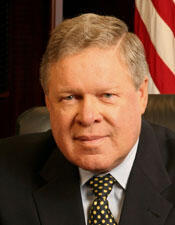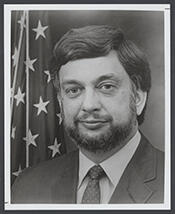
Michael Edward Lowry (March 8, 1939 – May 1, 2017) was an American politician who served as a United States Representative from Washington from 1979 to 1989 and as the 20th governor of Washington from 1993 to 1997. A member of the Democratic Party, he was known for his populist style, strong advocacy for social and environmental causes, and efforts to expand health care access. His political career effectively ended after allegations of sexual misconduct by a staff member during his gubernatorial term, though he remained active in public affairs and community projects in later years.
Lowry was born in St. John, Whitman County, Washington, on March 8, 1939, the son of Helen (née White) and Robert Lowry. He was raised in this small eastern Washington farming community, an upbringing that informed his later political emphasis on rural issues, working families, and agricultural concerns. He attended local schools and went on to Washington State University in Pullman, where he studied political science. Lowry graduated from Washington State University in 1962, laying the academic foundation for a career in public service and politics.
Following his graduation, Lowry embarked on a brief early career in and around state government. He worked for the Washington State Senate, gaining experience with the legislative process and the mechanics of state policymaking. He subsequently served as a lobbyist for Group Health Cooperative, a nonprofit health care organization based in Washington. This work deepened his interest in health policy and access to medical care, themes that would become central to his later legislative and executive agendas.
Lowry entered elective office in local government when he was elected to the King County Council in 1975. Representing a portion of the Seattle metropolitan area, he served on the council during a period of rapid urban growth and increasing attention to regional planning, transportation, and social services. His tenure on the council helped establish his reputation as an energetic, outspoken Democrat and positioned him for higher office.
In 1978, Lowry was elected to the United States House of Representatives from Washington’s 7th congressional district, a heavily Democratic district centered on Seattle. He took office on January 3, 1979, and served five consecutive terms, remaining in the House until January 3, 1989. During his decade in Congress, Lowry participated actively in the legislative process and represented the interests of his constituents in a period marked by the Carter, Reagan, and early George H. W. Bush administrations. He was identified with progressive positions on social welfare, environmental protection, and opposition to certain aspects of U.S. foreign policy, and he was a vocal critic of policies he believed disadvantaged working people and the poor. His service in Congress occurred during a significant period in American history, and he consistently aligned with the liberal wing of the Democratic Party.
While serving in the House, Lowry twice sought election to the United States Senate. In 1983, he ran in a special election to fill the seat left vacant by the death of Senator Henry M. “Scoop” Jackson. Lowry won the Democratic nomination but was defeated in the general election by Republican former governor Dan Evans, who had been appointed to the seat and was serving as the incumbent. In 1988, he again sought a Senate seat, this time challenging Republican Senator Slade Gorton. In a close and hard-fought race, Lowry was defeated, and he left the House of Representatives at the end of his fifth term in 1989. After departing Congress, he worked at Seattle University and with an environmental organization, continuing his involvement in public policy and advocacy outside of elected office.
Lowry returned to electoral politics in the early 1990s and was elected governor of Washington in 1992. He took office as the state’s 20th governor on January 13, 1993, and served a single four-year term, leaving office on January 15, 1997. To date, he is the last governor of Washington to serve only one term. As governor, Lowry pursued an ambitious policy agenda, with his principal initiative being the creation of a statewide system of health insurance with premiums based on ability to pay, reflecting his long-standing commitment to expanding health care access. His administration also focused on environmental protection, education funding, and services for low-income residents. However, his tenure was overshadowed by a sexual harassment scandal involving his deputy press secretary, Susanne Albright, who accused him of making inappropriate remarks and fondling her. Amid the controversy and public scrutiny, Lowry chose not to seek reelection in 1996, and his decision effectively ended his career in high elective office.
After leaving the governorship, Lowry remained intermittently involved in politics and public service. In 2000, he ran unsuccessfully for Washington’s office of Commissioner of Public Lands, seeking to oversee the state’s public lands and natural resources. In subsequent years, he devoted much of his time to community and nonprofit efforts, particularly in the area of affordable housing. He was notably active in projects to build affordable housing for Washington’s migrant farm workers, reflecting his enduring concern for marginalized and low-income populations. Throughout his career, Lowry’s appearance drew frequent comparisons from media and political opponents to Palestinian leader Yasser Arafat, due to a perceived similarity in physical appearance; according to some accounts, Lowry shaved off a beard he had previously worn in part to minimize such comparisons.
Lowry married Mary Carlson in 1968, and the couple had one daughter. He continued to reside in Washington State for the remainder of his life. Michael Edward Lowry died on May 1, 2017, at the age of 78, from complications of a stroke. His public life, spanning local, congressional, and gubernatorial service, left a lasting imprint on Washington State politics, particularly in the realms of health care, social policy, and advocacy for disadvantaged communities.
Congressional Record