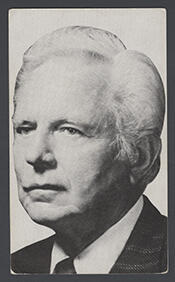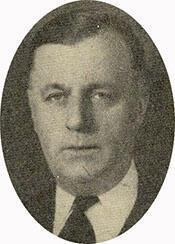
Michael Joseph Kirwan (December 2, 1886 – July 27, 1970) was an American World War I veteran and Democratic politician from Ohio who served 17 terms as a Representative in the United States Congress. A member of the Democratic Party, he represented Ohio’s 19th congressional district from January 3, 1937, until his death in 1970 in Bethesda, Maryland. At the peak of his long congressional career, Kirwan was regarded as one of the most influential Democratic members of the House of Representatives, particularly on matters related to conservation, and he played a significant role in the legislative process during a transformative period in American history.
Kirwan was born in Wilkes-Barre, Luzerne County, Pennsylvania, a manufacturing town in northeastern Pennsylvania. In 1907, he relocated to Youngstown, Ohio, a major center of steel production located just west of the Pennsylvania border. Youngstown’s industrial character and working-class population would shape his political outlook and later define the constituency he represented in Congress. Kirwan married Alice Kane, and together they had three children: John, Michael, and Mary Alice. His family life in Youngstown was closely intertwined with his emerging role in local civic and political affairs.
During the First World War, Kirwan served overseas in the United States Army. He was a sergeant in the 348th Machine Gun Company of the 64th Artillery, serving between 1917 and 1919. His military service in Europe during World War I contributed to his public standing upon his return and informed his later support for veterans and national defense measures in Congress. After the war, he returned to Youngstown, where he became an outspoken advocate for regional economic development, most notably championing a proposed Lake Erie to Ohio River canal. This project, which he would continue to promote throughout his congressional career, reflected his long-standing interest in infrastructure and economic revitalization for northeastern Ohio.
Kirwan’s formal political career began at the municipal level. He served on the Youngstown City Council from 1932 to 1936, a period marked by the Great Depression and intense local need for public works and relief programs. His effectiveness in securing improvements for the city and his advocacy of large-scale infrastructure projects helped build a political base that would support his move to national office. In 1936, he ran for a seat in the U.S. House of Representatives from Ohio’s 19th congressional district and won, beginning the first of 17 consecutive terms in Congress. He took office on January 3, 1937, and would remain in the House until his death, becoming one of the chamber’s long-serving members.
Throughout the late 1930s and early 1940s, Kirwan distinguished himself by securing substantial federal support for public works in his district and across Ohio. He was instrumental in obtaining funding for dams, reservoirs, public swimming pools, and public park facilities, reflecting both New Deal priorities and his own commitment to conservation and recreation. In 1940, he helped secure federal financing for what was described as the nation’s first major public housing project, Westlakes Housing Village (later known as Westlakes Terrace), located west of downtown Youngstown. The project comprised 618 units capable of sheltering 2,500 people and received 90 percent of its funding—$2,862,000—on a 60-year loan basis. Kirwan hailed Westlakes as a model for the nation and a welcome replacement for a dilapidated residential district. In later decades, however, Westlakes Terrace, like many low-income housing projects, produced mixed results, as cheap housing could not offset the loss of thousands of urban jobs, the decline of public transportation, and the broader forces of suburbanization that adversely affected many city residents.
Kirwan’s influence within the Democratic Party grew steadily alongside his legislative seniority. A powerful testament to his standing came in 1948, when he was unanimously elected chairman of the Democratic Congressional Campaign Committee (DCCC), becoming the first Northern Democrat to hold that key post. In this capacity, he played a central role in shaping Democratic electoral strategy and fundraising. He was widely credited by Democratic congressional leaders as a principal architect of the party’s success in the 1954 midterm elections, which returned control of the House to the Democrats. Despite his advancing age, Kirwan announced on December 3, 1957—his 71st birthday—that he would seek a 12th term in Congress. In 1958, he was part of a sweeping set of victories by Mahoning Valley Democrats, and in 1959 he was elected to his seventh term as chairman of the DCCC, underscoring his continued importance in national party politics.
Kirwan’s later congressional career was marked by both national prominence and continued attention to his district. Among the highlights was a 1959 testimonial event held in his honor at Youngstown’s Idora Park Ballroom, where the keynote speaker was U.S. Senator John F. Kennedy, then an emerging national figure who would be elected president the following year. Kirwan’s legislative interests continued to include conservation and public lands, though he was also known for his skepticism about certain federal land acquisitions. He was an outspoken critic of expanding Gettysburg National Military Park through additional U.S. Interior Department spending and was quoted as saying, “We have enough land at Gettysburg. There is no use taking any more.” In 1968, after winning his 17th term in Congress, he announced that he would retire from public office at the close of that term in 1970. His long tenure coincided with major national developments, including the New Deal, World War II, the early Cold War, and the Great Society, during which he consistently represented the interests of his industrial Ohio constituency.
In 1969, Kirwan was injured in a fall at the University Club in Washington, D.C., and was subsequently confined to Bethesda Naval Hospital in Bethesda, Maryland. His health declined over the ensuing months, and he died there on July 27, 1970, before the conclusion of the term from which he had planned to retire. His death made him one of the members of the United States Congress who died in office in the period from 1950 to 1999. More than 600 people attended his funeral, including a delegation of 50 members of Congress, reflecting the respect he commanded among his colleagues. He was buried at Calvary Cemetery in Youngstown, Ohio, the city that had been both his home and the center of his political base.
Kirwan’s legacy is reflected in several enduring memorials and in the historical record of the region he served. The Michael J. Kirwan Reservoir, which impounds the west branch of the Mahoning River in Portage County, Ohio, bears his name and symbolizes his long-standing commitment to water projects and conservation. The primary educational television station in American Samoa is also named in his honor, indicating the broader reach of his influence on federal communications and educational initiatives. His papers are archived at Youngstown State University’s Maag Library Archives and Special Collections, providing researchers with insight into his role in mid-twentieth-century congressional politics. While aspects of Kirwan’s legacy have proved durable, the industrial constituency he represented was later hard hit by deindustrialization, which swept through much of northeastern Ohio starting in the late 1970s, transforming the economic and social landscape that had defined his career.
Congressional Record