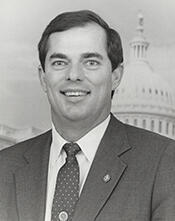
Max Allen Sandlin Jr. (born September 29, 1952) is an American politician and attorney who served eight years in the U.S. House of Representatives as a Democratic Representative from Texas. He represented Texas’s 1st congressional district from January 3, 1997, to January 3, 2005, completing four terms in office. His tenure in Congress coincided with a significant period in American political history marked by partisan realignment, contentious budget and tax debates, and the post‑September 11 national security era, during which he participated actively in the legislative process and represented the interests of his East Texas constituents.
Sandlin is the son of Margie Beth Barnett and Maxwell Allen Sandlin. He was raised in Texas and pursued his higher education at Baylor University in Waco, Texas. At Baylor, he was a member of the Phi Delta Theta fraternity and distinguished himself academically and in campus life, later being named an Outstanding Young Alumnus of the university. He continued his education at Baylor University School of Law, where he was a member of the National Championship Mock Trial Team, honing the advocacy and courtroom skills that would later underpin his legal and political careers. In recognition of his professional accomplishments and connection to his alma mater, he was invited back to Baylor Law School as the Distinguished Speaker for the John William Minton and Florence Dean Minton Endowed Law School Lecture Series at Law Day 2004.
Before entering national politics, Sandlin built a broad-based legal and business career in Texas. He practiced law with a focus on litigation and business matters and was active in the banking and energy industries, sectors central to the East Texas economy. In addition to his private practice, he contributed to public-interest legal work by serving on the Board of Directors of East Texas Legal Services, reflecting a commitment to access to justice for low-income clients. Sandlin also held judicial office at the local level, serving as a County Judge and as a County Court at Law Judge, roles that provided him with experience in both judicial administration and the practical application of Texas law.
Sandlin was first elected to the U.S. House of Representatives in the 1996 elections and took office in January 1997. Over the course of his four terms, he rose into the senior ranks of the House Democratic leadership, serving as a Chief Deputy Whip, a position that placed him at the center of vote‑counting, legislative strategy, and party discipline. He served on several key House committees, including the powerful and exclusive Committee on Ways and Means, which has jurisdiction over tax, trade, and entitlement policy; the Committee on Financial Services, which oversees banking, securities, and housing policy; and the Committee on Transportation and Infrastructure, which handles federal transportation and public works issues. He was elected to the Democratic Steering and Policy Committee and later served as a leadership representative on that body, helping shape committee assignments and policy priorities. He was also selected for the small Parliamentary Group of legislators relied upon for rapid parliamentary and procedural action on the House floor.
Ideologically, Sandlin was identified with the centrist and moderate wing of the Democratic Party. He was an active member of the Blue Dog Coalition, a group of fiscally conservative and moderate Democrats, and served as Chairman of the Blue Dog Energy Task Force, where he worked on energy policy issues important to his district and the nation. Additionally, he chaired the Democratic Caucus Financial Services Task Force, reflecting his influence on banking and financial legislation, and was a member of the New Democrat Coalition, another centrist Democratic group focused on pro‑growth and pragmatic policy solutions. The Almanac of American Politics described him as having a “moderate voting record that straddles Democratic wings,” and his colleagues in the Democratic Caucus and leadership often relied on his coalition‑building skills. Representative George Miller of California observed that party leaders “always looked for a way to build that bridge [between liberals and centrists],” noting that Sandlin “certainly has that talent.”
Sandlin developed a reputation in Congress and in Texas politics as an effective communicator and campaigner. The Austin American‑Statesman described him as “a forceful and articulate speaker, a lawyer by trade who treats audiences like juries that can be charmed, coaxed, inspired and won over,” and later added that “Sandlin’s a versatile campaigner, equally at home with Unitarians as he is in a roomful of good ol’ boys.” The Paris Daily News characterized him as “highly polished…with God‑given speaking talents” and an “ability to communicate eloquently.” These skills supported his role as a frequent presenter and advocate on policy matters for the Democratic Caucus, where he was often called upon to explain complex legislative issues and help forge consensus among diverse factions within the party.
Sandlin’s congressional career was dramatically affected by the 2003 mid‑decade redistricting of Texas’s congressional map, a process orchestrated by then‑House Majority Leader Tom DeLay. As one of the so‑called “Texas Five,” a group of Democratic incumbents targeted in the Republican re‑redistricting plan, Sandlin saw his East Texas district substantially redrawn to become more urban and significantly more Republican than its predecessor. He denounced the reconfiguration as an illegal and unconstitutional effort to dilute and eliminate the voices of rural and minority voters in his region. In the 2004 election that followed the redistricting, Sandlin was defeated by former state district judge Louie Gohmert in a landslide, receiving approximately 39 percent of the vote. Three other members of the “Texas Five” were also defeated after their districts were radically altered, and no Democrat has garnered more than 35 percent of the vote in Texas’s 1st congressional district since Sandlin left office.
After leaving Congress in January 2005, Sandlin transitioned to work in public affairs and strategic consulting while maintaining his legal and policy expertise. He became a partner and co‑chairman of Mercury, a public strategy firm, where he has advised corporate, governmental, and political clients on legislative strategy, communications, and regulatory issues. In addition to his professional endeavors, Sandlin has been active in his community as a youth baseball, basketball, and softball coach. He is the father of five children and has three grandchildren. He is married to former U.S. Representative Stephanie Herseth Sandlin, a Democrat from South Dakota, linking two congressional careers in a family that has remained engaged in public service and national policy.
Congressional Record